
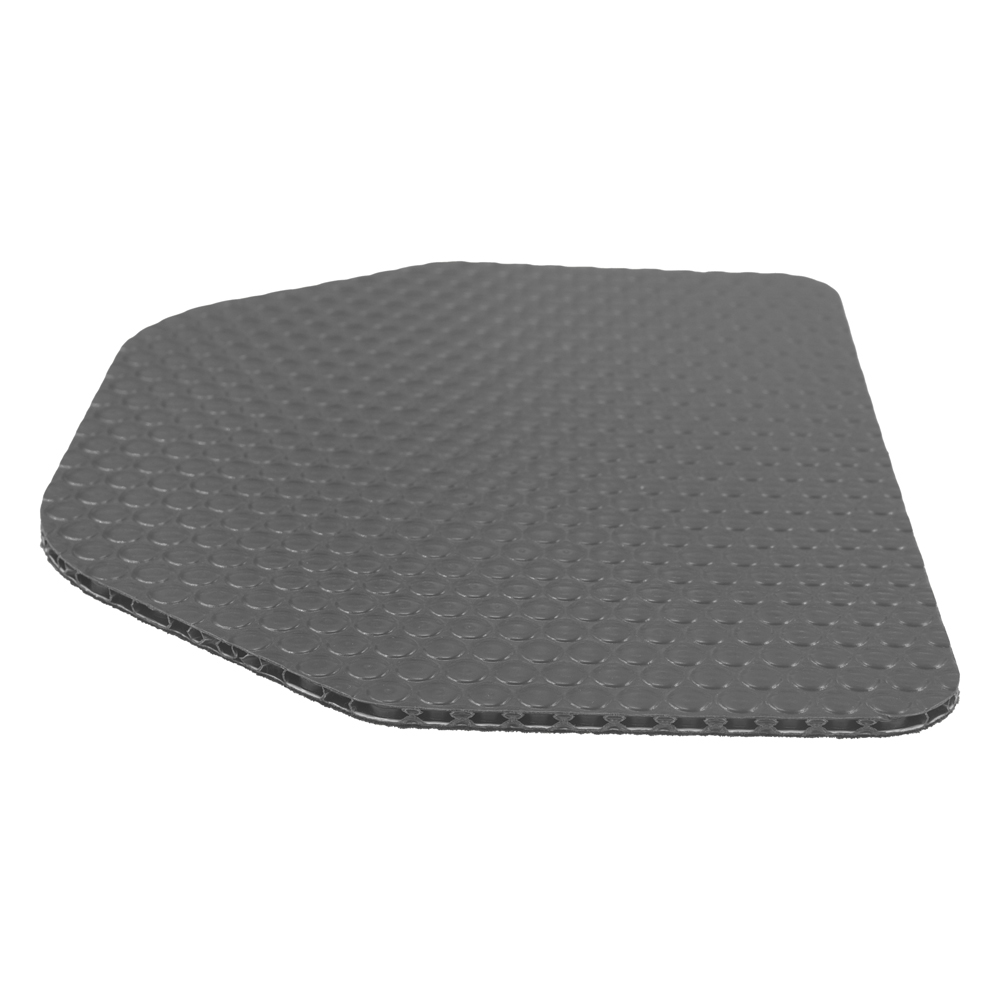
These two get compared constantly, usually on price per square metre, and that comparison is close to useless. They are both polypropylene with an internal geometry, but they behave differently enough that the application usually picks one before cost gets a vote.
The structural difference in one line
A corrugated sheet is a pair of skins joined by parallel walls running in one direction. A honeycomb panel is a pair of skins joined by cells in two directions. That single difference explains nearly everything that follows.
Where corrugated sheet wins
It has a grain, and the grain is strong. Loaded in the flute direction, a corrugated sheet is very stiff for its weight, which is why boxes and sleeves work – the walls are loaded along their flutes.
It folds. Score it and it hinges cleanly. You cannot fold a honeycomb panel the same way without crushing the core at the fold, which is why boxes are made from corrugated sheet and trays with folded corners usually are too.
It is cheaper per square metre at the thicknesses most people buy, and it is available in a wider range of colours and print finishes because the flat surface takes ink well.
It drains. The channels run through, so liquid that gets in can get out. A honeycomb core is closed cells, and water that finds its way in stays.
Where honeycomb wins
Flat compression. Load a honeycomb panel flat against a face and the cells support each other in both directions. A corrugated sheet loaded the same way relies on walls that can buckle sideways. For layer pads under a heavy, evenly distributed load, honeycomb usually performs better at the same weight.
Bending in an unknown direction. Corrugated sheet is stiff one way and much less stiff the other. If your panel might be loaded across the flutes – a shelf, a tray base, a lid – honeycomb removes that weakness.
Denting and puncture at equal weight, because the load spreads across more cell walls rather than onto a few flute tips.
Thickness without weight. Above roughly 8 mm, honeycomb gives you stiffness at a weight corrugated sheet struggles to match.
Where both lose
Neither is a structural material in the way plywood or steel is. Both creep under sustained load – a pallet left stacked for months will show it – and both soften as temperature rises. If your load case involves long-term constant stress above about 40 C, both need to be derated, and it is worth saying so rather than discovering it in a warehouse in August.
How to choose quickly
- Does it need to fold? Corrugated sheet.
- Is it loaded flat and evenly? Honeycomb.
- Is it a vertical wall on a box? Corrugated sheet.
- Is it a shelf, lid or tray base? Honeycomb.
- Will it get wet and need to dry? Corrugated sheet.
- Does it need to survive being walked on? Honeycomb, with a thick skin.
Repairability and end of life
Both materials are thermoplastics and both can in principle be reprocessed. In practice, what usually happens is simpler: a damaged panel or sheet is cut down for a smaller use, or it is scrapped.
Corrugated sheet is easier to work with on site because it can be scored, folded and stapled with hand tools, which makes it the better choice where panels get modified locally. Honeycomb panels need edge treatment after cutting, so a damaged one is more likely to be discarded than trimmed.
If your local practice is to repair rather than replace, that is a genuine point in favour of corrugated sheet, and it is worth weighing against the structural advantage honeycomb may have for your load.
What we supply
We make both, which makes us a poor source of unbiased advice but a reasonably honest one. Our honeycomb panels and our corrugated PP sheet overlap in a narrow band, and outside that band the answer is usually obvious. Send us the load and we will tell you which side of the line you are on.