
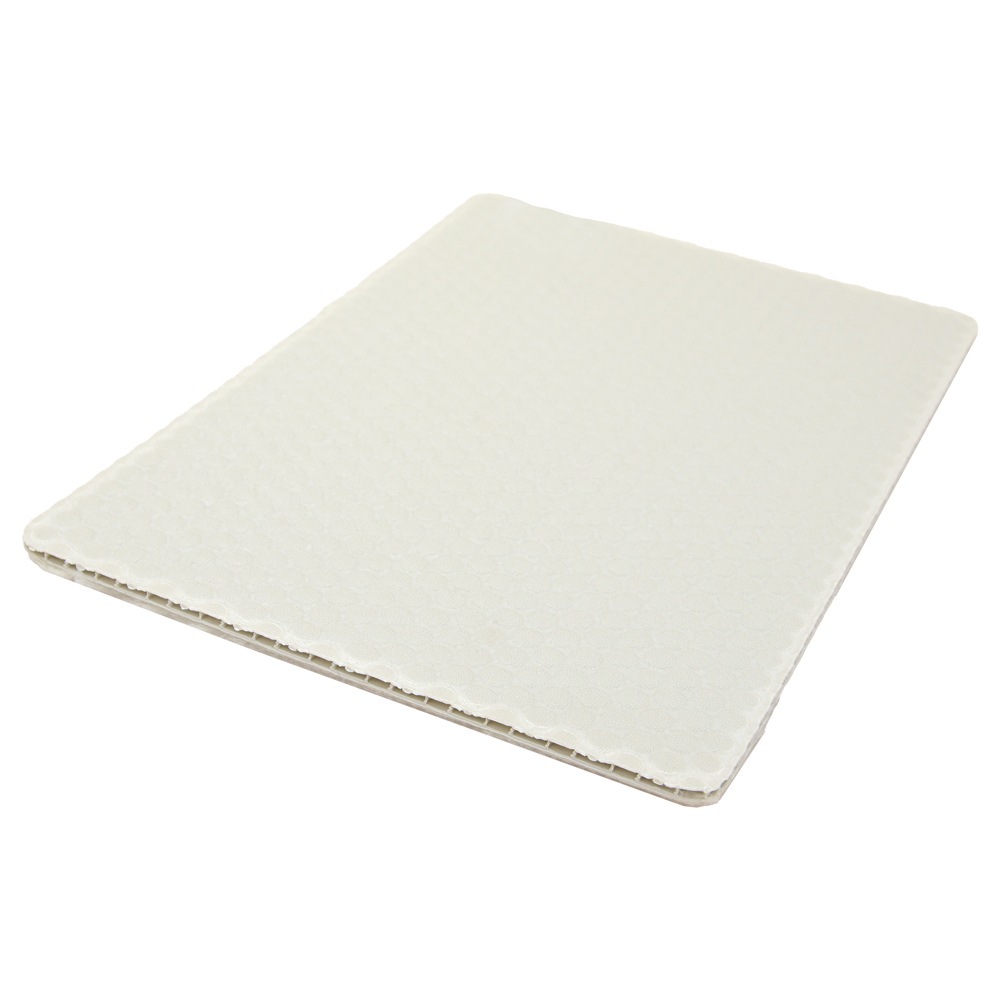
MDF and hardboard are still bought for temporary floor protection because they are flat, cheap and available everywhere. On a dry job of a fortnight they are adequate. The moment water appears they fail, and they fail in a way that damages the floor they were protecting.
Why MDF is attractive
It lies flat, it is easy to cut, it takes tape well and it is very cheap per square metre. For a short, dry, low-risk job it is a rational purchase and there is no reason to spend more. Pretending otherwise is the kind of advice that loses trust.
What happens when it gets wet
MDF absorbs water at an unsealed edge and swells. Swollen MDF is no longer flat, so every sheet edge becomes a trip lip and the sheet starts to break up under traffic. It also leaches, and the residue bonds to some floor finishes. It does not recover – there is no drying MDF out and putting it back.
What polypropylene does
Nothing, which is the point. Water sits on it or runs off it, it does not wick into the core, and it does not soften or swell. It can be washed and re-laid. That single material property is the entire argument for the more expensive product, and it is why the comparison reverses on any job with wet trades.
The dust question
Cutting MDF on site produces fine dust that is unpleasant to work with and gets everywhere, including onto finished floors. Board cuts cleanly with minimal dust. On an occupied building that difference matters more than the price.
Where MDF still makes sense
Dry interiors, short programmes, and floors that are going to be covered or treated afterwards anyway. Where a job is genuinely dry and short, buying board is spending money for a property nobody will use.
What MDF is genuinely better at
Lying flat and taking a fixing. MDF is dimensionally stable when dry and it will hold a screw, which makes it the better choice for a temporary worktop or a formsurface where something has to be attached. Board is not a substitute for that. Where protection has to be fixed down to something, MDF or ply is often the right answer and board is not, which is worth saying rather than selling.
The two things MDF does badly
MDF sheet is stiff and cheap, which is why it gets used for temporary floors. Its two problems are water and weight. A sheet that gets wet swells at the edges, and once swollen it never lies flat again, so it becomes a trip hazard at exactly the point where people are walking. The weight is the second issue: a 2440 x 1220 sheet of 18 mm MDF is a two-person carry up a stair, and that handling is when edges get chipped and backs get scratched.
PP honeycomb panel of similar thickness weighs a fraction of that, does not swell, and can be carried by one person. Where MDF still wins is point load under very heavy static plant, and where a surface needs to be screwed into – the honeycomb core does not hold a screw in the same way. For walkways, protection over finished floors and phased areas, the weight and moisture behaviour matter more, and the felt face gives grip that bare MDF does not. If your concern is dents rather than water, why thin protection sheet does not stop dents covers the thickness question separately, and the wet-failure mechanism is set out in why cardboard and MDF floor protection fail when wet.
What we can do
We supply PP honeycomb protection board and will say when MDF or hardboard is the sensible buy instead. Tell us the programme length and whether there is any chance of water, and we will quote both. The failure mode is described in why cardboard and MDF floor protection fail when wet.