
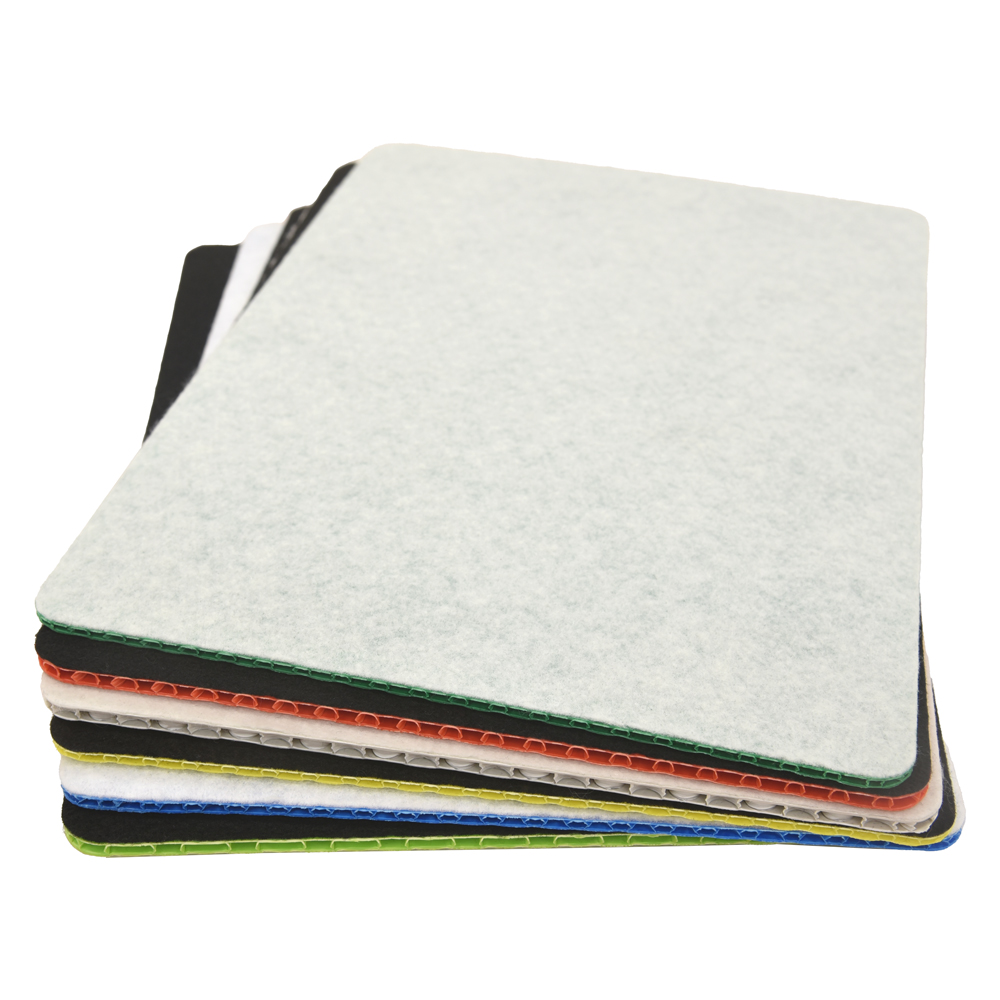
Wash-down areas are one of the hardest environments for any panel material: hot water, detergent, sanitiser, and repeated cycling. Polypropylene is a good choice here, and the failures that do occur are usually not about the polymer.
Why PP handles wash-down well
It does not absorb water, so it does not swell or soften. It resists most aqueous detergents and the sanitisers commonly used in food and pharmaceutical environments. It wipes clean and does not support microbial growth on its own surface.
That combination is why PP board is common in wash-down areas, and why the material selection is rarely the interesting decision.
Where it actually fails
- Cut edges. A honeycomb panel’s open cells at a cut edge collect water and residue. If it does not drain, it sits there and concentrates whatever chemistry is in the wash water.
- Bond lines. Adhesives and edge tapes are usually less chemically resistant than the panel itself, and they are the first thing to go.
- Fasteners and inserts. If these are metal, they are a different material in the same environment and will corrode.
- Printed or labelled areas. Ink and adhesive lift, and once identification is gone the panel cannot be tracked.
- Crevices. Any joint that holds water will hold chemicals at higher concentration than the bulk wash liquor.
Notice that none of these are about the polypropylene. They are all about the assembly and its detailing.
The chemistry worth checking
Three things in a wash-down regime deserve specific attention. Chlorinated sanitisers attack PP progressively and embrittle it, especially warm. High-pH caustic cleaners are harder on the material and on any adhesive than neutral detergents. And temperature multiplies all of it – a chemistry that is comfortable at 40 C may be a problem at 70 C.
If your cleaning regime uses any of these at temperature, it is worth saying so rather than assuming a general-purpose panel will cope.
Detailing that helps
- Seal the cut edges so water cannot enter the cells.
- Give every enclosed section a drain path at its lowest point, and check the drain actually empties – surface tension holds a film across a small hole.
- Weld rather than bond where the joint sits in the wash environment. Welding produces a homogeneous joint with no adhesive to attack.
- Use plastic fixings or choose a corrosion-resistant grade and accept that it will still be the weak point.
- Keep identification moulded or embossed rather than printed.
Testing it properly
Immersion testing beats a compatibility chart. Put a sample of the actual panel, including a cut edge and a joint, into the actual cleaning solution at the actual temperature, and leave it for a few weeks. Then check for weight change, dimensional change, embrittlement at the edges, and whether the bond still holds.
It is a slow test and a cheap one, and it settles questions that no datasheet can.
Two things a compatibility chart leaves out
A compatibility chart is produced on a clean, unloaded coupon at room temperature. Your panel is neither unloaded nor always at room temperature, and that difference is where most wash-down surprises come from.
The first gap is stress. Polypropylene resists most cleaning chemicals well under no load. Put the same chemical on a panel carrying a bending load – a shelf, a trolley deck, a wall panel clamped flat – and you have the two ingredients for environmental stress cracking: a susceptible material, a tensile stress, and a fluid that attacks the surface. None of the three alone is enough. Together they produce cracks that appear months later and look inexplicable because nothing obviously changed.
The second gap is concentration. Charts usually quote the recommended dilution. What reaches the panel is whatever the dosing unit happened to deliver, and dosing units drift. A detergent dosed at three times specification is a different chemical exposure to the one you qualified. The cheapest control we know is not a better material: it is a written dilution check recorded once a week, and a spare coupon of the actual panel hanging in the wash bay so you can see what the regime does over a season rather than guessing.
What we can do
We build PP honeycomb panels with sealed edges and welded construction for wash-down service, and we will ask about your cleaning chemistry and temperature before we recommend a build. If your regime is aggressive enough that PP is the wrong material, we would rather say so than sell panels that fail in a year.