
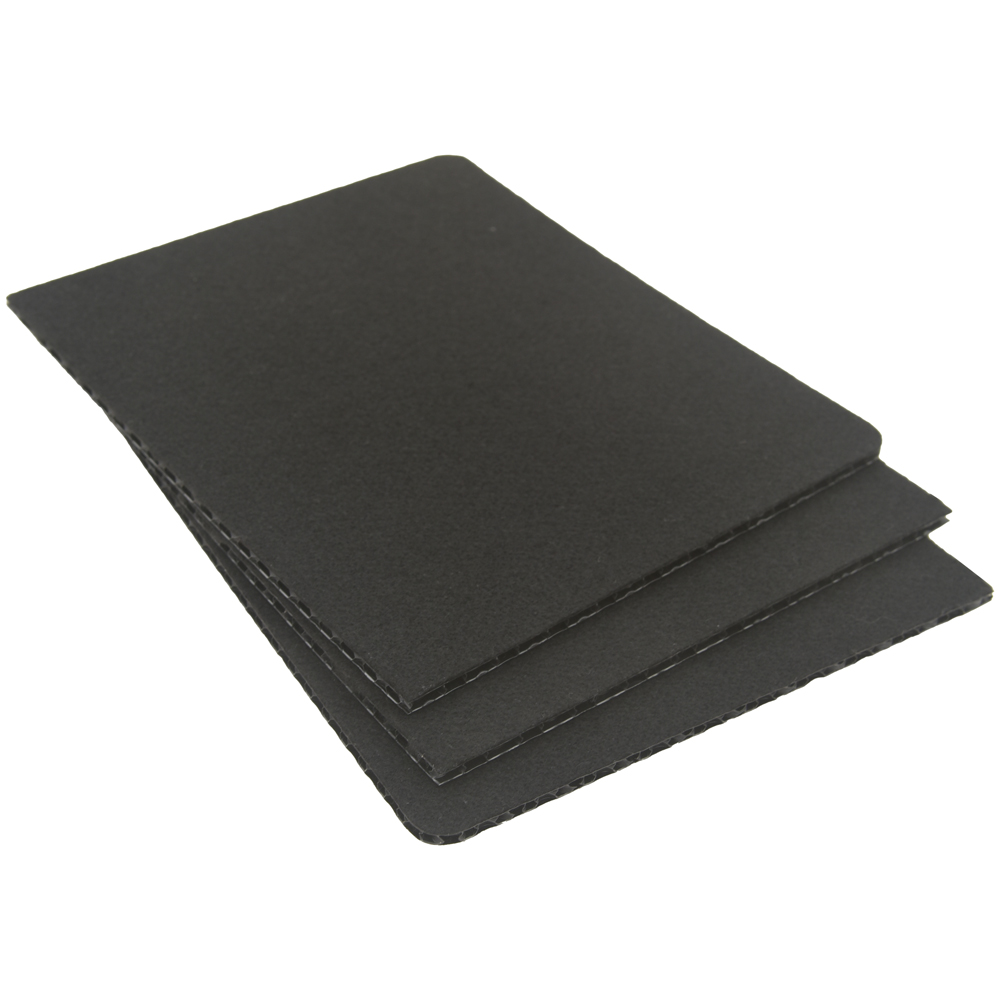
Two numbers drive most filter media decisions, and they pull in opposite directions. Increase open area and you reduce resistance, which means less fan energy and more airflow. Decrease it and you capture more, but the fan works harder and the filter loads faster. Every washable screen is a settlement between those two, and the settlement should be made deliberately rather than by copying whatever was in the housing before.
What open area actually means here
In a honeycomb filter screen, open area is the fraction of the face that air can pass through. It is set by the cell size and the wall thickness — larger cells and thinner walls give more open area.
It is worth separating open area from porosity, because they get used interchangeably and are not the same. A very thick screen with high open area presents a long channel to the airflow, and the friction along those channel walls adds resistance even though the face looks wide open. Thickness is not free.
Where the pressure drop comes from
Three contributions, in rough order of importance for a screen of this type:
- Face resistance — the contraction and expansion losses as air enters and leaves the cells. Dominant at low thickness.
- Channel friction — air rubbing along the cell walls. Grows with thickness and with velocity.
- Loaded resistance — the captured material itself. This is what changes over the service life, and it is often the largest term by the time the screen is due for cleaning.
The first two are fixed by geometry and can be designed. The third is a function of the dust loading and the cleaning interval, and it is where most real-world surprises come from.
Thickness: the under-used variable
People tend to pick a thickness by what fits the frame. That is a constraint, but within it, thickness does two useful things: it increases capture, because a particle travelling through a longer cell has more opportunity to contact a wall, and it increases dirt-holding capacity, which extends the interval between washes.
The cost is resistance, and the relationship is not linear — doubling thickness does not double the pressure drop, but it does add meaningfully. For a given face velocity there is usually a thickness beyond which the extra capture is not worth the extra fan energy.
If you are replacing a disposable media with a washable screen, check the fan curve before you change thickness. A thicker screen in a system with no spare static pressure will simply reduce airflow.
Why washability changes the economics
A washable screen is not judged on its initial efficiency alone. It is judged on whether it returns to close to its original pressure drop after cleaning, and how many cycles it survives.
Polypropylene is well suited to this in three respects: it does not absorb water, so it dries quickly; it is not corroded by water or by mild detergents, so repeated washing does not degrade it; and it is tough enough to survive handling and a soft brush. A metal mesh may capture marginally better in some regimes, and a paper or synthetic fibre medium will usually capture finer particles — but neither comes back from a wash the way an open honeycomb structure does.
Matching the screen to the job
A useful way to think about it is by what sits downstream:
- Pre-filter ahead of a fine filter. The job is to protect the expensive downstream media. Capture efficiency matters less than loading capacity and low resistance — a coarser, more open screen with generous thickness.
- Grease and mist service. Captured material is liquid and drains. Open structure with a drainage path beats fine media, which blinds.
- General dust in fresh air. Moderate cell size, moderate thickness, and a wash interval set by measured pressure drop rather than by calendar.
What to specify
- Face dimensions and the frame or channel it sits in
- Cell size, or open area if that is how the existing media is described
- Thickness
- Face velocity — the actual airflow divided by the face area, not the duct velocity
- Initial pressure drop you can accept, and the point at which it will be cleaned
- Washing method, temperature and detergent type
- Whether there is UV exposure, and whether the screen sees elevated temperature
Measuring instead of estimating
The single most useful thing you can do is fit a manometer across the screen and log it. You will learn your actual loading rate in your actual conditions, which lets you set a cleaning interval on evidence instead of guessing. It also tells you immediately whether a screen is returning to its clean pressure drop after washing — and if it is not, the wash method needs changing rather than the media.
If you send us the housing dimensions, the airflow and what you are capturing, we can recommend a cell size and thickness, and cut a PP honeycomb filter screen to suit.