
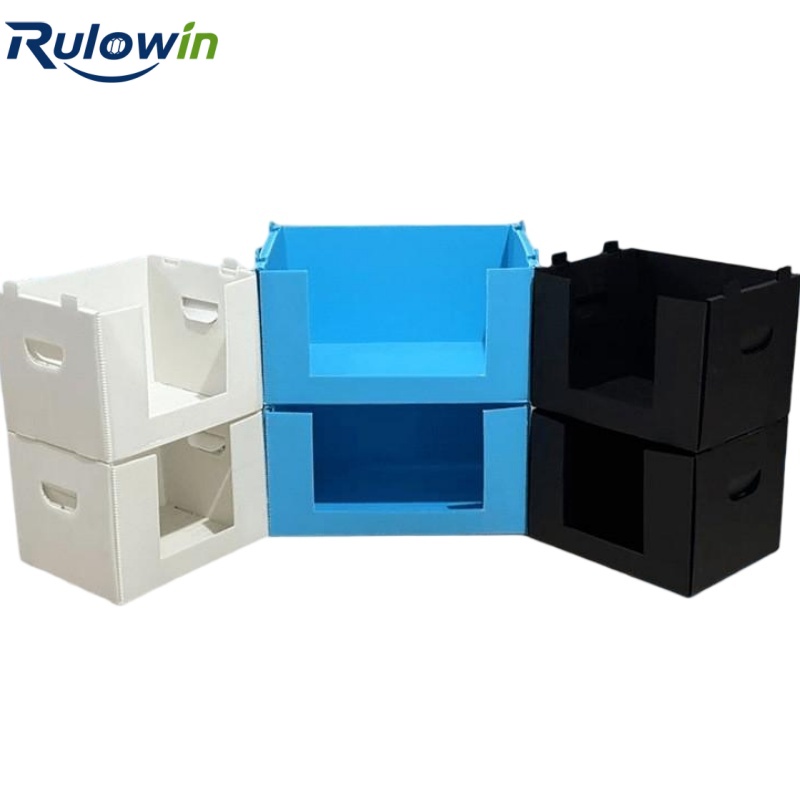
A picking box that performs perfectly on static shelving can be a problem the moment it goes onto a conveyor or a flow rack. The requirements are different, and they are mostly about the base of the box rather than its capacity.
What a conveyor demands
A consistent, flat base. Anything that rocks, or that has a varying footprint from box to box, will catch. Consistency between boxes matters as much as the design of any one box.
Predictable friction. A box needs to grip the belt enough to be carried and release at a diverter. Too much friction and it does not slide when it should; too little and it slips on an incline. PP on steel has a particular coefficient and it changes with wear and dust.
Enough rigidity not to deflect over rollers. A box that sags between rollers will catch on the gap, and it will do it unpredictably depending on the load.
A base that survives the rollers. Abrasion on the bottom face is continuous and it wears the surface, which changes the friction over time.
Flow rack is a different problem
On a flow rack the box slides under gravity, which means:
- Consistent friction between boxes – one sticky box stops the line behind it
- A base that does not dig in at the leading edge when the box is pushed
- No lip or feature on the base that can catch on a rail
- Enough weight to move reliably when nearly empty – a very light empty box may not travel
- A controlled stop at the front, which is a rack design issue but the box has to survive hitting it
Where PP corrugated sheet helps and hurts
It helps by being light, consistent and quiet, and by not shattering if it jams. It hurts because the flute direction gives the base a directional stiffness, and because a sheet base can flex more than a moulded one. For conveyor use, the base thickness and flute orientation matter more than they do on a shelf.
Sealed or capped edges also matter here: an open flute on the leading edge of a box on a flow rack will catch eventually.
What to test
Run samples on the actual equipment, loaded at both ends of the weight range and empty. Watch them through a diverter, at an incline, and at the stop. Most problems show up within an hour and are obvious once seen. Testing on a bench tells you almost nothing.
Noise is worth considering
Plastic boxes on steel rollers are noisy, and in a large picking area the noise is a real working-condition issue. PP is quieter than many alternatives, but a box with a hard, flat base on steel will still be heard. If noise matters, ask about it – there are base treatments that help.
When boxes are too light
A very light box causes its own problems on powered equipment. It can bounce on rollers, it may not trigger sensors reliably, and on a gravity section an empty box may not travel at all.
If your boxes are light and your lines are powered, check whether the sensors see them consistently – an occasional missed box is often a weight or a colour issue rather than an electrical one. A contrasting strip on the box is usually enough to make sensing reliable.
On gravity sections, weight is what moves the box. A box that is too light to travel reliably needs either a steeper section or a heavier base, and that is worth checking with samples rather than in theory.
What we supply
We make picking boxes with consistent, sealed bases suitable for conveyor and flow rack use, and we will ask what equipment they run on. If your boxes are jamming, send us a photograph of the base and the equipment – the fix is usually the base, not the box.