
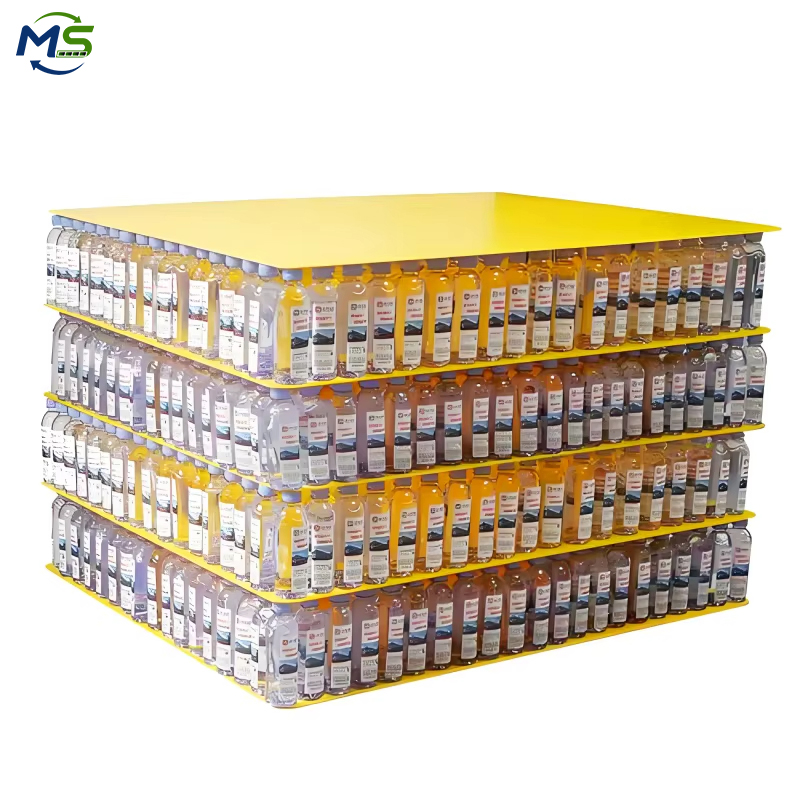
Using returnable boxes directly as pick faces – rather than decanting into a fixed location – saves a handling step and removes a source of counting errors. It works when the box is designed to be picked from and fails when it is not, and the two design details that decide it are depth and how the box opens at the front.
Depth is the constraint, again
The picker has to reach the back of the box. That caps depth at roughly an arm’s length from the face, which for a shelf at waist height is about 400 mm and for a shelf above shoulder height is considerably less. A box that is deep enough to be efficient to transport is usually too deep to be efficient to pick from, and the resolution is a shallower box at a higher count rather than a deep one.
Opening at the front
A drop-front box – where the front wall is lower or folds down – converts a box into a bin and is the single biggest improvement available to a pick face. Where a drop front is not practical, a cut-away front achieves most of the benefit at no cost, provided the cut does not remove so much wall that the box loses stacking strength. If boxes are stacked two high on a shelf, only the top one needs to open; the lower one is reserve stock and can stay closed.
Label position for a pick face
The label has to be on the face the picker sees, which is the front, at a height that is readable when boxes are stacked. In a pick face the front is the only visible surface, so any label on the end of the box is invisible. If the same box is used in transport and in a pick face, put two label panels on it: one on the end for transport, one on the front for picking. The conveyor and flow-rack version of this is in picking boxes on flow rack.
Replenishment from the back
A pick face works best when replenishment happens from the rear and picking from the front, which gives automatic stock rotation and keeps the picker out of the replenishment activity. That needs either a two-deep shelf or a rear-access aisle. If the operation cannot do that, accept front replenishment and put the oldest box at the front by rule rather than by chance.
What to do about the reserve
A pick face built from boxes has a finite depth, and everything beyond that is reserve stock that has to live somewhere. In a two-deep shelf the reserve is behind the pick face, which is ideal. In a single-deep shelf it has to be above or below, and both are awkward: above means lifting a box down to replenish, below means bending.
The usual compromise is reserve stock on a shelf above at a lower height, replenished by a runner rather than by the picker, with the pick face at waist height. Where that is not available, put the reserve in a stack on the floor at the end of the aisle and accept the extra walk. The mistake to avoid is mixing reserve into the pick face, because a pick face containing both current and reserve stock cannot be read at a glance, and a pick face that cannot be read is a pick face that gets counted every time.
What to measure to know whether a pick face works
Two numbers tell you whether a box-based pick face is doing its job. Picks per hour at that face, measured before and after. And the number of times a picker has to move or lift a box to complete a pick, counted by observation over an hour. The first is the outcome, the second is the cause, and the second is the one that tells you what to change.
If pickers are moving boxes, the fault is usually depth or opening: they cannot see or reach the back, so they pull the box forward. A drop front or a shallower box fixes it. If they are lifting boxes, the fault is usually that the label is not visible in the stacked state, and the fix is a front label panel. Both are cheap, and both are invisible until somebody stands and watches for an hour, which is the whole method.
What we can do
We supply PP corrugated boxes with drop fronts, cut-away fronts and twin label panels for combined transport and picking duty. Tell us the shelf depth and the reach height and we will set the depth and the opening for the picker, not for the pallet.