
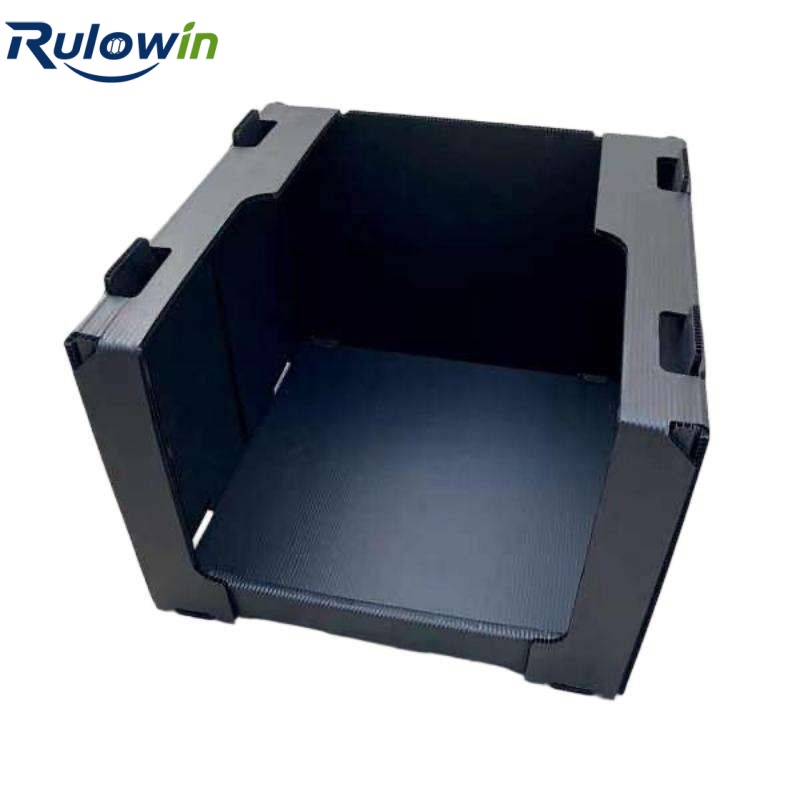
A container crossing an equatorial route goes through a large temperature range, and warm moist air condensing on a cold steel roof drips onto whatever is underneath. It is called container rain and it is one of the most common causes of corrosion on exported machined parts. A returnable box helps and does not solve it, because the condensation forms inside the box as well as outside it.
PP does not absorb water, and that is the point
The material advantage is real: a PP corrugated box does not take up moisture, does not lose strength when wet and does not wick water into contact with the part. A cardboard box does all three. So on a wet leg the box stays dimensionally stable and structurally sound where a carton would soften – which removes the collapse failure but not the corrosion one.
Drain, then dry, then barrier
Three steps, in that order, because they are in descending order of cost-effectiveness. Drain: base drainage so any water that forms or enters can leave rather than pooling under the part. Dry: parts and box interior dry at packing, which is the single most effective measure and the one most often skipped at the end of a production week. Barrier: a lid plus, where the parts justify it, a desiccant or a vapour-phase inhibitor inside the box.
Desiccants work on the air inside the box
A desiccant only protects the volume it is sealed in. Dropping a sachet into an open-topped box in an unsealed container protects nothing. Use them with a lid that closes reasonably well, size them to the box volume and the transit duration, and check the calculated quantity rather than guessing – on a three-week leg through the tropics the required quantity is larger than most people expect.
Pack dry, and prove it
Parts coming off a wash line or out of a wet machining process carry water into the box, and that water is already inside the barrier before the container is sealed. Dry parts before packing, and if the process cannot guarantee it, use a corrosion inhibitor on the part rather than relying on the packaging. The condensation mechanism is set out in more detail in container condensation on a sea leg.
What the desiccant cannot do
A desiccant absorbs moisture from the air inside a sealed volume. It cannot dry parts that went in wet, it cannot protect a load in an open container, and it has a finite capacity that is consumed by the first humid day. The usual failure is a sachet in a box of parts that were washed the same morning, in a lidded but not sealed box, on a three-week leg. It does nothing, and the parts rust anyway.
The sequence has to be right: dry the parts, dry the box interior, close the lid, then size the desiccant to the box volume, the leg duration and the expected humidity range. Sizing tables are available from any desiccant supplier and the quantity for a tropical three-week leg is typically several times what people estimate. Where the volume is large and the parts valuable, a vapour-phase inhibitor inside the box is more reliable than a desiccant, because it protects the metal surface directly rather than trying to keep the air dry.
Where the container itself is the problem
Before changing the packaging, check the container. A container with a damaged roof seal, a previous cargo that left residue, or wet floor boards will produce condensation regardless of what is inside it, and no amount of desiccant compensates for a leaking roof. Inspect the container before loading: roof condition, seals, floor condition, and smell, which is a surprisingly good indicator of a previous wet cargo.
Rejecting a bad container costs an hour and prevents a claim. Where a route has a known condensation problem, additional measures at container level – a moisture-absorbing liner on the roof, or desiccant poles hung in the container rather than sachets in boxes – are more effective per pound than anything done at box level, because they address the water before it reaches the load.
What we can do
We supply PP corrugated boxes with drainage and with lids that close well enough for a desiccant to do its job. Tell us the route and the leg duration and we will tell you what the box can and cannot protect against – and where the answer is a process change rather than a packaging one.