
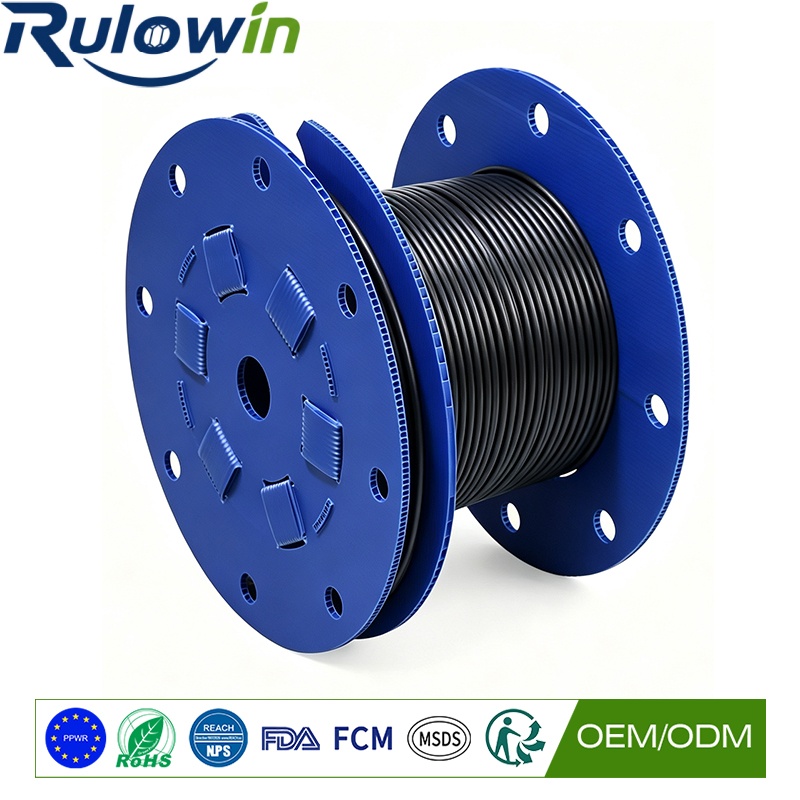
Packaging supply risk is rarely dramatic and often expensive: not a fire, but a four-week slip that stops shipments. Full duplication is one way to manage it and usually the most expensive. Three cheaper mitigations, in ascending order of cost.
One: know your real lead time
Not the quoted one – the observed one, from order to goods received, including the days lost to quotation, approval, payment and customs. Most buyers underestimate this by a week or more, and the gap is where stockouts come from.
Measure it over the last six orders and use the longest, not the average. Then set the reorder point from that and review it twice a year, because lead times drift.
Two: hold a buffer
Cheapest effective mitigation for most operations. Enough stock to cover the observed lead time plus a margin, held either at your site or – often better – at the supplier’s, released against call-off.
Supplier-held buffer costs you a commitment rather than cash and space, and it is frequently available for the asking. Ask for it explicitly: we will commit to X per year, hold a month’s worth for us.
For bulky items where your own storage is constrained, this is usually the best-value arrangement available and it costs only a commitment you intended to make anyway.
Three: qualify an alternative
Most expensive, most reliable, and worth it above a certain volume or where a stoppage is genuinely costly. The qualification is dimensional and takes a couple of months; the detail is in evaluating a second source for cable reels.
Note that a qualified alternative you never buy from still has value – it is the thing that makes the buffer negotiable and the relationship honest.
Two things that help more than any of the above
Standardise. Fewer variants means any supplier can cover more of your need, and the buffer is fungible. A bespoke size for every application maximizes risk and eliminates alternatives.
Forecast. Giving a supplier a rolling three-month view costs nothing and dramatically improves their ability to hold material for you. Most supply failures are failures of information, not capacity.
What to monitor
Order-to-receipt time against your observed baseline. Fill rate – whether you get the full quantity. And resin price movement, which affects both cost and, at the extremes, availability.
Any of those trending the wrong way is a signal to widen the buffer before you need to, not after.
What to put in the buffer
The items that stop you if they are missing, and the items with long lead times. Not everything – a buffer across all lines is expensive and unnecessary where a commodity item can be sourced in days.
Rank each line by consequence of a stockout and by lead time, and buffer the top of both lists. That is usually a small fraction of the total spend.
How to review it
Twice a year, against observed lead time and observed consumption rather than the figures you started with. Both drift, and a buffer set two years ago is usually either too large or too small.
Also review after any incident. A stockout is the cheapest risk assessment you will ever get.
What we can do
We supply compact plastic cable reels and will confirm a committed lead time in writing and hold buffer stock against an annual commitment. Tell us your consumption and we will propose an arrangement – including telling you when your volume does not justify one.