
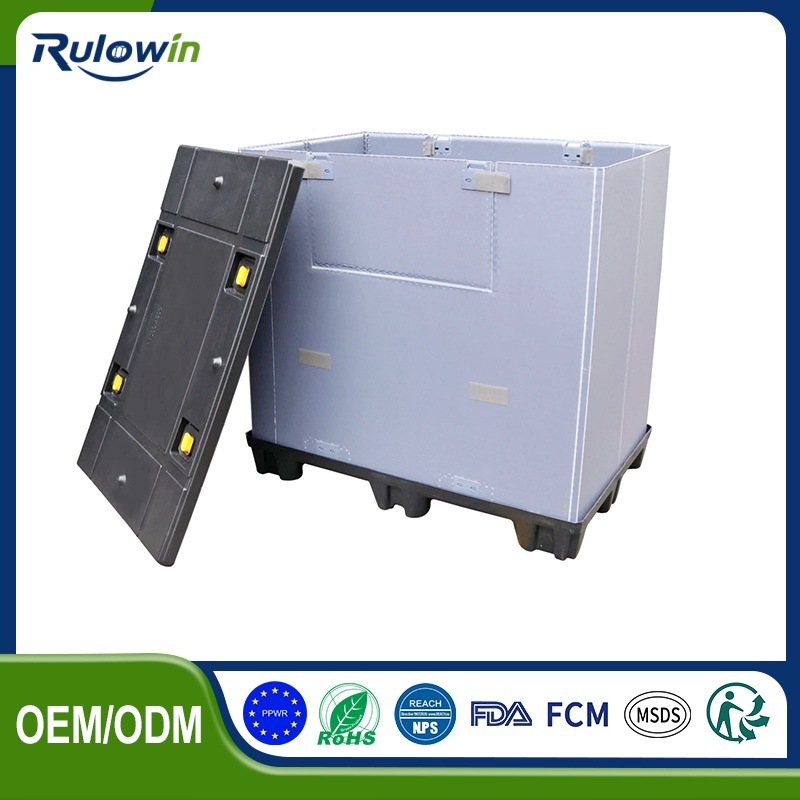
A multi-drop vehicle is loaded in the reverse of its delivery sequence, so the first drop is the last on. That only works if whoever loads and whoever unloads can tell which container belongs to which drop. Where containers are unmarked or identically marked, the sequence is discovered by opening things, and the route loses time at every stop.
The marking has to survive the load
A drop-number mark has to be visible when the container is in the vehicle, which usually means on a vertical face, and legible from the position someone standing in the vehicle can see. A mark on the top works for a single layer and is invisible in a stack. A mark on the base is invisible entirely. Where containers are stacked in a vehicle, the end faces are the ones that remain visible.
Sequence numbers versus destination names
A number is compact and only meaningful with a list. A destination name is self-explanatory and takes more space. Where the loading team changes frequently, names reduce errors. Where the route is fixed and the team is stable, numbers are fine and allow a container to be re-marked for a different route easily. The choice depends on how stable the operation is rather than on the container.
Colour for the coarse sort
Colour lets a loader see at a glance that a container belongs to a particular part of the route, and it works from a distance in a badly lit vehicle. It is coarse – four or five categories realistically – and it works best in combination with a number for the fine sort. Where a route has more stops than colours, group the stops into colour zones and number within them.
Changing the mark between trips
A container that serves a different route each trip needs a mark that can change. A card holder or a sleeve is the usual answer and it is worth designing into the container, because an adhesive label applied and removed every trip generates waste and leaves residue. Where the mark changes daily, the holder pays for itself quickly and the container stays clean.
Where the sequence breaks down
At the transhipment point, where containers are moved between vehicles and the sequence has to be re-established; at a part load, where the vehicle is not full and containers can be placed anywhere; and at an added stop, where the route changes mid-run. In all three the marking has to be re-checked, and where it is not, the sequence is lost. A re-check at the transhipment point is cheap insurance.
What to check before dispatch
That every container carries a mark, that the marks match the load plan, and that the marks are visible in the loaded configuration. Three checks, and the third is the one usually missed – a mark that is legible on the floor is not necessarily legible in a stack three high against the vehicle wall. Where the third check fails, the mark position has to move, and that is a container design question. See the wider identification discussion in which face carries identification.
Cost of getting it wrong
An out-of-sequence vehicle means digging containers out at each stop, which costs time, risks damage and occasionally means a container is left on the vehicle and discovered at the end of the run. Where a route runs daily, the annual cost of a modest error rate exceeds the cost of marking the fleet properly by a wide margin.