
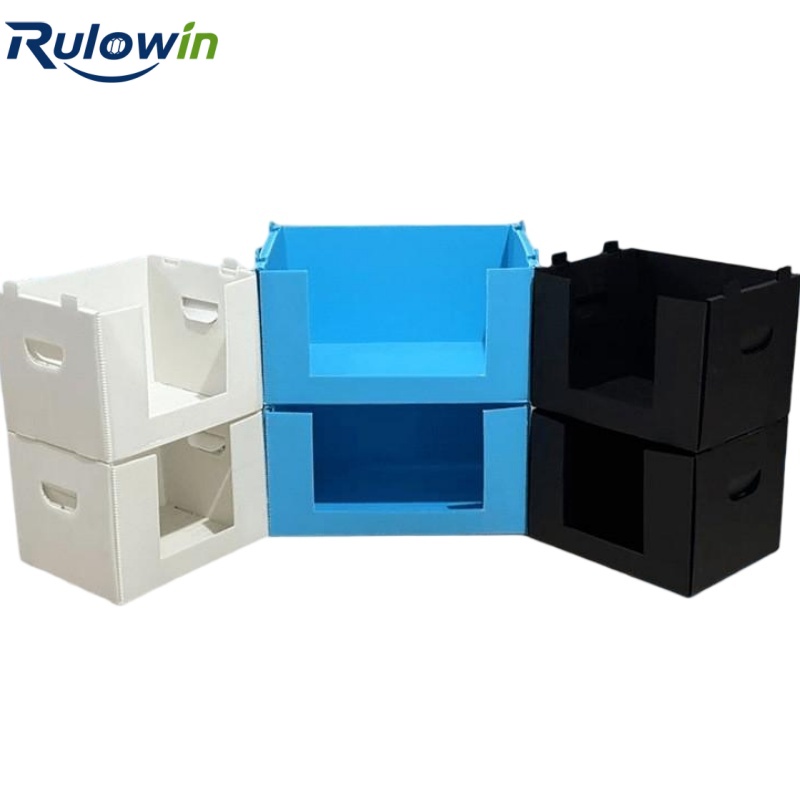
A box sitting at a workstation is not in transit, it is in use. It gets picked up, put down, slid along a bench, reached into dozens of times an hour, and emptied while the line is running. Most container specifications are written for the transport leg and then used at line side anyway, which is why operators end up cutting the tops off cartons or working out of a box that is too deep to reach the bottom of.
Reach is the first constraint
An operator should be able to reach the last part in a box without lifting it or leaning over it. That puts a practical limit on depth of roughly 300 mm for a box on a bench, and less for small parts where the last item is a fastener at the bottom of a 400 mm well. Deeps boxes look efficient because they hold more, and they cost more in operator time every single shift. If volume per station is high, the answer is two shallow boxes side by side rather than one deep one.
Opening has to be one-handed
Line-side replenishment happens while the operator is doing something else. A lid that needs two hands and a twist will be left off, and then parts get contaminated or fall out when the box is moved. A hinged or a drop-on lid that can be flipped with a wrist while the other hand holds a part is the difference between a box that stays closed and one that does not. This is the single detail most often missed when a container is chosen from a catalogue rather than from the workstation.
Footprint has to be a module
Bench and flow-rack widths are not arbitrary. Whatever the box footprint is, it should divide into the available width with a small gap, so two or three boxes sit side by side without overhang. A box that is 390 mm wide on a 1200 mm shelf leaves an unusable 30 mm; a box that is 400 mm gives three across exactly. Designing footprints to a module rather than to the part is what makes a line-side layout reconfigurable later, and the same argument is made for flow rack in picking boxes on conveyor and flow rack.
Grip, when hands are oily or gloved
A hand hole sized for a bare hand is a hand hole that does not work with a nitrile glove and does not work with oily hands. Cut the hand hole generously, put it on the short end where the load is easier to control, and give it a rolled or doubled edge so it does not cut. If the box is moved by trolley instead, put a smooth base on it that slides rather than grips, and skip the hand holes entirely – a box with hand holes and a sliding base is a compromise that serves neither.
Identification at arm’s length
The operator needs to know what is in the box without walking to it. That means a label panel on the end facing the aisle, large enough to read from two metres, and a colour that survives the environment. Colour coding by part family, with the label carrying the part number, is faster to read than text alone at line-side distances and survives a dirty label better.
The two-box rule, and why it works
The simplest reliable line-side arrangement is two boxes per part per station: one in use, one in reserve, replenished by a runner who swaps an empty for a full and takes the empty away. The operator never waits for stock, never hunts for it, and never has to signal – the empty box is the signal. It is the basis of most kanban systems and it works because the container itself carries the information.
What it requires from the box is a consistent fill quantity, because the reserve box has to cover consumption until the next runner pass. That argues against bespoke sizes at line side and for a standard box with a standard fill level, marked with a fill line so a part-filled box is visibly not a reserve. It also argues for a box that is obvious when empty from across the aisle – a light-coloured interior makes an empty box read as empty at a distance, which sounds trivial and speeds up replenishment more than most other changes available at the same cost.
What we can do
We make PP corrugated turnover boxes to a footprint and depth set by the workstation rather than the pallet. Give us the bench width, the reach limit and how the operator opens the box, and we will specify from there – including the lid, which is the part that decides whether the box stays closed.