
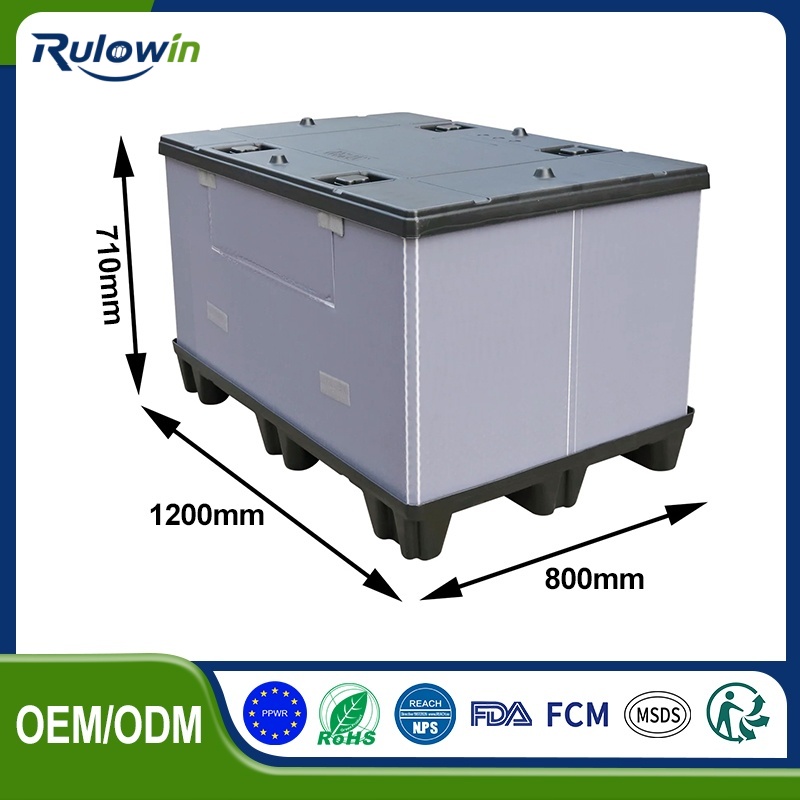
A production station fed from containers runs until the container is empty, and then somebody has to bring another one. The interval between those events is the box capacity divided by the rate the station consumes it. That single division determines how much material sits at the line, how often the aisle has traffic, and how much space the presentation needs – and it is usually the last thing considered when the container is chosen.
The arithmetic, and why it is usually skipped
A station consuming two hundred parts an hour, fed from a container holding a hundred, needs two containers an hour. Two an hour is a manageable delivery frequency. The same station fed from a container holding twenty needs ten an hour, which is a different operation entirely – more traffic, more space, more handling, and a much higher chance that a late delivery stops the line. The container size is not a packaging decision here; it is a logistics one.
Space at the station is the binding constraint
Line-side space is finite and expensive, and a station can usually hold one container in use plus one in reserve. That caps the running time between replenishments regardless of how good the delivery system is. Where the reserve does not fit, the station has no buffer, and every late delivery is a stoppage. Choosing a container that fits the available presentation space – including its height, which is often forgotten – is usually more valuable than choosing one that holds more.
Height matters as much as footprint
Line-side presentation is often a two-level stand: one container at working height, one below or behind. A container that is too tall for the upper level, or that cannot be stacked safely at that height, forces a single-level layout and doubles the floor space. Where the stand already exists – and it usually does – the container height is constrained by it, and the capacity has to come from the footprint instead.
Presentation angle and access
A container at a station has to be reachable by the operator without turning, lifting or stretching. That means an open front, or a container short enough to reach into, or a stand that tilts it. A deep container holding a lot of parts can be worse than a shallow one holding fewer, because the parts at the back are hard to reach and the operator ends up working around the container rather than from it. Access is part of capacity in practice.
Empty container removal is half the problem
Every full container delivered creates an empty one to remove, and both movements use the same aisle at the same time. Where the return is not planned, empties accumulate at the line, which is the most common cause of a station that looks tidy on paper and is crowded in practice. A container that nests or folds when empty takes a fraction of the space and makes the return much easier to absorb. See empty box return and line-side space.
Standardising the interval across stations
Where several stations are fed by the same route, giving them all the same replenishment interval makes the route efficient: one pass, every station, predictable timing. That usually means different container sizes at different stations, sized so the interval matches. Where every station gets the same container – the common default – the intervals differ, the route cannot be scheduled, and the delivery becomes reactive.
What to calculate before choosing
Consumption rate per station, available presentation footprint and height, target replenishment interval, and how empties will leave. Four numbers, and the container follows from them rather than the reverse. Where the container is chosen first, all four get adjusted around it, and the station ends up with less material than it needs or more than it has room for.