
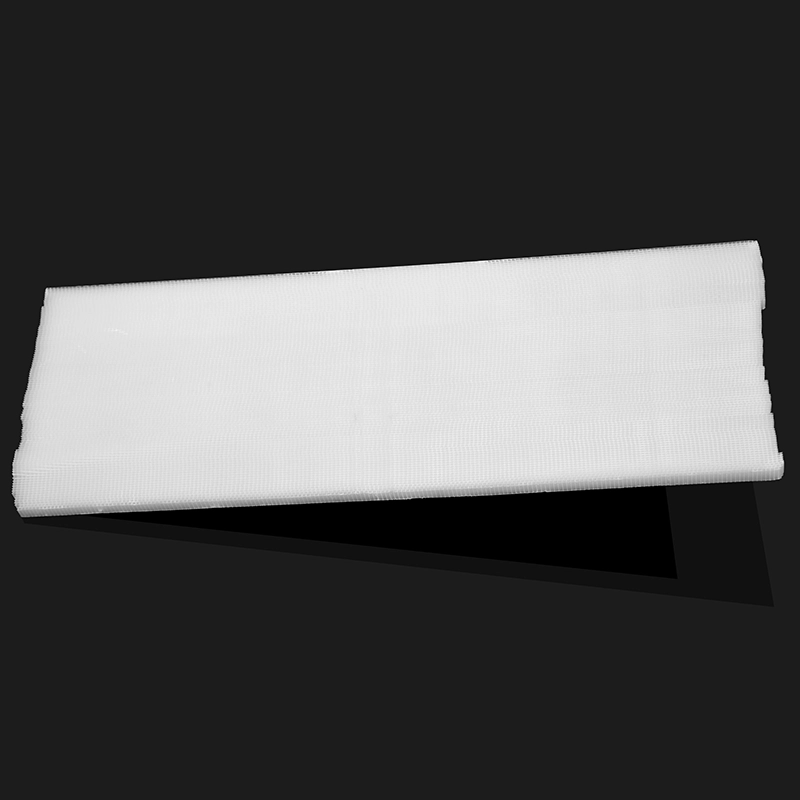
A washable polypropylene filter screen has no consumable life in the way a disposable pad does. Polypropylene tolerates repeated wetting without softening or losing shape, and the structure is not progressively worn away by dust. So the useful answer is not a number of washes – it is a list of what ends one.
Thing one: contamination that does not wash out
Oily or greasy aerosol is the main one. Dry particulate sits on the surface and in the open cells and rinses away. Oil wets into the structure, holds dust, and does not come out with water and detergent. Once that has happened the screen is finished, and no amount of washing will recover it.
Where this applies – kitchens, machining with oil mist, any process with a sticky aerosol – a washable screen is simply the wrong product, and the honest advice is to buy disposables. We would rather say that before an order than after.
Thing two: mechanical damage
Cracked cell walls, a bent frame, a torn face. A light-gauge screen will deform if it is pressed hard during cleaning or hit with a pressure jet at close range. Once cell walls have folded, the open area at that spot has gone and the screen is locally blocked.
Which is a roundabout way of saying: the washing is what damages screens, not the service. Rinse from the clean side outward, keep pressure jets back, use a soft brush. We set out the procedure in how to clean PP honeycomb panels, and most of it applies directly.
What does not end it
Number of washes, within reason. Ultraviolet, indoors. Age, over any normal planning horizon – polypropylene does not embrittle on a shelf the way some filter media do. A screen that has been in service five years and washed monthly is usually fine.
How to tell when it is done
Hold it up to a light after washing and drying. If it comes back to roughly the same appearance it had when new, it is fine. If there is permanent darkening or a visible film that survived the wash, the contamination has gone into the structure. If there is deformation, it is mechanically finished. Both are obvious once you know to look, which is why we suggest photographing a screen the day it goes in – it settles every later argument.
Access, which decides more than the product
The most common reason a washable screen underperforms is that taking it out is awkward. If removing it needs tools and twenty minutes, it will be washed when somebody has time, which means rarely.
Worth designing for: a screen that slides out of a frame without tools, in a position someone can reach without a step ladder. This is not a filter specification, it is a maintenance specification, and it determines whether the screen delivers anything like the life the material is capable of.
If the location cannot be made easy to access, buy disposables and put them on a schedule. It is the more honest answer.
What we can do
We supply washable honeycomb filter screens with high open area and low pressure drop, cut to your intake dimensions. Tell us the intake size, airflow and what the dust is, and we will specify the open area – and tell you plainly if your contamination is the kind that does not wash out.