
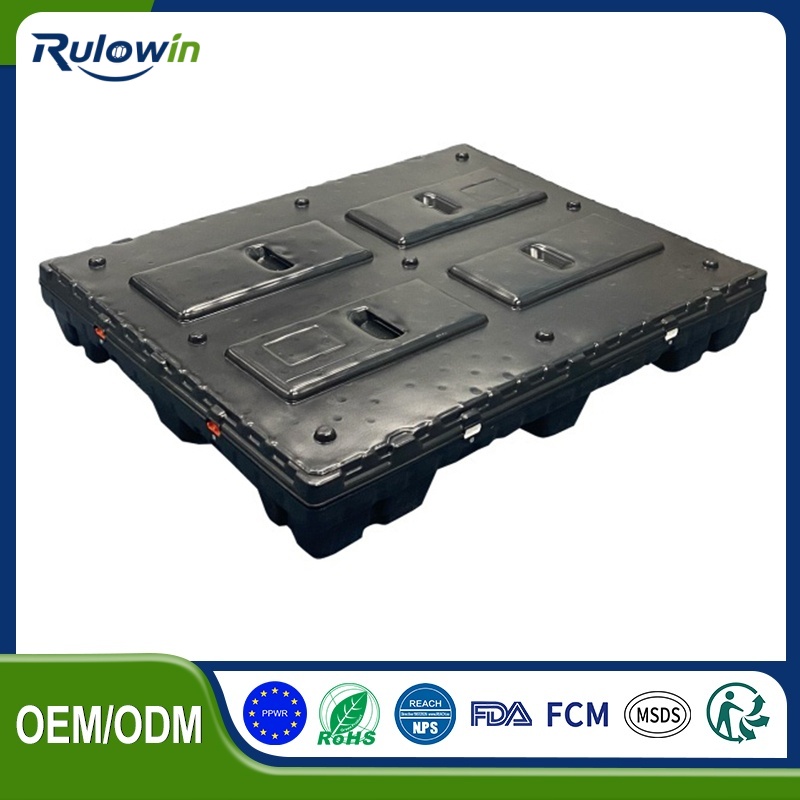
A single supplier and a single customer can run returns on trust: the boxes come back when the next vehicle goes. Add a second plant, then a third customer, and the same arrangement collapses into half-empty vehicles and phone calls about who has whose boxes.
When direct returns stop making sense
The rule of thumb is somewhere around three receiving sites or three shipments a week. Below that, direct returns are cheaper because there is no depot cost. Above it, the number of small movements grows faster than the volume, and consolidation at a depot starts to pay. The depot exists to convert many part-loads into a few full loads.
What a depot has to do
Three jobs: receive, inspect, and dispatch. Inspection is the one people skip, and it is the one that protects the fleet, because a damaged box caught at the depot never reaches a customer. It takes a minute per box and a simple accept, repair or scrap decision with a written rule for each.
Depot location and the geometry of the network
Put the depot near the centre of the flow, not near the biggest site. A depot at the largest customer saves one leg for that customer and adds a leg to everyone else, which is the wrong trade once there are four or five sites. The right answer is often a third-party site with spare space rather than a new building.
Ownership, the argument that always happens
With a pool, boxes stop belonging to a lane and start belonging to a fleet, and the first question is who pays when a box is lost. The workable answer is a pool administrator, an agreed loss allowance and a simple monthly reconciliation. Programs that avoid this conversation end up with each site hoarding boxes just in case, which is the opposite of what a pool is for.
Reconciliation without software
One number per site per week: boxes in, boxes out, boxes held. If held stock drifts up at a site for three weeks running, someone visits. That is the entire control system, and it works better than a tracking platform that nobody updates. The same discipline is covered in cycle counting a box fleet.
Cost allocation and the invisible subsidy
The site nearest the depot always looks efficient and the furthest site always looks expensive, because the legs are different lengths. Allocating return cost per movement rather than per kilometre keeps the picture honest and stops the furthest site from quietly ordering its own boxes.
The staged rollout
Start with two sites and direct returns, prove the boxes survive and the numbers work, then add the depot when the third site arrives rather than before. A depot set up in advance of the volume it needs becomes a cost centre that the fleet is blamed for.
The depot decision, in one calculation
Add up the cost of the small movements you would otherwise make and compare it with the cost of running the depot, including the handling of every box through it. Below about three sites the small movements are cheaper. Above five, direct returns produce so many part-loads and so many phone calls that the depot almost always wins, even before the inspection benefit is counted.
There is a middle case that catches people out: a depot that is justified on volume but located badly. A depot an hour from the centre of the flow adds an hour to every leg and turns a marginal saving into a loss. Model the legs before signing a lease, and remember that the depot’s own cost is charged to the fleet whether or not the fleet is busy that month.
What we can do
We build PP honeycomb board boxes that nest and knock down so a mixed return load stays compact, and we will help you work out whether a depot is justified at your volumes. Send us the site list and the shipment frequency.