
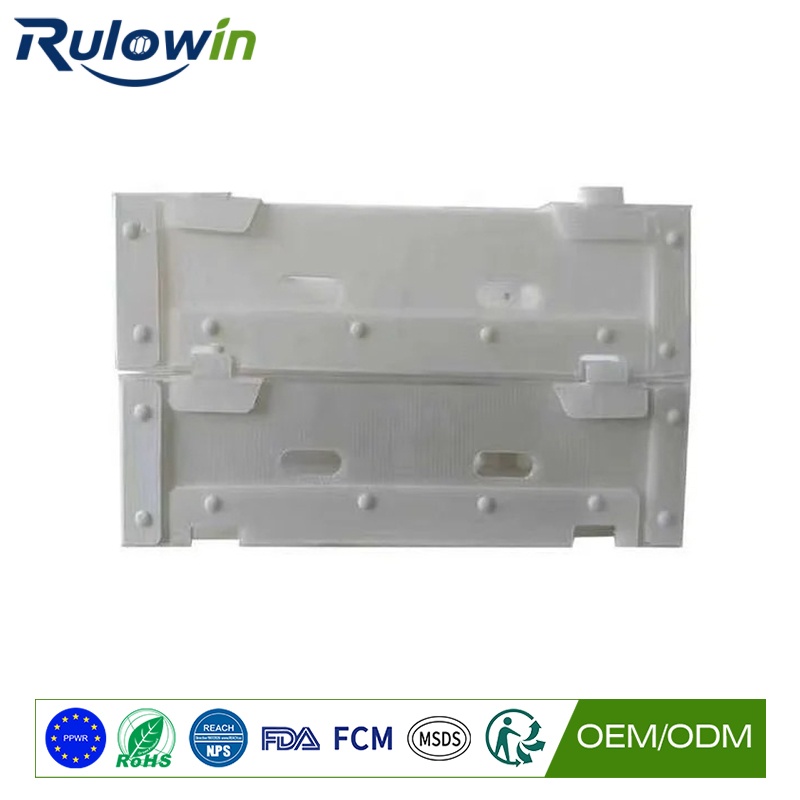
Hydro-cooling and icing are the fastest ways to pull field heat out of produce, and both put the packaging through conditions it would never see in dry handling. Boxes that perform perfectly in a dry pack house fail quickly in a hydro-cooler.
What the box is exposed to
Full immersion or heavy spray. Water gets into every opening, including the flutes of a corrugated sheet if any edge is unsealed.
Repeated wet-dry cycling. A box that is soaked, drained, used, washed and soaked again ages much faster than one that is simply used wet.
Weight. Water retained in the structure adds mass, and a stack of wet boxes carries it.
Chemical exposure. Hydro-cooler water is often treated, and sanitiser concentrations that are fine for produce can be hard on adhesives and print.
Cold. Icing and chilled water bring the box down to near zero, and PP is stiffer and more brittle there than at room temperature.
What fails
- Unsealed edges take water into the flutes and hold it. This is the most common problem and the cheapest to prevent.
- Adhesive bonds on taped or laminated construction break down with repeated soaking.
- Metal staples corrode, stain and eventually let go.
- Print and labels lift, which then makes the box unidentifiable in a pooled fleet.
- Impact damage at low temperature. A box dropped when it is near freezing cracks where it would have deformed at ambient.
Designing for it
The measures are not exotic, but they have to be specified:
- Welded or sealed edges rather than cut ones, particularly at the rim and around vents
- Drainage paths that actually empty – the lowest point of the box needs a way out, not just a hole somewhere
- Welded construction rather than stapled
- Identification moulded or embossed rather than printed
- A material grade chosen for low-temperature impact rather than just for stiffness
The drainage trap
A box can have plenty of holes and still hold water, because the holes are not at the lowest point or because surface tension holds a film across a small opening. If you are specifying for hydro-cooling, test it: fill it, drain it for the real cycle time, and weigh it. The retained weight is the number that matters for your stack and your freight.
Icing is harder on boxes than water
Ice is a step beyond hydro-cooling in three ways. It is applied as a solid, so it loads the box mechanically before it melts. It melts slowly, so the box stays wet for longer than in a dip. And it is often applied on top of the load, so meltwater runs down through the product and out of the base rather than being drained quickly.
Boxes for iced service need drainage at the base that works while the box is stacked, which means the drainage path cannot be in the footprint of the box below. They also need to tolerate being handled at low temperature straight out of the ice.
If you ice in the box, tell us. The design response is different from hydro-cooling, and a box built for one will disappoint in the other.
What we supply
Our produce boxes can be built with sealed edges and drainage for hydro-cooling and iced service. Tell us the cycle – how long it stays wet, what is in the water, and how cold it gets – and we will build for that. If your sanitiser concentration is high enough to be a problem for PP, we would rather know now.