
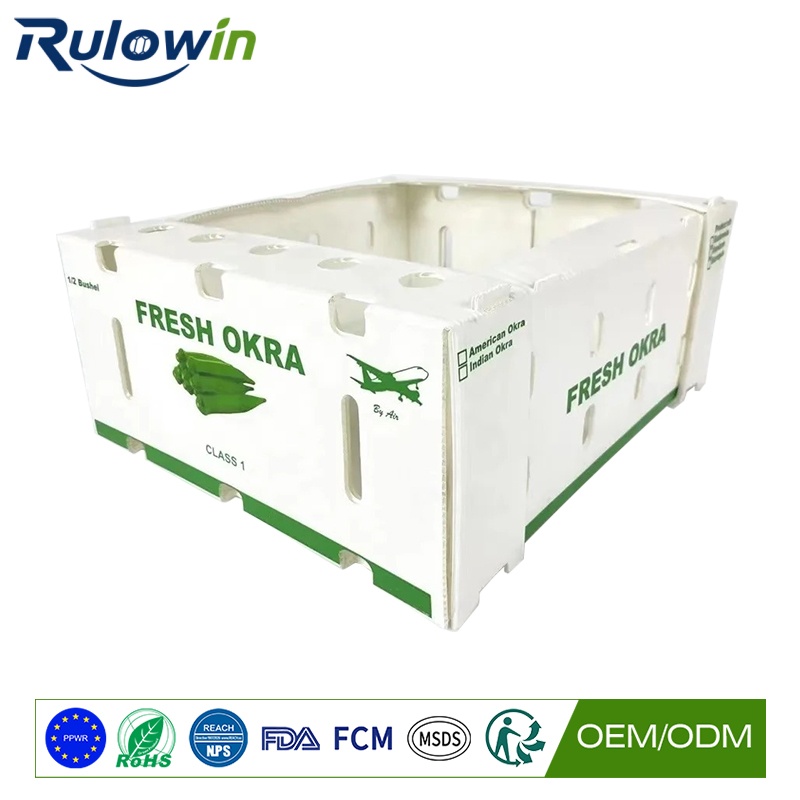
Anyone buying crates for produce should ask about food contact before ordering, and should ask in a way that produces a document rather than a verbal assurance. Three questions, and the third is the one that matters most.
Question one: what is the resin?
Virgin or recycled. This is the question that actually carries weight, because recycled content in food-contact applications is a regulated area and the answer determines what documentation is possible. A supplier should state it plainly.
Polypropylene itself is widely used for food contact and is not the issue. The issue is what else is in it – and whether anyone is willing to say.
Question two: is it intended for this use?
Packaging intended for food contact is made and documented as such. Packaging intended for industrial use may be chemically identical and undocumented. The difference is the paperwork, and for a food business the paperwork is the point.
Ask directly: is this crate intended for direct contact with unpackaged food? If the answer is hesitant, assume no.
Question three: what will you put in writing?
This is the one that predicts whether you will have a problem later. A supplier who will state compliance on a declaration, reference a specific regulation, and put it on their letterhead is a supplier who has thought about it. One who says “it’s food safe” has not.
Get the declaration with the first order, not when an auditor asks. Retrospective documentation is much harder to obtain than contemporaneous documentation.
Two things worth adding
Colour and additives. Pigments and any additive package are part of the material. If you are specifying a non-standard colour, ask whether the pigment is cleared for the same use.
What the crate is used with. Direct contact with unpackaged produce is the strictest case. Crates used to carry sealed cartons are a different and easier one. Being precise about your actual use gets you a more useful answer than asking in general terms.
The honest boundary
We can tell you what our crates are made of and what documentation we can supply. We are not going to give you a legal opinion about your market – that depends on where you sell and what your customers require, and it is worth asking your own compliance function rather than a packaging supplier.
What we would say is: ask early, get it in writing, and do not accept a verbal assurance on something you may later have to evidence.
What to do about washing
A food-contact declaration covers the material as supplied. It does not cover what happens to the crate afterwards, and washing is where a lot of the risk actually sits – detergent residues, rinse water quality, and whether crates are dried before they stack.
Worth asking your detergent supplier the same questions you asked the crate supplier, and worth having a written wash procedure. In most audits the wash process gets more attention than the crate does.
Also worth noting: a crate that has been abused – deeply scored, cracked, with material stuck in a corner – is not cleanable regardless of what it is made of. Culling damaged crates is part of food-contact control, not just fleet management.
What we can do
We make PP crates for fruit and vegetables and will state resin and intended use in writing with the quote. Tell us the crop and the market, and we will tell you exactly what documentation we can provide – including being explicit about anything we cannot.