
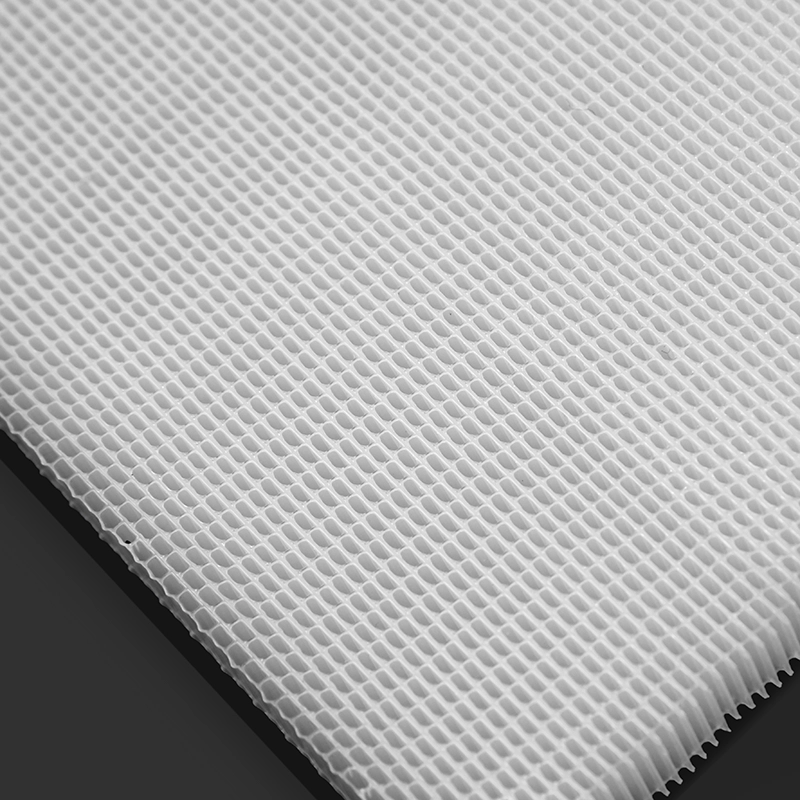
Attention goes to the mesh, and failures usually start at the frame. The mesh is a uniform, well-understood material; the frame is where different materials meet, where stress concentrates, and where the assembly is handled.
Why frames fail first
Stress concentration. The mesh distributes load across thousands of wires. At the frame, all of that load transfers into a joint, and the joint is the weak link.
Differential expansion. If the frame is a different material from the mesh – metal frame, PP mesh, or the reverse – the two expand at different rates. Over repeated thermal cycles that works the attachment loose.
Handling. A screen is lifted, carried and installed by its frame. Damage there is invisible until it leaks.
Chemical attack at the joint. Crevices at the attachment hold fluid at a different concentration from the bulk, and attack concentrates there.
Attachment methods
- Welding the mesh to a matching PP frame gives a homogeneous joint with no crevice and no differential expansion. It is the most durable option where the material suits the service.
- Mechanical clamping between frame sections is simple, allows mesh replacement, and creates a crevice that needs cleaning.
- Overmoulding the frame around the mesh edge gives a clean, sealed result with good fatigue life, and requires tooling.
- Bonding with adhesive is cheap and is usually the first thing to fail where temperature or chemistry is aggressive.
Support spacing
A screen is only as strong as the distance between its supports. A wide unsupported span will deflect under pressure, and cyclic deflection fatigues the wires at the crossings. If your screens deform or crack in the middle rather than at the edges, the answer is usually more support rather than stronger mesh.
This is also the cheapest reliability improvement available: adding an intermediate support rib costs far less than upgrading the mesh gauge.
Flow direction matters
Loading the mesh in one direction puts it in tension against the frame; reversing it puts the same load into a joint that may not be designed for it. If backwashing is part of your cycle, the frame has to be designed for load in both directions, and it is worth stating that explicitly when ordering.
Sealing
A screen that bypasses at the edges is not filtering, no matter how good the mesh is. The seal between the frame and the housing needs to suit the pressure, the temperature and the fluid, and it needs to be replaceable. Silicone and EPDM behave very differently, and the wrong one will harden or swell.
What to specify
- Frame material matched to the mesh where possible
- Attachment method appropriate to the temperature and chemistry
- Support spacing relative to the design pressure differential
- Seal material and whether it is replaceable
- Whether backwashing occurs, so the frame can be built for reverse load
Replaceable mesh or a one-piece unit
There are two philosophies. A one-piece welded unit is cheaper, has no crevice, and is discarded when the mesh wears. A frame with replaceable mesh costs more initially, generates a spare parts requirement, and lets you change the aperture without buying a whole assembly.
The replaceable version makes sense where the aperture changes with the product, or where the frame is expensive relative to the mesh. The one-piece version wins where the aperture is fixed and the cleaning regime punishes crevices.
We supply both, and the honest answer depends on how often you expect to change specification. If the answer is never, buy the welded unit.
What we build
Our filter screens are supplied with welded or overmoulded PP frames for chemical and thermal compatibility, and we will ask about backwashing and pressure differential before settling the design. If your existing screens are failing, send us a photograph of the failure – where it broke tells us most of what we need to know.