
Edge protection is usually bought as one thing and used for two. One job is spreading the load from a strap or band along the edge of the box. The other is absorbing an impact from a fork, a doorway or a neighbouring pallet. A component that is good at one is often mediocre at the other, which is why generic edge protection underperforms.
The spreading job
Here the requirement is stiffness along the length of the edge and enough width to distribute the strap load. A thin angle section works because it does not have to absorb anything – it just has to stop the band cutting in. This is the cheaper job, and it is the one most strap damage needs.
The impact job
Here the requirement is energy absorption across the width of the edge. That needs more material and a section that deforms rather than one that resists. A stiff thin angle protects against a band and does almost nothing against a fork, which is a distinction worth making before ordering.
Where the impact arrives
Mostly at the bottom corner, from a fork entering or a pallet being set down, and at the top corner, from a strap, a doorway or a racking upright. Those two positions are worth protecting specifically rather than protecting all edges equally at higher cost.
Reusability
In a returnable system, edge protection that is destroyed on opening is a consumable with a disposal cost. Reusable protectors that clip on and come off intact are better on a closed loop and worse where they are likely to be lost. Matching the protector to the loop matters more than matching it to the box.
Adhesive and residue
Some protective sections are supplied with an adhesive backing. On a reusable box that adhesive becomes a cleaning problem and a contamination risk in controlled environments. Where a box will be washed, specify a mechanical fixing or no fixing at all.
What to specify
Length, section, material, whether it is single-use or reusable, and the positions it is fitted to. Five details that make the difference between protection that works and protection that is bought and then quietly dropped.
Specifying them properly
State the length, the section, the material and the positions. The job differs by position – a protector under a band is spreading a load, one on a bottom corner is taking an impact – and the two are not interchangeable.
Where the box has a reinforced vertical edge, the spreading job may be unnecessary and only the impact position needs protection. Checking that before ordering is the difference between a specification and a shopping list.
Where the impact arrives
Mostly at the bottom corner, from a fork entering or a pallet being set down, and at the top corner, from a strap, a doorway or a racking upright. Those two positions are worth protecting specifically rather than protecting all edges equally at higher cost.
Where they are genuinely needed
Under a band, because that is the spreading job. On the bottom corner, because that is where the fork arrives. And on any edge that meets a doorway or a racking upright repeatedly. Three positions. Protecting every edge equally costs several times as much and protects the same three.
What we can do
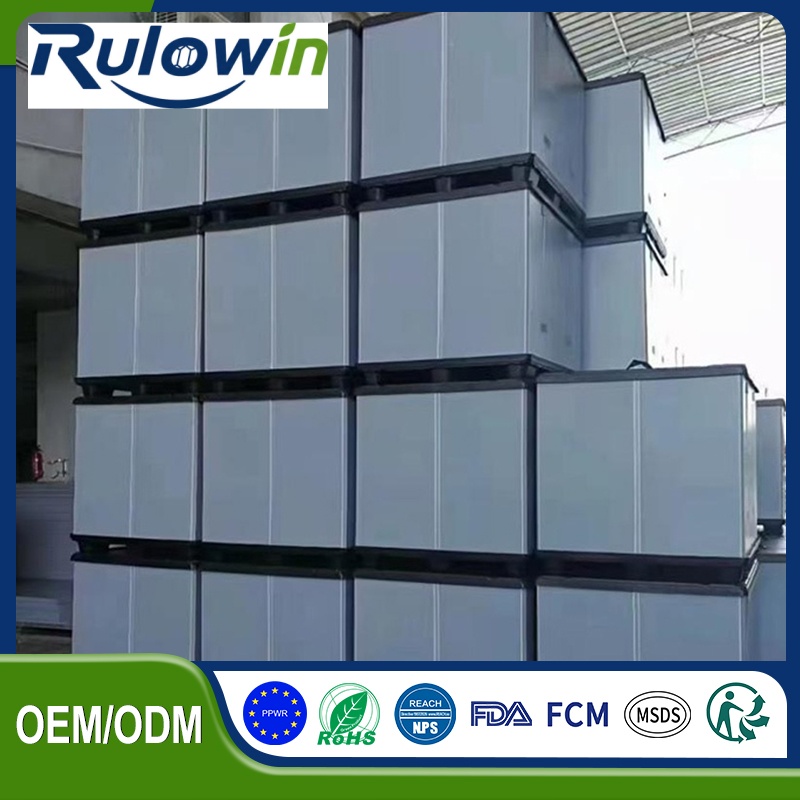
We build PP corrugated turnover boxes with corner details that take banding directly, which removes the need for most separate edge protection. Tell us how the load is secured and we will say what is still needed. The strap side of it is covered in strapping a stack without crushing corners.