
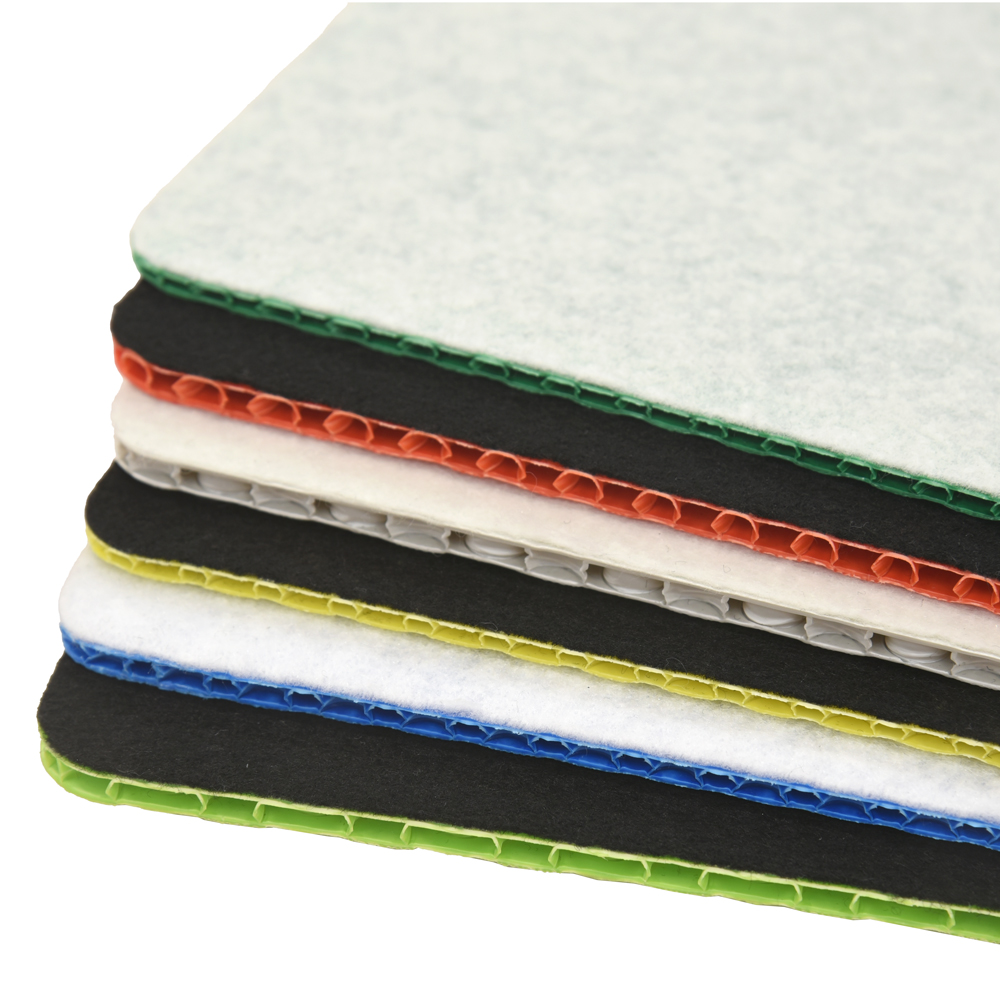
A tool dropped from bench height onto protected flooring leaves a crescent in the surface below far more often than site teams expect. The instinct is to blame the protection for being too thin. Thinness plays a part, but three other things decide the outcome: how much energy arrives, how large an area it arrives over, and what happens to be underneath the panel at that exact spot.
What actually causes the dent
A one kilogram tool falling half a metre carries roughly five joules. That is not a large number, but it arrives in a few milliseconds and through a contact patch about the size of a coin. The floor sees a very high pressure for a very short time. Whether it yields depends on whether that pressure exceeds what the surface can carry. Polished concrete usually shrugs it off. Timber, vinyl and linoleum take a permanent mark. Soft stone sits somewhere in the middle and is the one that surprises people.
Why thickness alone does not fix it
Adding thickness helps and then stops helping. A thicker panel of the same construction spreads load over a wider cone, but it also has more material to compress before it does so. Going from 6 mm to 10 mm is a genuine improvement on impact. Going from 10 mm to 20 mm for a dropped-tool event buys much less than most specifiers assume. Where thickness really earns its keep is standing load – scaffold feet, machines parked for a fortnight – not impact.
What the core does with the energy
Construction beats thickness here. A honeycomb core is a field of small cells standing on end. Load arriving at the top skin is carried down through the cell walls and out sideways, so by the time it reaches the bottom skin the contact patch has spread over a much larger area. The core also absorbs part of the energy in its own cell walls instead of passing all of it through. Two panels of identical thickness and identical weight per square metre behave completely differently under the same dropped tool depending on whether the middle is hollow-cored or solid.
Where a dent happens anyway
Four places, and none of them are cured by buying thicker board. Directly over a joint between two panels, where there is no core under the load at all. Within about 30 mm of a cut edge, where the cells are open rather than closed. Over a hard inclusion trapped beneath the panel – a screw, a blob of dried adhesive, a stone chip – which turns the whole panel into a punch. And on raised access floors, where the panel bridges between pedestals and the floor tile takes a concentrated load it was never sized for. All four are laying problems, not buying problems.
What to do with the panel afterwards
A panel that has taken a serious hit is usually still serviceable, because the skin flexed and the core crushed locally rather than the whole panel failing. The check that matters is whether the skin has split. If it has, water and grit get into the core and the panel is finished. If the skin is intact and only the core has crushed, the panel can go back down on a rougher surface. Sorting panels on that basis rather than binning them is what when to write off a protection panel is about.
What we can do
We supply PP honeycomb protection panels and will tell you honestly whether impact is really your problem – on a lot of sites the damage at handover is abrasive rather than impactive, and that is a different specification entirely. Tell us what gets dropped and onto what, and we will size the panel from that rather than from a rule of thumb.