
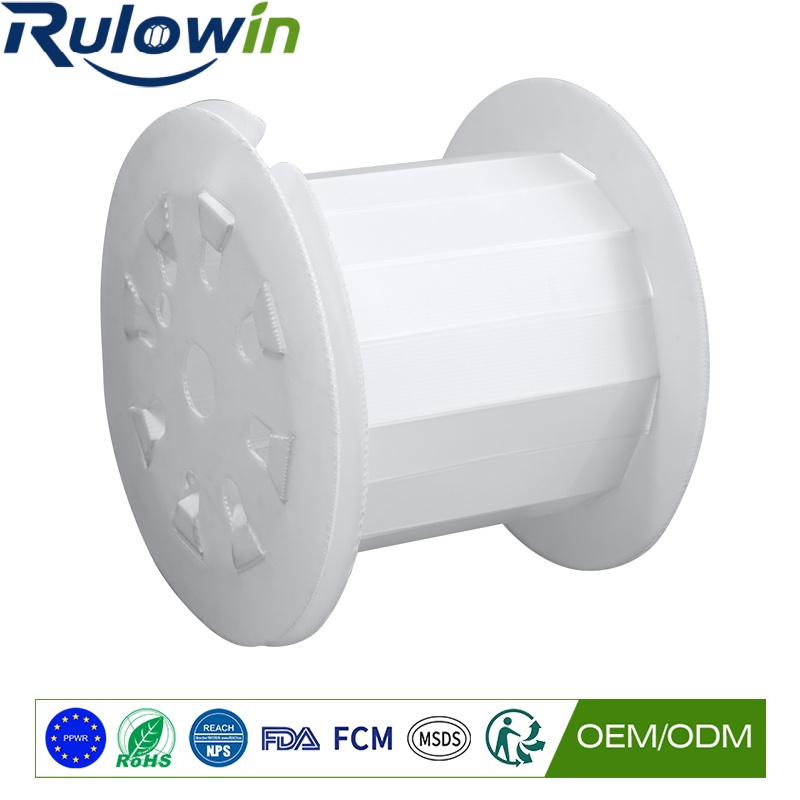
Short answer: no. ISPM 15 is the international standard governing wood packaging material in international trade, and it applies to wood – pallets, crates, dunnage made of wood. Manufactured plastic packaging is outside its scope and needs no treatment and no stamp.
That is a real and practical advantage for anyone shipping across borders, and it is one of the main reasons operators move from wooden drums and crates to plastic. But there are a couple of boundary cases worth understanding before you rely on it.
Where the boundary actually sits
The standard covers wood packaging material: unprocessed or processed wood used to support, protect or carry goods. A plastic reel, a plastic pallet sleeve, a polypropylene crate – none of these are wood packaging, and none need treatment.
What catches people out is composite items. A plastic crate with a wooden base, or a pallet sleeve box used on a wooden pallet – the pallet is in scope even though the box is not. The wooden pallet needs to be compliant; the plastic box sitting on it does not.
So the practical rule
Check the whole unit load for wood, not just the container you are buying. If the pallet underneath is wood, it needs to be treated and stamped regardless of what is standing on it. Switching the box to plastic removes one item from the list and not necessarily all of them.
Where a plastic pallet replaces the wooden one as well, the whole unit load is out of scope – and that is where the administrative saving really lands.
Why it matters in practice
Two ways. Documentation: a treated wooden item needs to carry the mark and someone has to be able to show it. And delay: a shipment held at a border because a mark is missing or illegible costs more than the packaging.
For operations shipping through several jurisdictions, this is often the deciding factor in a plastic-versus-wood comparison, and it is a paperwork cost rather than a materials cost – which is exactly why it gets omitted from comparison spreadsheets.
What it does not do
ISPM 15 exemption does not exempt you from anything else. Packaging material rules, recycling declarations, and any customer-specific requirements all still apply. In particular, some markets have their own requirements for packaging waste declarations that are entirely separate.
And plastic is not universally easier: a few destinations have restrictions on certain single-use plastics. Reusable industrial packaging is generally not what those rules target, but it is worth confirming for an unfamiliar lane rather than assuming.
What to keep on file
Even for packaging that is out of scope, it is worth having a supplier statement saying so. Some border inspections start from the assumption that everything needs checking, and a one-line declaration on a supplier’s documentation resolves it quickly.
Ask for it with the first order rather than when a shipment is held. It is a trivial request at quote stage and an urgent one later.
Where the pallet is wooden, the pallet supplier’s documentation is the one that matters. Keep both together – inspectors look at the unit load, not at individual components.
What we can do
We supply export-grade plastic fiber optic cable reels and other PP packaging that is outside ISPM 15 scope, and we will confirm it in writing on the documentation. Tell us your lane and we will tell you what the packaging needs to carry – including flagging anything that is still in scope.