
Matching Footprint to Racking Geometry
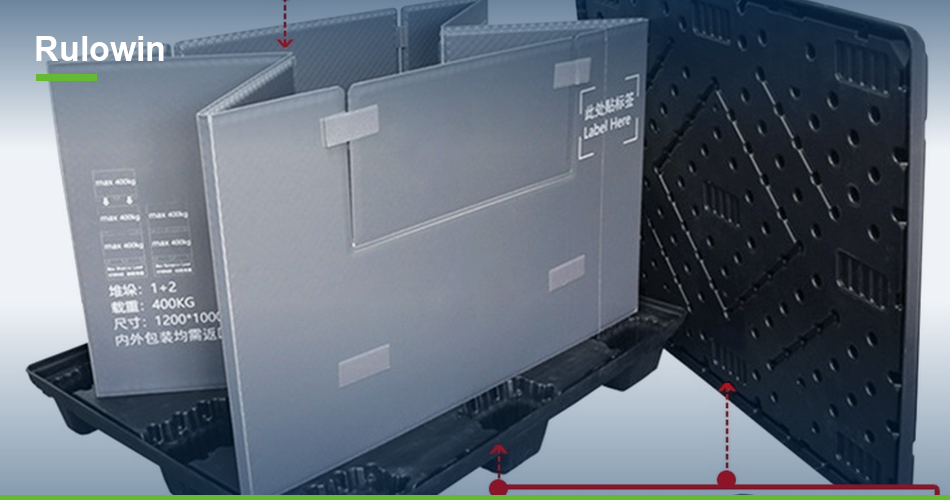
High-rack warehouses punish mismatched footprints with wasted cube and unstable loads that risk a collapse during a high retrieval by a crane. Rulowin sizes returnable containers to the 1,200 by 800 mm and 1,200 by 1,000 mm Euro footprints so they index cleanly into beam slots without shimming or overhang that would violate the racking approval and create a safety hazard for the operatives below.
A 25 mm base lip locks the unit to the pallet, preventing the 12 mm shift that causes load topples during narrow-aisle retrieval by a high-reaching turret truck operator working under a tight delivery window. That small lip is the difference between a load that arrives intact and one that arrives as a spill on the floor, which is why we treat it as a core feature rather than an optional extra on the base.
Stacking Interlock and Load Transfer
Stacked containers must transfer vertical load through the walls, not the contents inside them, or the product crushes and the bottom box fails under the column weight. We mold a positive interlocking rim so a 5-high stack of 400 kg units carries 2,000 kg without the bottom box deforming beyond its elastic limit on the rack.
Finite element analysis confirms wall strain stays below 2 percent at rated load, preserving long-term shape and preventing the gradual bulge that eventually jams an automated crane’s gripper during a retrieval cycle at height. The analysis also lets us tune wall thickness to the exact duty, avoiding both an under-strength box and an over-built one that wastes resin and adds freight weight for no operational benefit to the customer.
Automation Compatibility
AS/RS cranes demand flat, dimensionally stable bases that do not vary shift to shift as cardboard does with humidity. PP keeps its tolerance through temperature swings better than cardboard, so a vision-guided grab finds the same edge every time and the system does not need to slow down to re-measure a deformed carton before picking it from the lane.
We add a 50 by 50 mm clear zone on two sides for barcode or QR reading by fixed scanners at 1.5 meters, which removes the misread exceptions that force a manual intervention and slow the whole storage system during peak throughput hours. The clear zone is kept free of handles and labels so the scanner sees a clean target and the read rate stays above 99 percent across the day’s volume of inbound and outbound pallets.
Ventilation and Hygiene
Perforated sidewalls cut weight 15 percent and allow air exchange in chilled racking, which matters for any food-adjacent or pharma-adjacent inventory stored in the same facility under temperature control. The open structure also drains wash water, so sanitized containers re-enter stock dry and mold-free after the regular cleaning cycle that the hygiene plan requires for the stored goods.
A clean, vented container is both lighter for the crane to move and safer for the product it protects through a long dwell in dense, humid storage that would ruin a sealed cardboard box. The ventilation also helps equalize temperature across the load, reducing condensation that could otherwise form on a cold item when the ambient air warms during a defrost cycle in the chamber over the weekend.