
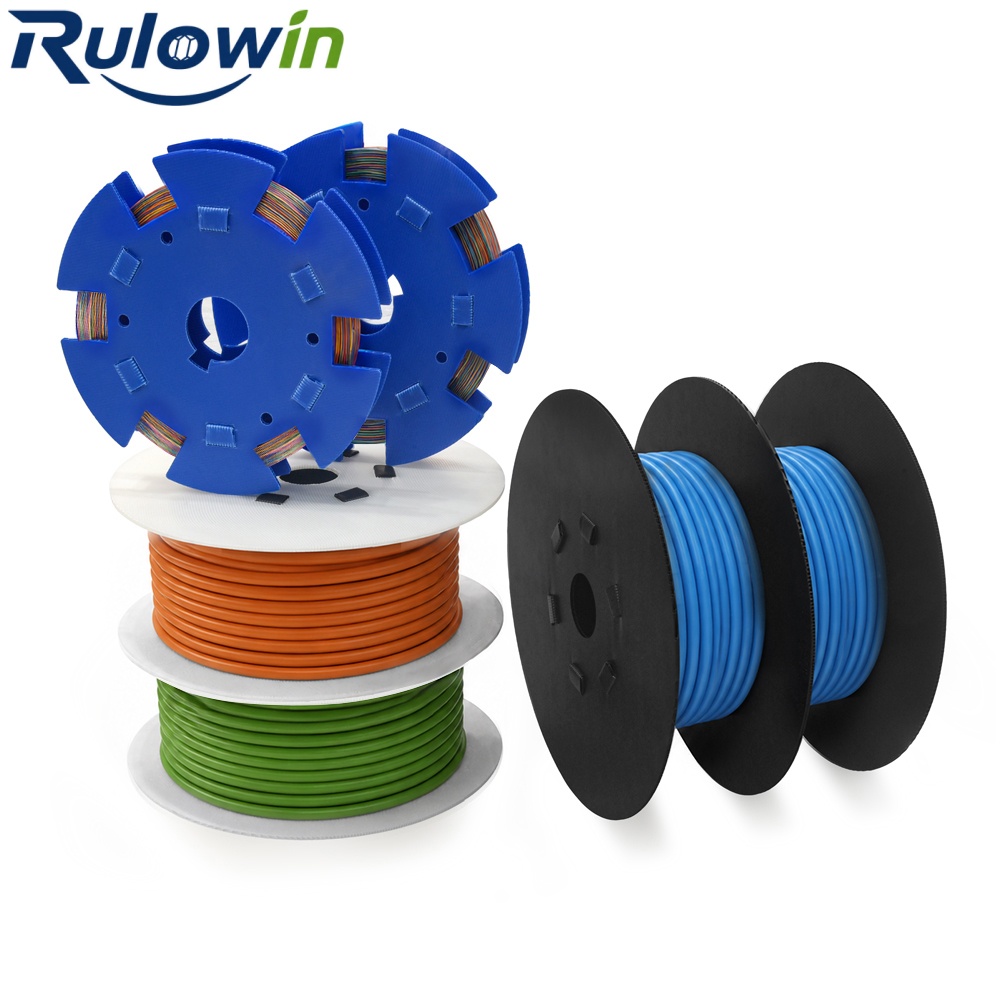
Manual handling is forgiving. A person looks at a spool, works out where to grab it, and adapts. A robot does not adapt — it executes. If the spool is not where it expects it, or the gripping surface is not where the program says, the cycle fails or the spool gets dropped.
Automating a line that was designed around human handling is where most of these problems come from, and the fix is usually in the spool rather than the program.
What automation needs from a spool
- Repeatable geometry. The most important requirement by some distance. A gripper programmed for a flange of a given diameter needs every spool to be that diameter. Variation that a human would never notice is a cycle failure to a robot.
- A defined gripping feature. Somewhere consistent to grab — the bore, a hub recess, a specific rim profile. “Grab the flange somewhere” is not a specification.
- Predictable weight and centre of gravity. A partially wound spool has a different weight from a full one, and if the gripper has a force limit, the program needs to know which it is dealing with.
- Stiffness at the grip point. If the spool deforms when gripped, the grip is unreliable. Hollow board flanges are stiff across the face but can flex at the rim if gripped there — so grip inboard, not at the edge.
- A surface that suits the gripper. Friction pads on a smooth flange are marginal. Vacuum on a porous or ribbed surface will not hold. Match the feature to the technology.
Where fabricated spools are at a disadvantage
Being straight about it: injection-moulded spools have tighter inherent dimensional consistency than fabricated hollow board ones. If your automation is unforgiving on tolerance, that is a real consideration and it is the first thing we raise.
What we can do is identify which dimensions actually matter to your gripper and hold those tightly, while letting the ones that do not matter vary normally. That usually makes fabricated spools viable in automated handling, but it requires knowing which is which — which is a conversation, not a default.
AGVs and palletised handling
Automated guided vehicles usually move pallets rather than individual spools, which changes the problem. What matters then is:
- Consistent stack geometry. A leaning or uneven stack is a problem for a vehicle that places by dead reckoning.
- Self-locating features. Spools that nest or register into each other resist shifting in transit far better than flat-on-flat stacking.
- Pallet footprint discipline. A spool overhanging the pallet edge by a few centimetres is fine for a human and a problem for an automated aisle.
Identification
Automation usually wants to know what it is handling. Barcodes and RFID both get used, and both have placement requirements — a label on a curved flange rim will not scan reliably, and a tag buried in the middle of a wound pack will not read at all.
Plan for a flat, protected, consistent location for whatever identification you use. Retrofitting this after the fact is much harder than designing it in.
What to tell us
More than you think you need to:
- How the spool will be gripped — bore, hub, flange, or external
- The gripper technology and its force or vacuum capability
- Which dimensions the automation is sensitive to, and to what tolerance
- Whether spools are handled full, empty, or both
- Whether identification is required and how
With that, we can tell you whether a standard hollow board spool will work or whether you need a modified design — and we would much rather have this conversation before you have programmed a cell around a spool that will not repeat.
The honest caveat
Automation projects have a habit of discovering late that the packaging is the variable. Get the spool settled early, get samples in the cell before the program is finalised, and expect to adjust the program to the spool rather than the other way round.