
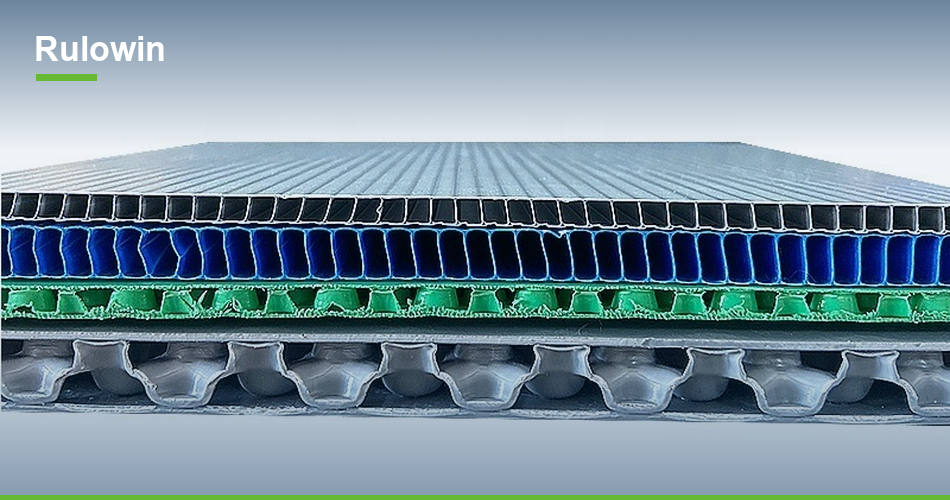
PP corrugated sheet is made to fold, but only in one direction and only if the fold is prepared. Most of the cracked corners and uneven boxes in the field come from folding the wrong way or from folding without a score.
Fold along the flutes, never across
The fold line should run parallel to the flutes. Fold that way and the sheet hinges on the flute walls, which collapse slightly and give you a clean, straight, strong corner. Fold across the flutes and you are trying to bend the flute walls sideways, which either resists or tears.
Check your blank before you score it. It is a common and expensive error to lay out a box on a sheet where the flutes run the wrong way, and it is not recoverable.
Why scoring matters
Unscored sheet folds where it happens to bend rather than where you want, and the fold is a broad curve rather than a crisp corner. Worse, folding unscored sheet puts high strain on the outer skin and it can whiten or crack – polypropylene shows stress whitening readily, and once it has whitened it has been damaged.
A score compresses the sheet along a line and creates a deliberate weak point, so the fold happens there and the corner is straight.
Methods, from hand to production
- A scoring wheel or a blunt blade drawn along a straight edge. Good for one-offs and small runs. Score the side that will be on the inside of the fold, and do not cut through.
- A dedicated creasing tool with a rounded profile. Better control of depth, which matters because too deep cuts the sheet and too shallow does nothing.
- A router with a V-bit or a round-bottom bit for production. Consistent depth, clean result, needs a jig.
- A heated creasing bar for volume work. Relieves the material so it folds without whitening, and it is the best result where appearance matters.
Depth is the variable
A useful score goes through one skin and partway into the flutes, leaving the other skin intact. Too shallow and it will not fold straight; too deep and the sheet is cut and the corner has no strength. Expect to adjust the setting for each thickness and each batch, because material varies.
Cutting
A sharp knife works for straight cuts on thin sheet and is the usual answer on site. For volume, a router or a die gives consistent edges. Two things to avoid: a dull blade, which melts rather than cuts and leaves a lip, and cutting with the sheet unsupported, which lets it flex and gives a wandering edge.
Holding the fold
A folded corner will spring back, because PP has memory. Where the corner needs to stay, it has to be fixed – welded, stapled, taped or riveted. Welding gives the cleanest and most durable result; staples are fast and adequate; tape is the weakest and fails first in wet or cold conditions.
Why folds crack in cold weather
Polypropylene becomes noticeably less tolerant of bending as it gets cold. A fold that is fine in a warm workshop will crack along the score in a cold one, and the crack is usually on the outside of the fold where the skin is in tension.
If you fold sheet in an unheated space, three things help. Score slightly deeper so the fold requires less strain. Warm the sheet if you can – an hour in a heated area is often enough. And fold more slowly, because PP is sensitive to strain rate as well as temperature.
This is also a reason to fold and assemble in a controlled area and store the finished units cold, rather than folding outside where the product is being used.
What we can supply
We supply corrugated sheet cut and scored to your layout, with the flute direction controlled, which removes the variables above from your process. If you are doing it in-house, tell us how and we will tell you whether the sheet grade we are proposing will fold cleanly with your method.