
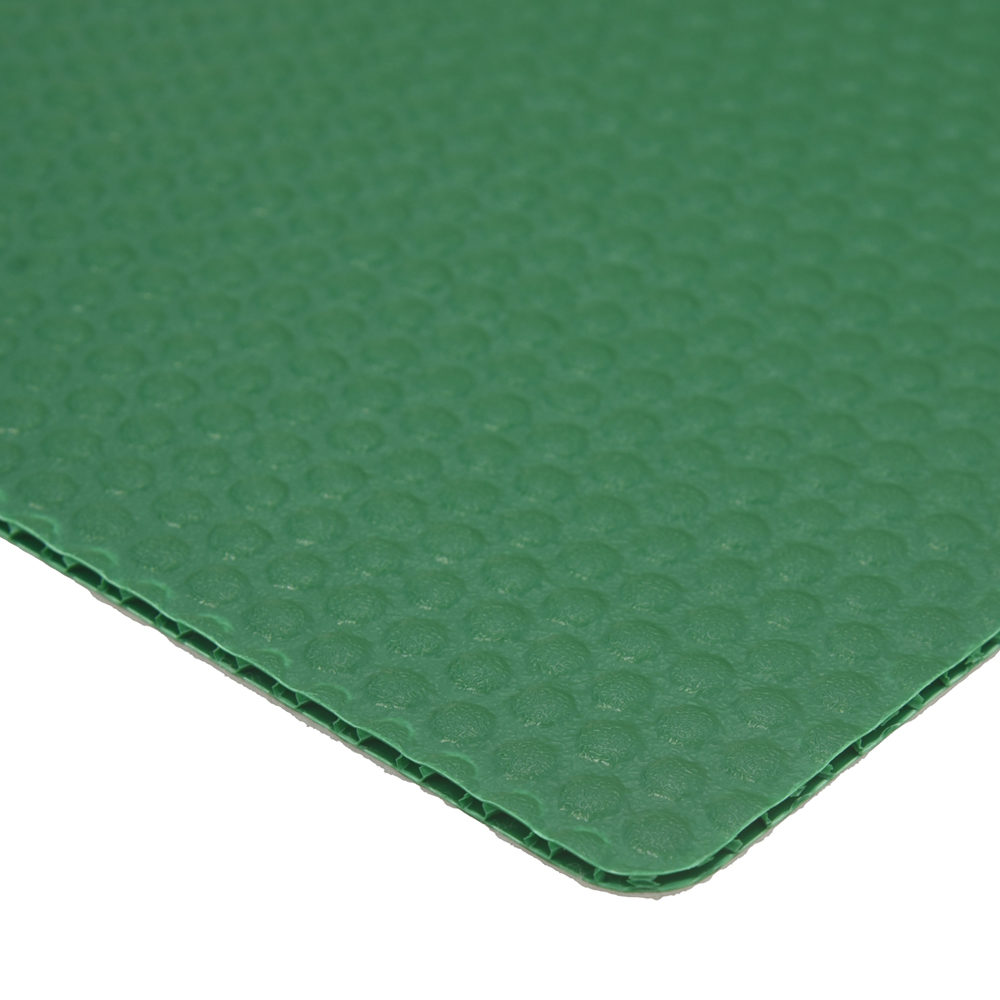
A cut edge on a honeycomb panel is the weakest part of the assembly. The cells are open, the skins have no support at the perimeter, and any strap, clamp or impact lands on exposed cell walls. Most panels that fail early fail at an edge, not in the middle.
What a bad cut looks like
A knife dragged through a honeycomb panel tears the cell walls rather than cutting them, leaving a ragged, compressed edge with the skins lifted. A blunt saw blade melts the polypropylene instead of removing it, smearing a lip of re-solidified material along the cut that looks acceptable and bonds to nothing.
Both edges will hold up for a while. Neither will hold a fixing or survive a strap.
Methods, worst to best
Hand knife, single pass. Acceptable for thin panels and one-off work, but use a fresh blade and accept that the edge will need closing.
Circular saw with a fine-tooth blade. Fast and common. Use a blade meant for plastics or non-ferrous metal, keep the panel supported close to the cut, and expect to clean the edge afterwards. A dull blade is worse than a slow one.
Router with a straight bit. The best shop-floor option for repeatable work. A sharp two-flute bit at high speed gives a clean edge with no melting, and a template makes it repeatable.
CNC router or water jet. For production volumes. Water jet leaves a clean edge with no heat affected zone, though it leaves the cells wet and they need drying before any edge sealing.
Closing the edge
Whatever you cut with, the edge should be closed if the panel is going to be handled, strapped or washed. Options, roughly in order of durability:
- Edge tape or a U-channel extrusion slipped over the cut and bonded or stapled. Cheap, replaceable, and the usual answer for trays.
- A folded PP edge heat-formed or welded along the perimeter. Durable and washable, but it needs tooling.
- A frame – aluminium or plastic – which turns the panel into a composite assembly and is the right answer when the edge needs to carry load.
- Heat sealing the skins together at the edge. Works, but it is slow and easy to do badly.
Fixings near an edge
Keep fixings away from the perimeter. A screw within about 15 mm of a cut edge is going into unsupported skin and will work loose. If you need to fix near an edge, the edge treatment should carry the fixing, not the panel.
A word on dust
Cutting PP produces fine, statically charged dust that clings to everything and does not wet easily. It is not pleasant to breathe and it makes subsequent bonding unreliable if it is not removed. Vacuum at the cutter if you can, and wipe edges with isopropyl alcohol before bonding anything to them.
Fixings and inserts
Anything screwed into the face of a honeycomb panel is only gripping the skin unless the fixing is designed for it. That is fine for a light load and unsatisfactory for anything structural.
The options are a through-fix that clamps both skins, which is the strongest and needs access to both sides; a potted insert, where a threaded sleeve is bonded into a filled pocket in the core; or a frame or edge extrusion that carries the load into the panel perimeter. For repeated assembly and disassembly, the potted insert is usually the one worth paying for.
Whatever you use, keep it away from the edge. A fixing near the perimeter works against the edge treatment rather than with it, and that is where pull-out starts.
What we can supply
We can deliver honeycomb panels cut to size with the edge treatment already applied, which removes the variable that causes most of these failures. If you are cutting in-house, tell us how and we will tell you whether the panel build we are proposing will survive your method – a thin-skinned panel and a circular saw are a bad combination.