
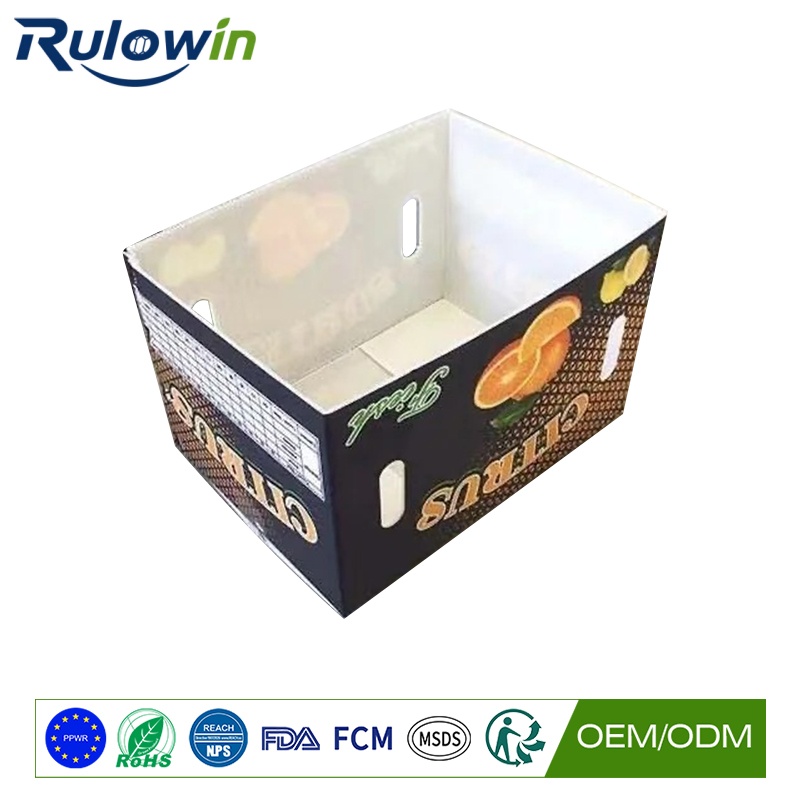
Vacuum cooling removes field heat by boiling water off the produce surface under reduced pressure. It is fast and it is effective, and it only works if the vapour can get out of the package. That makes the crate a functional part of the cooling process rather than a container that happens to be in the way.
What the vapour has to pass through
Water leaves the produce as vapour, and it has to travel out through the crate wall and the base, through any liner, and through whatever is stacked on top. Anything that blocks that path slows cooling, and a stack of crates with poor vent alignment can cool unevenly – the outside crates reach temperature and the middle ones do not.
Vent area is the specification that matters
Not the number of holes but the open area as a proportion of the wall, and critically the open area in the base, because that is where a stacked crate is covered by the crate above. A crate with generous wall vents and a nearly closed base will cool badly in a stack regardless of what the walls look like. Ask for the open-area figure rather than counting holes.
Water loss is a yield issue
Vacuum cooling removes water from the produce, and that water is saleable weight. Typically the loss is a small percentage, but on a high-value crop it is a real number and it is one of the costs of the method. Good crate venting does not change the loss – it changes how evenly and how fast it happens, which reduces the proportion of the load that is over-cooled at the edges while the centre is still warm.
Wetting and re-wetting
Some vacuum coolers spray water before or during the cycle to reduce weight loss. That puts the crate back into a wet situation immediately, so the base has to drain as well as vent. A crate that vents well and drains badly will leave the bottom layer sitting in water, which is the exact problem the cooling was meant to avoid.
Stacking pattern inside the chamber
Chambers are loaded to capacity and air paths are tight. Crates should be stacked with vents aligned rather than offset, and stacks should not be pushed against the chamber walls where condensation runs. This is the same alignment principle that applies in a cold room, and it is the thing most often lost when a chamber is loaded in a hurry at the end of a picking day.
Crate behaviour under vacuum
Polypropylene does not outgas significantly and is not affected by the pressure range used, so the crate itself is fine. What does matter is that any trapped water in a hollow section can boil and, in principle, stress a weak joint. Crates with hollow rims or sealed sections are worth checking before putting them through repeated vacuum cycles. The wider cold performance question is in do PP crates go brittle in long-term cold storage.
What to check after a cycle
Produce temperature at the centre of the pallet and at the outside, immediately after the cycle. If the two differ by more than a couple of degrees, the vapour is not getting out of the middle of the stack evenly, and the usual causes are vent misalignment between crates or a base that is too closed.
Then check the bottom crate for standing water. If the cycle included a spray and the bottom crate is holding water, the base channels are not clearing, and that is a crate specification issue rather than a cooling one. Both checks take minutes and both point at specific fixes.
What we can do
We supply high-open-area produce crates for vacuum and forced-air cooling, and we can state the open area in the wall and the base as a percentage. Tell us the cooling method and the cycle time and we will say whether our standard vent pattern suits it.