
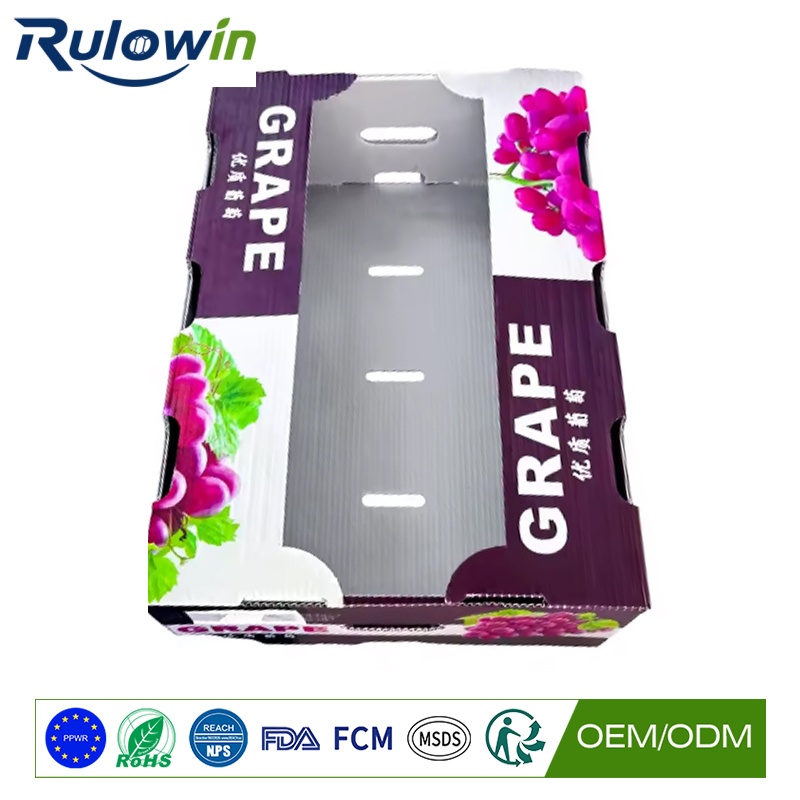
Temperature loggers tell you what happened in the trailer. They tell you very little about what happens in the twenty minutes after the doors open, and that is where a lot of produce damage occurs – on a dock, in a corridor, or in a room that was not as cold as everybody assumed.
What actually goes wrong at delivery
Three things, in order of frequency. The load sits on a warm dock while paperwork is sorted. It is moved into a cold room that is recovering from a defrost cycle and is several degrees above setpoint. Or it is broken down and re-stacked in a space that is chilled but has poor air circulation, so the middle of the stack never actually cools. None of these are packaging failures and all of them get blamed on packaging.
Why a crate helps here
A vented crate lets air move through a stack rather than around it, so a pallet of crates pulls down to temperature faster than a pallet of closed cartons. That is a genuine advantage at the receiving end where the clock is running, and it matters most for produce that arrived with field heat still in it. Solid-wall crates do not have this advantage, and the choice between them is a real one – set out in vented versus solid wall crates for storage.
Crate temperature is not produce temperature
A crate wall equilibrates with the air quickly. The produce inside does not. Measuring the crate tells you about the room; measuring the produce needs a probe in the fruit. This distinction causes endless confusion at receiving points where the check is done on the outside of the package, and it is worth stating clearly in any receiving procedure.
Stacking for airflow
A crate stack that blocks the evaporator or sits directly in front of a fan does not cool in the middle no matter how well vented the crate is. Alignment with the air path matters more than the vent ratio at this point. Where cold rooms are routinely overloaded, the crates will be blamed for a problem that is really about how much was put in the room.
The defrost problem
A cold room on defrost rises in temperature and the produce nearest the air stream warms first. Crates stacked tight against a wall or under the evaporator take that swing repeatedly. Keeping crates off the floor on pallets and away from the air discharge is standard practice and it is worth checking whether it is actually being followed, because it is one of the first things to slip in a busy season.
What to record
Time on the dock, room temperature at loading, and produce temperature on arrival and an hour later. Three numbers, and they identify which of the failure modes is happening. Without them, every cold chain problem becomes an argument. Where crate identity is being tracked as well, the records can be tied to a specific grower or block, which is the subject of labelling and traceability on reusable fruit boxes.
What we can do
We supply vented produce crates designed to cool a stack rather than just contain it, and we will advise on vent patterns for receiving points where pull-down time is the constraint. Tell us the crop, the pull-down target and how the cold room is loaded.