
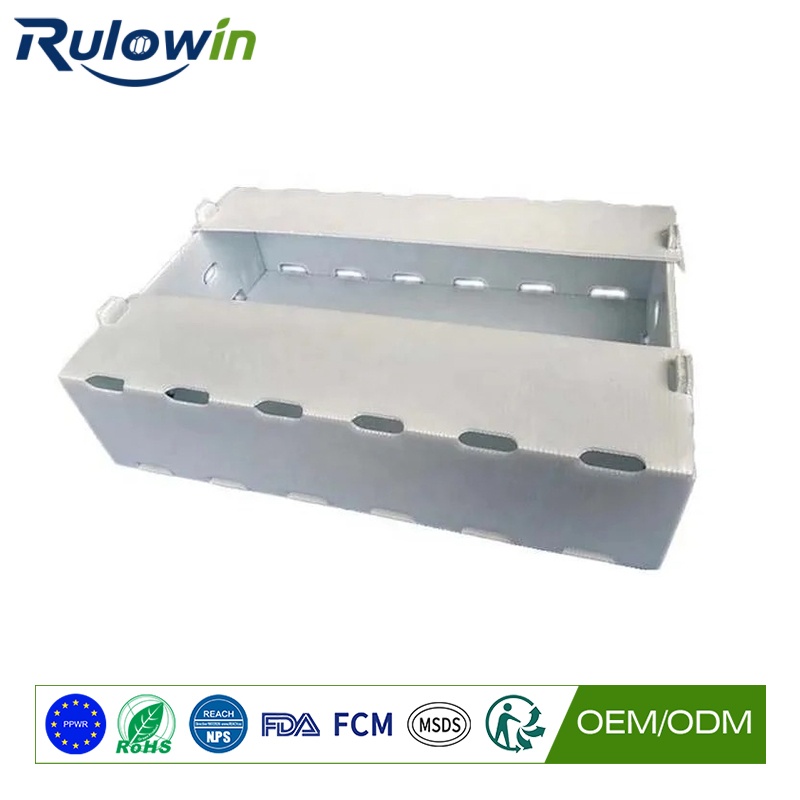
A thicker crate costs more and lasts longer, and the relationship is not linear. What complicates it is that thickness is easy to see and easy to specify, while the thing that actually determines life – how much material is in the crate and where it sits – is neither.
Weight is the honest measure
Two crates with the same wall thickness can differ substantially in weight, because wall thickness says nothing about rib density, base section or rim design. For the same external dimensions, weight per crate is a much better proxy for how much polymer you are buying. When comparing quotations, compare weight first and price second.
Where crates actually fail
Not in the middle of a wall. They fail at the rim, at the base-to-wall junction and at the hand holes – the thin, stressed places where the section changes. A crate with thick walls and a thin rim will fail at the rim. Reinforcement in those three places buys more life than a general increase in wall thickness, and it costs less.
The rib question
Ribs stiffen a wall without adding much material, and they are why a well-designed crate is lighter than a naive one for the same stiffness. They also create corners that trap debris and are harder to clean. On a crate that goes through a wash tunnel regularly, that matters, and it is one of the reasons a heavy ribbed crate can be the wrong choice for a high-care crop.
Impact resistance versus stiffness
Stiffness comes from section geometry; impact resistance comes from material and from the absence of stress concentrators. A very stiff, heavily ribbed crate can be more brittle than a slightly more flexible one, particularly in the cold. For field packing, where crates get dropped, flexibility is worth having. For a cold store stack, stiffness is what matters.
What thickness is worth paying for
On the base, yes – the base takes the load and the abrasion. On the rim, yes – the rim takes the stacking load. On the walls, usually less than people think, unless the crate is being handled roughly. If a specification has to be trimmed to meet a budget, trim the walls before the base and the rim.
How long a crate should last
For a well-specified crate in normal produce service, a life measured in years and in hundreds of trips is realistic; the wide range in claims mostly reflects differences in exposure, wash regime and handling rather than differences in the crate. The honest answer is that the loop determines the life more than the specification does, which is why how many trips a PP crate survives is a question about your operation as much as about the crate.
What to ask a supplier about reinforcement
Ask where the crate is reinforced and, more usefully, ask them to point at the three places it is most likely to fail. A supplier who says rim, base corner and hand hole, and can show what was done about each, has designed the crate. A supplier who says “it is a strong crate” has not.
Then do the simple test: drop a loaded sample onto concrete from waist height, ten times, and look at those three places. It is a crude test and it correlates better with field life than any datasheet figure, because it exercises exactly the failure mode that ends crate life in practice.
What we can do
We supply produce crates with the weight stated per crate and reinforcement where crates actually fail, and we will quote a lighter grade for gentle loops rather than selling the heaviest crate every time. Tell us the handling and we will specify accordingly.