
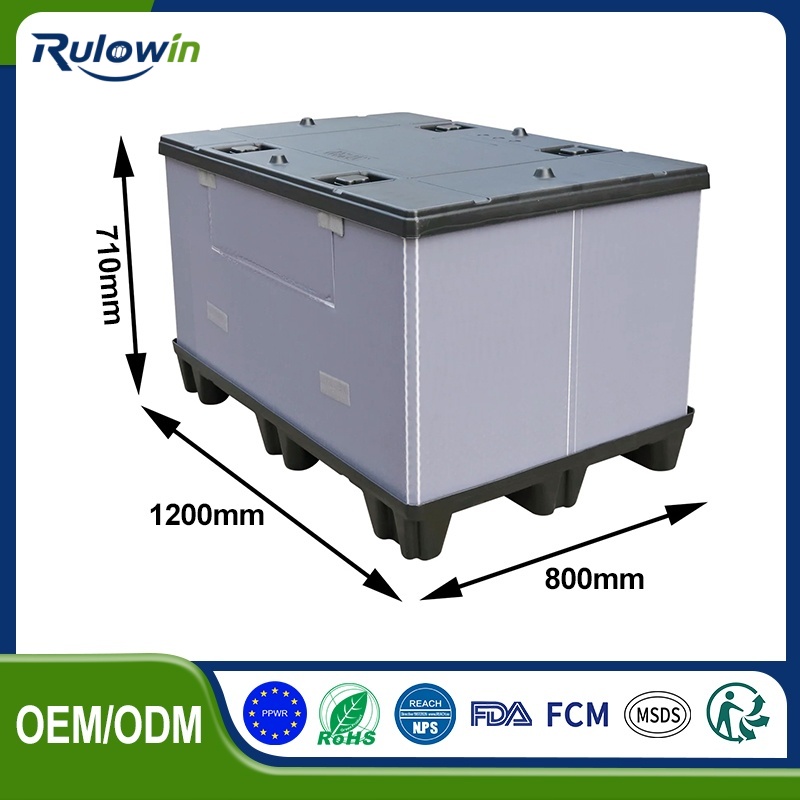
Loading a container with rigid returnable boxes is not the same job as loading it with cartons. Cartons deform slightly, which absorbs all the small tolerance errors in a load plan. Rigid boxes do not, so a plan that is twenty millimetres out either leaves a gap that lets the load shift or will not close at all. The load plan has to be right in a way that carton loading never required.
Tolerance is the whole problem
A carton load plan can be approximate because the material forgives it. A rigid box plan cannot. Work out the internal container dimensions – not the nominal ones, the measured ones, because containers vary – and lay the box footprint into them exactly, then check the total against the door aperture. Leave a deliberate gap at the door end and fill it with dunnage or an air bag, because a load tight to the doors is a load that will not close.
Weight versus cube, on the outbound leg
Boxes carrying machined parts are heavy, and a forty-foot container will reach its payload limit well before it is full of cube. That changes the plan: fill the floor area, cap the height by weight rather than by space, and do not stack higher than the weight distribution allows. Boxes carrying light assemblies are the opposite – they fill on cube and the stack height limit applies. Establish which regime you are in before planning the load.
Restraint for a rigid load
A rigid stack does not settle into a stable block the way cartons do; it stays as discrete columns that can walk. Three things hold it: strapping over the top of each stack to the container lashing points, dunnage or air bags in the void, and interlocking the boxes layer by layer. Interlocking is free and is the one that does the most work on a sea leg, where the motion is slow and sustained rather than a single impact.
Plan the return before the outbound
The container has to come back with empties, or the loop breaks, and that is a load plan in its own right. If the boxes nest or collapse, the empties fit in the same container as the next outbound load. If they do not, the return is a dedicated movement and it costs the same as a full outbound. Decide that before the first shipment rather than discovering it in month two – the calculation is the same as the one for the return leg on a collapsible container.
Container variation is larger than you think
Standard container internal dimensions are nominal, and the actual internal width of a forty-foot container varies by more than the tolerance most load plans assume. Damaged floor boards, a bowed wall, and floor repairs all change the usable envelope. A plan that works in one container leaves a gap or jams in the next.
Measure the actual container at the point of loading – internal width at three heights, internal length, and door aperture – and plan to the smallest figure. It takes five minutes with a tape and it removes the most common loading failure, which is a plan built on nominal dimensions that turns out to be twenty millimetres too wide at the point where it matters. Where a regular route uses the same containers repeatedly, record the measurements per container ID and the load plan becomes a one-off exercise rather than a per-shipment one.
What we can do
We supply PP corrugated turnover boxes in stacking, nesting and collapsible builds with stated dimensions, and we will lay a container load plan against measured internal dimensions rather than nominal ones. Send us the container type and the part weight and we will tell you whether you are cube-limited or weight-limited before you plan.