
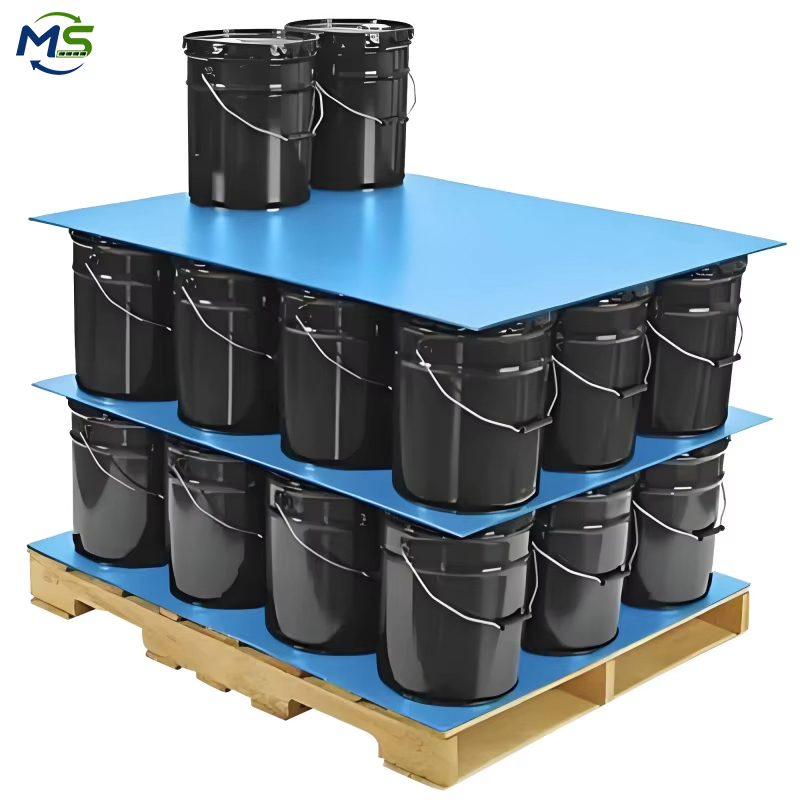
Returnable packaging programmes are usually justified on the container, and then quietly eroded by everything wrapped around it. Film, tape, strapping, pads, corner board and labels are all single-use, all recurring, and all now reportable in the EU. None of them appear in the business case.
Where the consumables sit
Between layers, around the load, over the top, and at the corners. Each does a job, and each is bought again on every shipment. Individually they are small line items; across a year and a fleet they are often comparable to a meaningful fraction of the packaging budget.
Which ones can go
Layer pads can be designed out where the box lid and base register against each other. Corner board can be designed out with a reinforced vertical edge. Stretch wrap is harder to remove but can usually be reduced substantially where the load is strapped or hooded instead. Tape is the easiest of all – a reusable closure removes it entirely.
Which ones should stay
Anything doing a job the box cannot. Where the load arrives at a point that the box below cannot spread, a pad earns its place. Where a strap would cut into a corner that cannot be reinforced, protection earns its place. The test is whether the box could be designed to do it instead, and whether that is worth tooling.
The reporting angle
Consumables are the visible part of packaging to a customer’s sustainability team, because they are what gets thrown away in the goods-in bay. Reducing them is a change the customer can see, which is a reason to prioritise it even where the financial saving is modest.
What to measure first
Weigh or count the consumables used per pallet for a week – film by weight, everything else by count. That gives a baseline that makes any reduction claim verifiable. Without it the programme is arguing from intention rather than evidence.
How to reduce them without breaking the load
Remove one consumable at a time and test the result on the real route. Film is usually the largest and the most reducible, particularly where a strap or a hood can carry part of the containment. Tape is usually the easiest to eliminate entirely.
Where removing something increases damage, put it back. The point is not austerity, it is paying only for what is doing work. A consumable that changes the arrival condition is worth its cost; one that does not is not.
Where the consumables are actually needed
Anything doing a job the box cannot: spreading a point load the base cannot spread, bridging a gap in a mixed layer, or containing a load the box features do not locate. In those positions a consumable earns its cost and removing it produces damage.
Everywhere else it is overhead. The distinction is worth making per component rather than in general, because the same item can be essential on one lane and useless on another.
The reporting angle
Consumables are the visible part of packaging to a customer’s sustainability team, because they are what gets thrown away in the goods-in bay. Reducing them is a change the customer can see, which is a reason to prioritise it even where the financial saving is modest.
What we can do
We build PP corrugated turnover boxes with registering lids, reinforced corners and reusable closures, which is where most consumables come off. Tell us what your pack currently uses. Where most of that is decided is in standardising the packing station.