
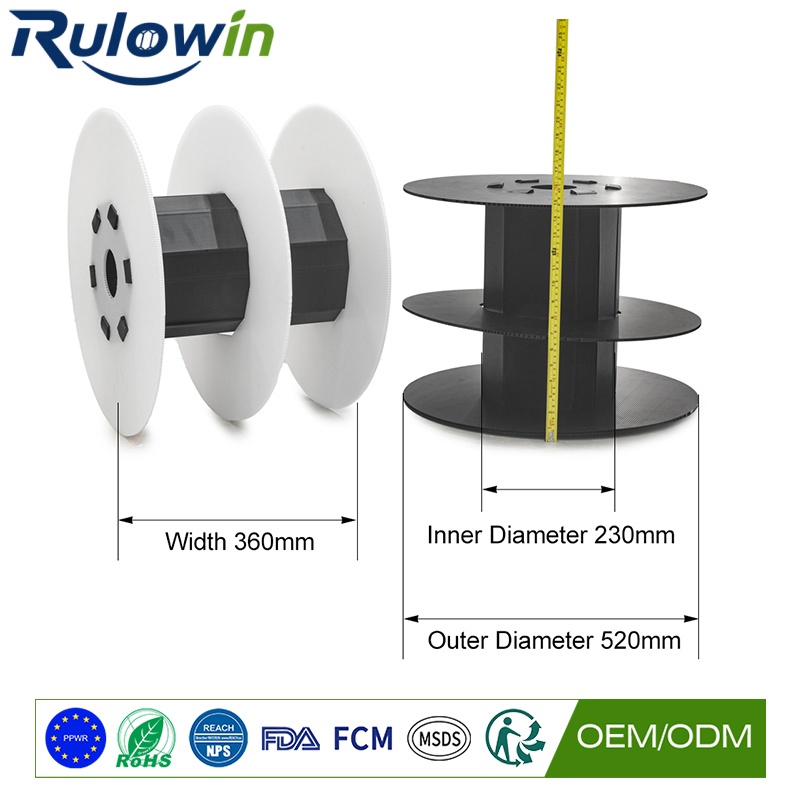
A yard of several hundred identical spools is an unmanaged yard. Somebody has to know which ones carry what, which are due back, and which belong to which customer — and if that knowledge lives in one person’s head or in a spreadsheet nobody updates, the fleet will drift.
Colour is the simplest fix and it mostly works. It needs no software, no training, no maintenance contract, and it is visible from across the yard. It also fails in predictable ways, and most of the failures are organisational rather than visual.
Four uses that earn their keep
Product family
One colour per product type means a mis-issued spool is obvious before it is loaded rather than after it is delivered. This is the highest-value use, and it works best when the same colour is on the label and on the rack or floor marking — three cues, one colour.
Ownership
In a shared or pooled arrangement, colour marks whose spools are whose. It sounds trivial until the day your spools go out on a customer’s return and come back mixed with somebody else’s.
Process state
Full, empty, quarantine, ready to ship. Keep it to three states at most — beyond that people stop distinguishing and the scheme becomes decoration.
Sensitivity or special handling
One reserved colour for anything that needs different treatment: conductive spools, product with a tight bend radius, customer-specific handling. A single, unusual colour is more effective than a subtle label.
Where colour schemes decay
- Substitution. A colour runs out, a plain grey spool gets used, and within a year the scheme is thirty per cent exceptions.
- Lighting. Colours shift under warm or dim light. Check the scheme under the actual lights, at the end of a shift.
- Colour vision. Around eight per cent of men have some deficiency, and red-green pairs are the worst offenders. Pair every colour with a position or a number so the scheme does not depend on hue alone.
- No owner. Somebody has to be responsible for the standard and for refusing substitutions. Without that, it erodes.
Practical notes on the material
Colour in polypropylene comes from masterbatch in the extrusion or moulding, so it is through the material rather than painted on. It does not scratch off and it does not need renewing. A few things worth knowing:
- Minimum order quantities apply per colour. Five colours means a larger commitment than one.
- Dark colours hide dirt, which is good for appearance and bad for spotting damage. A black spool with a hairline crack is harder to find than a light grey one with the same crack.
- Carbon black contributes UV resistance, so dark spools weather better outdoors for free.
Alternatives that outlast colour
Where the identification has to survive a long fleet life and repeated washing, moulded-in or embossed marks are more durable than any colour: a part number, an owner code, or a date stamp pressed into the flange. They cannot wear off and they cost nothing per unit after tooling.
The combination that works best in practice is colour for the at-a-glance sort and moulded marks for the permanent identity. Colour gets the spool to the right bay; the moulded number settles the argument.
Introducing it without a project
Start with one product family or one customer, not the whole fleet. Run it for a month, measure how many mis-issues it prevents, and let that number argue for the rest. Schemes that spread because they work survive; schemes that arrive by memo get quietly abandoned within a year.