
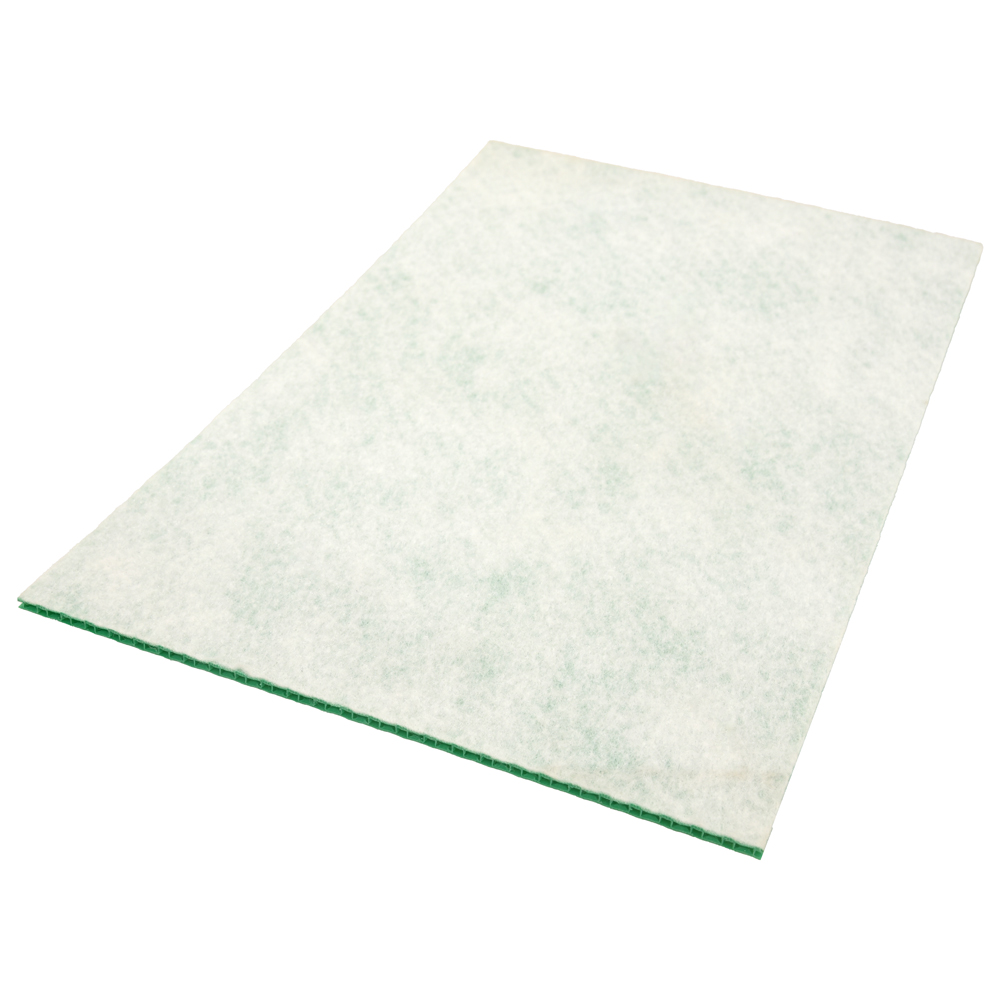
Colour is the most under-used feature of a protection specification. It costs nothing at manufacture for standard colours, and it does three jobs that otherwise need instructions, signage and supervision: identifying zones, marking phases, and showing which face of a two-face board is which.
Zone marking
Different colours for different risk areas – one for the client-facing route, one for the working area, one for the wet zone – lets everyone see where the higher specification is without reading a drawing. It also makes it obvious when protection has been moved out of the area it belongs to, which is otherwise invisible.
Phase marking
On a phased programme, a colour change per phase makes it easy to see which panels have been in place longest and are due for cleaning or replacement. It is a low-effort version of asset tracking and it works because it is visible to whoever happens to be walking past.
Face identification
The single highest-value use. A two-face board with a soft face and a grip face only works if it goes down the right way, and on a site where panels get lifted and put back by different people, that is not guaranteed. Different colours on the two faces make orientation obvious at a glance and remove the most common installation error.
What colour costs
Standard colours – grey, black, white, blue – usually cost nothing extra above a minimum run. A specific match is a production run with a minimum quantity and a premium. For zone coding, use the stock colours rather than matching a corporate palette; nobody on site needs an exact brand match on a floor panel.
Colour and heat
Worth noting: dark board on an external floor in direct sun gets hot enough to soften some finishes underneath and to be uncomfortable underfoot. Where board goes outside in summer, a light colour is worth specifying for that reason alone.
What the colours should mean
A colour scheme only works if it is consistent across the whole programme and, ideally, across the contractor’s other sites. Agree the meaning once and put it in the induction. A scheme that differs between phases is worse than no scheme, because people will assume they know what a colour means and will be wrong – which is the same argument made in labelling and colour coding protection zones.
Choosing a code that survives the job
A colour code only works if everyone on site learns it in a day. Four colours is about the limit; beyond that people stop distinguishing them. Assign colours by meaning rather than by trade – one colour for public routes, one for work zones, one for protected finished areas, one for quarantine or damaged panels – so the code stays valid when subcontractors change.
Stock colours are cheaper and available faster than matched ones, so it is worth designing the code around what is available rather than asking for a specific shade. Where a client has corporate colours, put them on a printed corner mark rather than asking for a custom panel colour across the order. Keep a note of which colour means what in the site induction pack, and keep a few spare panels of each colour for the zones that get re-cut most often.
What we can do
We supply PP honeycomb protection board in standard colours at no premium above minimum runs, including two-face boards with contrasting faces. Tell us how many zones or phases you need to distinguish and we will propose a set. Face orientation is explained in which face goes down on finished floors.