
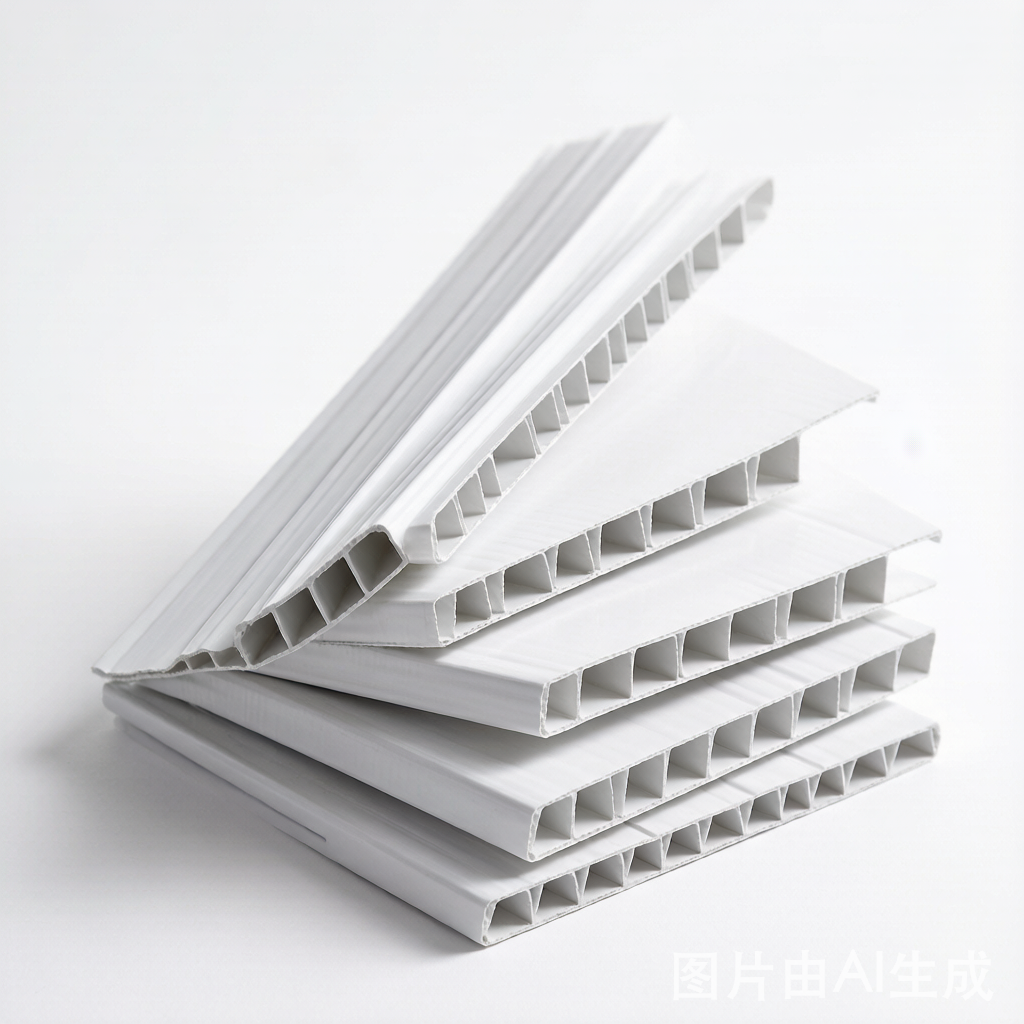
Two quotes for what looks like the same corrugated sheet can differ by a wide margin, and the cheaper one is usually cheaper for reasons that are visible if you know where to look. Sometimes the cheap sheet is the right buy. Often it is a thinner product wearing the same description.
Where the difference hides
Thickness. The most common one. A sheet sold as “4 mm” that measures 3.6 mm is meaningfully less stiff – stiffness goes up fast with thickness – and it will bow where the other does not. Take a caliper to samples. It takes seconds and it settles most of these arguments.
Grammage and resin. A sheet with high recycled or filled content can be denser and more brittle. It hits the same thickness at a lower cost and cracks sooner. There is nothing wrong with recycled content for the right application and it is not right for every one.
UV stabilisation. Cheap outdoor sheet without stabiliser chalks and embrittles within a season or two. Indoors, the additive is money spent for nothing. Knowing which you need is worth more than either choice made blindly.
When the cheap sheet is genuinely the right buy
Short-life applications. A one-way layer pad, a temporary floor protector, a job where the sheet is used once and discarded – buy the cheapest thing that survives the trip. Paying for durability you will not use is waste, and we say this to customers regularly.
Also: where the sheet is over-specified to begin with. A lot of sheet is bought at a thickness nobody justified.
When it is not
Anything load-bearing that gets reused, anything outdoors, and anything where a failure is expensive relative to the sheet. A layer pad that fails and damages a pallet of product costs more than the entire sheet order. Work the cost of one failure against the saving per sheet – on most export work, it is not close.
There is how to check corrugated sheet quality on a delivery for the practical version of this, including what to measure when the pallet arrives.
How to compare quotes properly
Ask for thickness in millimetres, grammage, resin description and whether UV stabiliser is included. Any supplier who can answer those four is comparable; any supplier who cannot is asking you to compare on price alone, which is how people end up with the wrong sheet twice.
Where the cheap sheet is genuinely better
Two cases, and both are common. Single-use applications – a one-way layer pad, a temporary floor cover, a protective sheet that goes in a skip after the job. Buying durability you will use once is waste.
And prototyping. If you are working out a design and expect to cut several versions, buy the cheapest sheet that behaves roughly right and save the good material for the final run. Sheet is easy to over-specify at the sample stage, and the samples are not the product.
In both cases, what you are buying is a price per sheet, and the cheap sheet genuinely is cheaper. The argument against it only applies where the sheet has to keep working.
What we can do
We supply PP corrugated sheet and quote with thickness, grammage and resin stated. Send us the application and we will tell you the cheapest specification that will do it – which is sometimes not our cheapest sheet and sometimes not ours at all.