
Foam dunnage works. It is soft, it conforms, and on the first trip it protects a painted or machined surface about as well as anything. The reason a lot of automotive supply chains moved away from it has almost nothing to do with the first trip.
What goes wrong with foam
It tears. Foam has low tear strength, and once a corner has gone the damage spreads. A tray that took six months to become shabby will then fall apart in about three weeks.
It sheds. Crumbled foam particles end up in the part, in the assembly area, and in the customer’s complaint. In a paint or electronics environment that is disqualifying on its own.
It absorbs. Oil, coolant, wash water. Once foam is wet it stays wet, and wet foam against a machined surface is a corrosion risk rather than a protection.
It cannot be cleaned credibly. You can wipe the surface. You cannot wash the inside.
What honeycomb changes
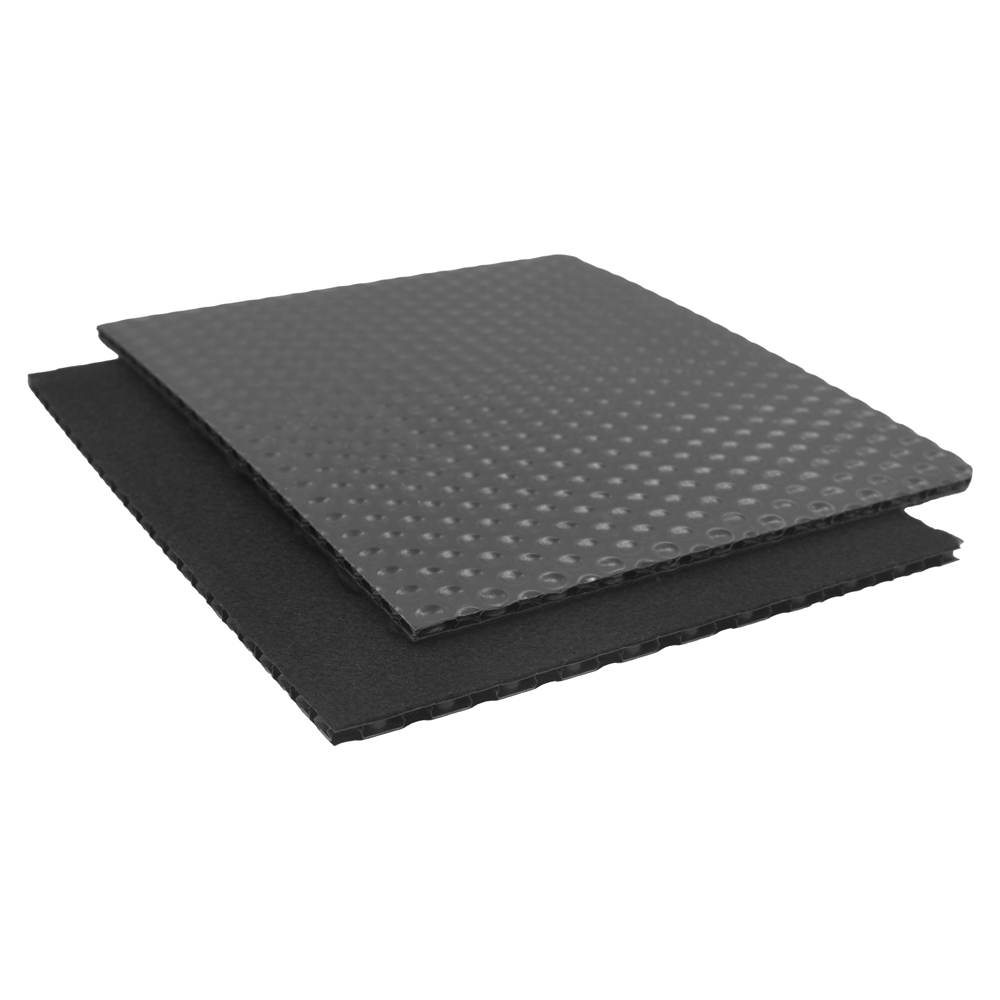
A PP honeycomb tray with a film or laminated facing has a hard, washable surface and a core that does not absorb. It does not shed, it can go through an industrial wash at temperature, and when it does eventually fail it fails locally – a damaged section – rather than progressively like foam.
That last point matters more than the rest. Predictable, local, visible damage can be managed. A tray that silently degrades cannot.
What you give up
Being honest about this is important, because it is where dunnage projects go wrong.
- Conformability. Foam cushions by deforming. Honeycomb does not, so the protection has to be designed – pockets, locators, clearance – rather than assumed.
- Vibration damping. Foam absorbs vibration well. Honeycomb transmits more of it. For sensitive assemblies you may need an isolating element in the design.
- Low tool cost. Cut foam is cheap to prototype. A thermoformed or welded honeycomb tray has tooling.
- Forgiveness of tolerance. A pocket cut to the nominal part dimension will be tight on a part at the top of its tolerance.
Where honeycomb is the wrong answer
One-off or very short runs, where tooling will never pay back. Very fragile parts where cushioning is the entire protection mechanism and geometry cannot be designed for. Applications where the tray is genuinely single-use. And anything involving a part with sharp edges that will saw through the facing film – in that case a wear strip needs designing in.
What actually drove the change
Mostly, trip count and cleanliness. Once a packaging loop runs more than about twenty trips, the foam cost per trip stops being competitive, and once a customer starts auditing for foreign material, foam is hard to defend. Those two things together moved the industry rather than any single performance advantage.
What the customer actually audits
When a customer inspection drives the change, it usually comes down to three things: foreign material, cleanliness, and whether the packaging is identifiable and in good condition. Foam struggles with all three once it has aged.
A tray that sheds particles is a finding. A tray that cannot be cleaned is a finding. A tray with no readable identification is a finding. These are dull, administrative reasons to change a packaging material, and in our experience they are more common than any performance argument.
If you are preparing for an audit, it is worth looking at your packaging the way an auditor will – walk the line, look at the oldest trays you can find, and ask what a visitor would write down. It is usually obvious.
What we do
We build honeycomb dunnage trays for repeated automotive loops, with welded or extruded edge treatment and facing films chosen for the part surface. If you are running foam now and wondering about the switch, the useful first question is your actual trip count – below about fifteen, the honest answer is usually to stay with foam.