
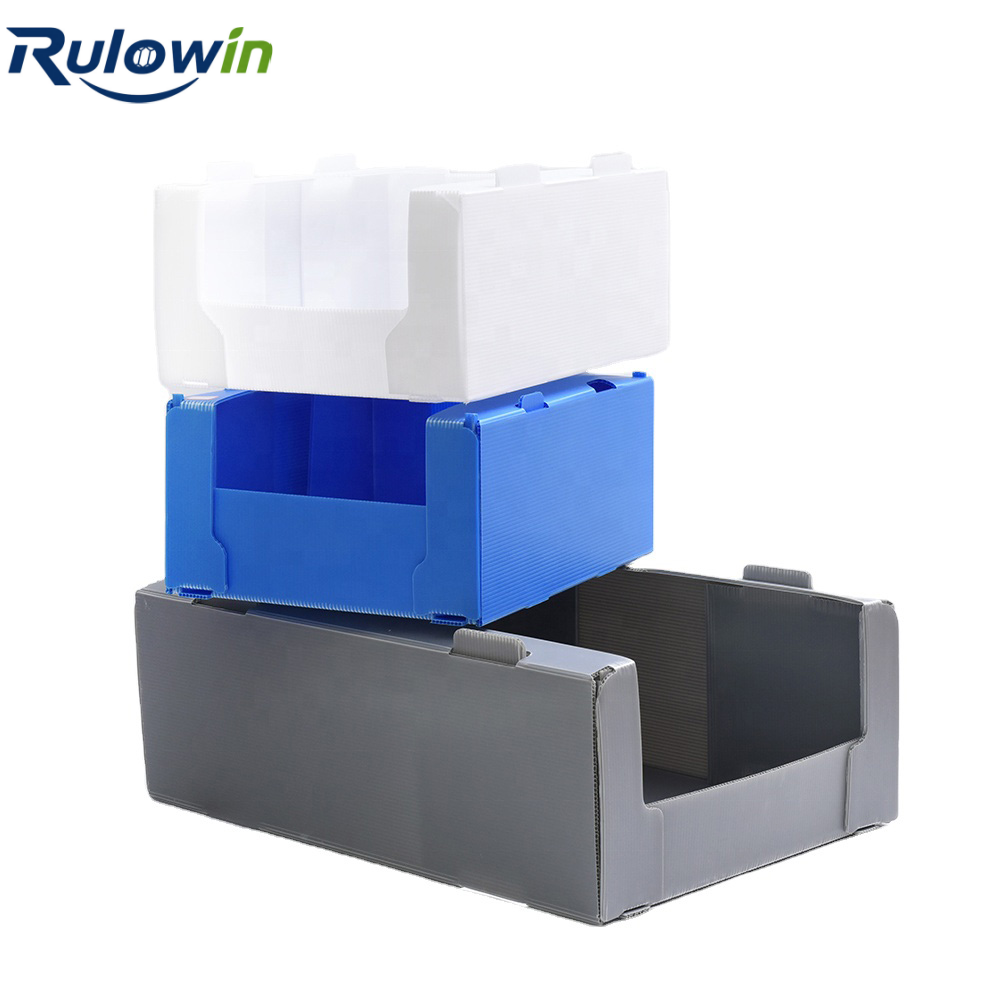
A picking container is defined by its opening as much as by its volume. The pick face – what the picker sees and can reach – determines whether a pick is a single movement or a search, and the difference across a shift is large. Most picking containers are specified for volume and for how they stack, and the opening is whatever the design happens to produce.
Reach depth is the hidden constraint
A container deep enough to hold a lot of parts is also deep enough that parts at the back are hard to reach. Beyond roughly an arm’s length, or beyond the point where the picker can see the bottom, the pick becomes a search and slows down. Where containers are deep, the usual adaptation is to tip them or to present them on a sloped stand, which recovers the reach at the cost of a stand and some capacity.
Drop-front and cut-down openings
A container with a lowered front – a drop-front or a cut-away – exposes the contents rather than the wall, and it converts a reach over an edge into a reach into an open tray. The capacity cost is small, because the container is usually not filled to the top, and the rate benefit is real. Where picking is manual and the container sits on a shelf or a cart, a drop front is the single most effective change available.
Sightline to the contents
A picker who can see the contents picks faster than one who has to feel for them, and the sightline is blocked by the container wall, by the container in front, and by the shelf above. Where containers sit on shelves, a low container with an open front is visible from a standing position; a tall one with a full-height wall is not. That is an argument for lower containers at the pick face even where taller ones would hold more.
Two-handed and one-handed picks
A pick that needs two hands – one to hold the container, one to take the part – is slower and more tiring than a one-handed pick. A container stable enough to be picked from one-handed, either because it is heavy enough not to move or because it is located in a stand, removes half the movement. Where a container is light and unrestrained, it slides or tips, and the picker stabilises it on every pick.
Where the container sits relative to the picker
At waist height, a container is picked from above and the depth matters. At chest height, it is picked from the front and the opening matters. On the floor, it is picked from above at a distance and both matter. Where a pick face is being laid out, the height of the presentation changes which container feature is critical, and the container should be chosen after the height is fixed rather than before.
How dividers change the pick
A divided container makes each pick unambiguous, which is faster, and reduces the space per line, which is slower when a line is bulky. Where line counts are high and lines are small, division speeds the pick. Where lines are large, it slows it. The same container is right for one operation and wrong for the other, which is why a mixed operation usually needs both. See matching capacity to order line count.
Measuring it
Time twenty picks from the current container and twenty from a candidate, with the same picker, and note any hesitation or repositioning. The difference is usually visible immediately and it does not need a trial to confirm. Where a candidate container is faster but holds less, the trade is pick rate against replenishment frequency, and both can be costed. The station side of the same decision is in pick faces built from turnover boxes.