
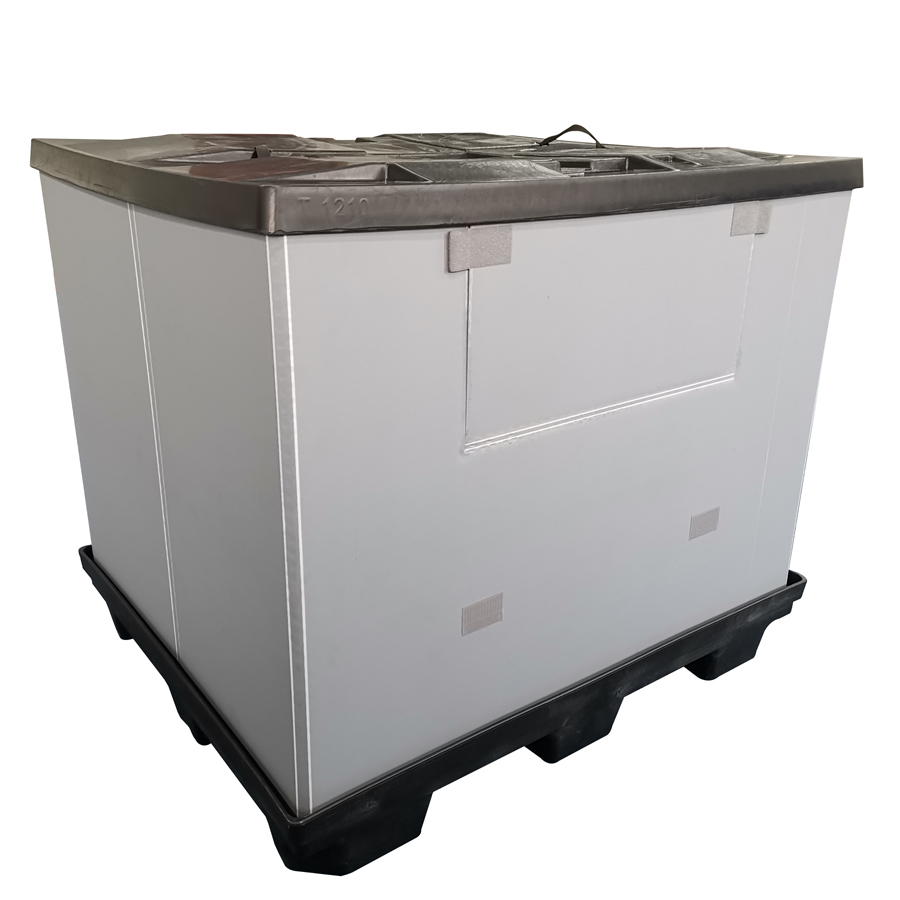
A shuttle-based storage system moves containers on rails inside a rack and transfers them with a compact lifting mechanism. The loads are modest and the containers are rarely close to their strength limit. What they are close to is their stiffness limit: the mechanism expects the box to hold its shape while it is supported at a few points and moved quickly, and a base that sags by a few millimetres is enough to cause a fault.
Support at points, not across the surface
A shuttle carrier typically contacts the load at two rails or a small number of pads. Between them the base spans, and the span is a fixed property of the carrier. A base designed to sit flat on a floor or a pallet has never had to span that distance and will sag under load by an amount that depends on the board or moulding stiffness. The sag matters because the lift mechanism has a small vertical travel, and a sagging base effectively shortens the box in a way the mechanism does not expect.
What sag does to the transfer
During a transfer the box is lifted, moved horizontally, and set down. If the base is sagging, the lowest point of the box is lower than nominal, and it can contact the rail or the shelf during the horizontal move. The contact is usually light, which is why it produces a fault rather than damage: the mechanism senses resistance and stops. The intermittent nature of it – worse with heavy loads, worse with warm boxes – is what makes it hard to attribute to the container rather than the machine.
Stiffness versus strength in a corrugated base
A corrugated PP base gains stiffness from the flute direction and from any perimeter structure. Increasing board weight raises both strength and stiffness, but the stiffness gain per unit of weight is much better if the perimeter is reinforced than if the whole panel is thickened. Where a container is being specified for a shuttle, the base detail is worth more attention than the board weight, and it is a cheaper change.
Temperature is the multiplier
PP loses stiffness as it warms. A box that spans acceptably at twenty degrees may sag noticeably at forty, and a high-bay building in summer can reach that. Where the specification is written from a test at ambient temperature, the summer case is untested, and the faults appear seasonally. Testing at the highest temperature the load will see is the only way to know, and it is a half-day exercise.
What a stiff base costs
Usually a small amount of weight and a small amount of money, and occasionally a change to the stacking geometry. Where the alternative is a wider slot clearance across an entire installation, or a slower shuttle cycle to reduce dynamic effects, the stiff base is by far the cheaper option. This is the same trade as in whether an existing box can run on automation, and it usually resolves the same way.
How to test it at home
Support the loaded box on two rails at the carrier spacing, leave it for an hour, and measure the deflection at the middle of the span. Then measure again after twenty-four hours, because creep continues. A deflection that keeps growing means the box will not hold geometry in service, and the number to watch is not the first reading but the second. Where the twenty-four hour figure is more than about twice the one-hour figure, the box is creeping and will cause trouble.
What to specify
Carrier support spacing, working load, maximum service temperature, and the allowable deflection. The first three come from the installation; the fourth is a design decision and it is what the container supplier needs. Given all four, a base can be specified that holds geometry for the life of the container rather than for the first month.