
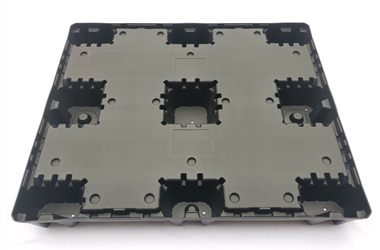
An automated storage and retrieval system is built around a grid of slots, and each slot is a fixed envelope with a small clearance around the load. The machine does not negotiate with that envelope: a load either goes in and comes out, or it does not, and when it does not, the fault usually stops the aisle. That makes container dimensional consistency worth more in an ASRS than anywhere else in a plant, and it makes the worst-case box the one that matters.
Clearance is small and every millimetre is contested
Slot clearance is set to make the grid dense, because density is the whole point of high-bay storage. Typical clearance is tens of millimetres in total, and it has to absorb the box tolerance, the machine’s positioning accuracy, any load deflection, and the rack’s own tolerance. Adding a loose container tolerance to that budget either forces the clearance up – which costs storage capacity across the whole installation – or produces intermittent faults. The first is expensive and invisible; the second is visible and worse.
The worst box, not the average box
A fleet of containers has a distribution, and the machine meets all of it. A box at the top of the tolerance range will go in; whether it comes out is a separate question, because extraction depends on the load lifting clear before it travels, and a tight box may not. Where a fleet is bought to a tolerance rather than to a nominal size, the specification conversation is about the distribution’s edge, and suppliers who quote only nominal are not answering the question that was asked.
Deflection under the extract cycle
A load being lifted from a slot is briefly supported differently from one at rest, and a base that deflects will sag into whatever clearance exists below it. Where the clearance is tight, that sag can be enough to prevent the lift completing, and the machine reports a fault it cannot explain. The same box sitting in the slot looks fine. This is the classic intermittent ASRS fault, and the container base stiffness is the usual cause rather than the machine.
Growth in service
Containers grow. A box stored loaded for months, or washed hot and cooled quickly, or simply used for a year in a warm building, takes a permanent set that is small in absolute terms and large relative to a slot clearance. Where a fleet has run in a system for a year without trouble and then starts faulting, measuring twenty boxes is the fastest diagnostic and it usually finds the answer. The wider point about drift is covered in the pre-automation box audit.
Height is the dimension that surprises people
Width and depth are checked against the slot and usually fit. Height is checked against the slot and often fits too – until someone stacks boxes two high inside a load, or a lid sits proud, or a box is placed on top of a divider. The machine has no way to detect an over-height load before it tries to store it, and the result is a collision at the top of the rack. Where loads are built by hand, a physical gauge at the build station is cheaper than any amount of machine-side detection.
What to ask for in the container specification
A tolerance held across the fleet, at temperature, after a defined period under load. Not a nominal dimension and not a drawing without tolerances. Where a supplier will not quote a held tolerance, the assumption should be that the distribution is wider than the machine can absorb, and either the clearance has to increase or the fleet has to be measured and sorted on arrival. Sorting is tedious and it works.
Commissioning with the real fleet
Test the system with the boxes that will run in it, including the oldest ones in the fleet, at the temperature the building will actually reach, with the loads that will actually be carried. A commissioning run using new boxes at ambient temperature in a half-empty building tells you very little about year two. Send us the slot envelope and we will tell you which of our containers hold a tolerance inside it. The general requirement behind it is set out in the dimensional tolerance automation demands.