
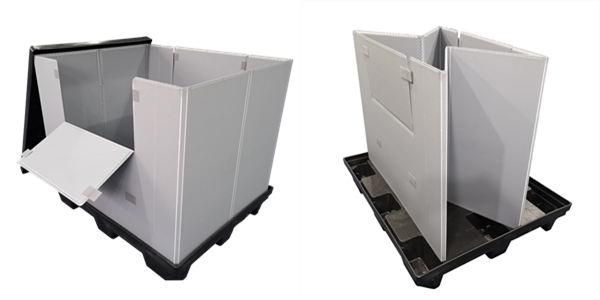
Identification on a reusable container has to be read by whoever or whatever needs it, and in an automated environment that is usually a fixed reader at a known height and a known approach direction. A label positioned where a human finds it convenient is frequently in a place the reader cannot see. Choosing the face deliberately, and then keeping it consistent across the fleet, is most of the work in making automated identification reliable.
Readers are fixed, boxes are not
A scanner on a conveyor is mounted at a particular height, pointing in a particular direction, and it sees whatever passes through its field. A box can arrive in any orientation unless the line constrains it, and even a constrained line usually allows two. Where identification has to be read with certainty, the container needs the identifier on more than one face, or the line needs an orienting feature, and the first is usually cheaper than the second.
The vertical faces are the useful ones
Top faces are read from above, which works on a conveyor with an overhead scanner and fails on a stack, in a rack, or on a vehicle deck where the top of the load is not the top of the box. Vertical faces – the ends and sides – are visible in racking, on decks, at bench height and on a conveyor with a side-mounted reader. Where only one face can carry the identifier, an end is usually the better choice, because ends are presented at transfers and at rack positions more consistently than sides.
Where not to put it
Not on a surface that slides against a guide rail, which is the fastest way to destroy a label. Not on the base, which is where the conveyor, the rollers and the deck all make contact. Not on a curved or heavily ribbed area, where a barcode will not sit flat and a reader will not get a clean return. And not so low that a stacked box hides it, or so high that a lid or a band covers it. Each of those is obvious in hindsight and each one is common in practice.
How many faces
Two opposed faces cover a conveyor where boxes can arrive in either of two orientations. Four faces cover an environment where boxes are placed by hand and arrive any way at all. One face only works where the orientation is mechanically guaranteed – a dedicated line with a single loading arrangement, or a vehicle that always picks the same way. The cost of additional labels is small; the cost of a missed read at a sorting junction is not. More on read reliability in why scanners miss boxes.
Label, plate, or moulded feature
An adhesive label is cheap and replaceable, and it is the right choice where the identifier changes – a container assigned to a lane for a season, for example. An engraved or moulded plate is permanent and survives washing, and it is right where the identifier belongs to the container for its whole life. A printed mark directly on the box is cheapest of all and wears fastest. The choice depends on whether the identifier belongs to the container or to the trip, and mixing the two on one fleet is the usual source of confusion.
Washing and chemicals
Containers that get washed will destroy the wrong label quickly. Hot water, detergent and the mechanical action of a wash tunnel remove adhesive labels unless they are specified for it, and a label that survives three washes and fails on the fourth produces exactly the intermittent read failure that is hardest to diagnose. Where containers are washed, the identifier has to be specified for the wash process, not for the dry handling process.
What to decide before ordering
The reader type and its approach direction, whether orientation is constrained, whether the container is washed, and whether the identifier belongs to the container or the trip. Four questions with short answers, and they determine face, method and material. Where they are answered after delivery, the usual outcome is a second labelling operation bolted onto a fleet that was never designed for it.