
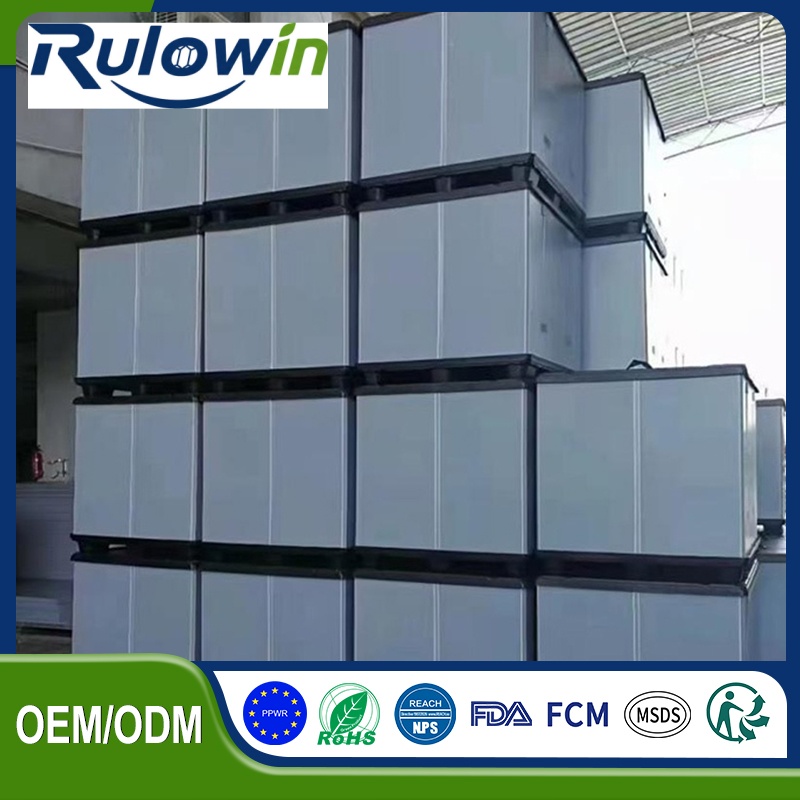
Every plant that moves oily or dusty parts has to decide what happens to the box between trips. Three answers exist: nothing, wipe it, or wash it in a machine. The choice is often made by accident, based on which of the three is easiest to start, and it sets the whole economics of the fleet.
What actually needs removing
Swarth, cutting fluid, dust, and whatever the part leaves behind on the dunnage. For most parts environments the requirement is appearance and cleanliness rather than hygiene, which means a wipe is sufficient nine times out of ten. Where the residue is hazardous or the route is regulated, a validated method is needed and the wipe is not adequate. Deciding which of those two situations you are in is the first step and it is frequently skipped.
Wipe, wash or dry steam
A manual wipe costs minutes of labour per box and is variable. A wash tunnel costs capital and volume and is consistent. Dry steam sits between them and is popular because it leaves no water to dry. In a plant running a few hundred boxes a week, manual wipe is almost always the cheapest, provided the box is designed so a wipe reaches the surfaces that matter.
The design decisions that make wiping work
No blind holes, no deep grooves, no unsealed double walls, and no fixed internal fixture with inaccessible cavities. A box that can be wiped in a minute is a box that gets wiped. A box that needs brushes and dismantling is a box that gets a hose pointed at it and put back into service wet.
What water does to a box that is not designed for it
Water in an open honeycomb edge soaks in and stays. That introduces weight, and in a cold store it introduces ice. Repeated wetting and drying also works on the edge seal and eventually breaks it, at which point moisture has a route into the core. If a route washes, edges have to be sealed and the base has to drain. This is the same edge-sealing question that decides how a box wall is built.
Drying, and the fleet size it costs you
A box that takes four hours to dry is out of service for four hours, which the fleet has to cover. That is usually the largest hidden cost of choosing a wash, larger than the labour or the detergent. Airflow, drainage and a warm drying position shorten it; a closed box in a cold corner never dries at all.
Dunnage and the water it holds
Foam and felt hold water and dry slowly, and a damp facing is the part that touches the product. Where a route washes, dunnage materials should be closed-cell or removable for separate cleaning. A removable set that dries on a rack is faster than a fixed set that has to dry inside the box.
Keeping the wash out of the loop where it is not needed
Washing everything because one part number needs it adds cost to the whole fleet. Segregating the dirty loops and cleaning only those boxes keeps the cleaning cost proportional to the problem. It also keeps the clean wash capacity available when it is actually needed.
Working out what a wipe actually costs
Time one box being wiped properly, multiply by the number of boxes a week, and put the labour rate against it. In most plants the answer is small and the answer for washing is larger than expected once drying space and dead time are counted. Having both numbers makes the choice straightforward and stops the argument being about hygiene preference.
Where the residue is light, a dry wipe at the point of unloading is nearly free because the operator is there anyway. Wiping a box somewhere else later costs a walk, and the walk is usually larger than the wipe. Positioning the cleaning point at the unloading point is the cheapest change available.
What we can do
We build PP honeycomb board boxes with sealed edges, drainage and removable internal sets for routes that have to be washed, and we will tell you honestly when a wipe is enough. Send us the residue, the frequency and the space you have for drying.