
When a heavy box fails, the walls are usually still standing. What has happened is at the bottom: a bearer has crushed, a corner has folded, or the deck has deflected enough that the part now rests on the base rather than on its dunnage. The base is the least visible part of the design and the part that decides the service life.
Where the load actually goes
In a stacked box the vertical load arrives at four corner posts and travels down them into the base. In a loaded box on a forklift the load reverses: the forks bear on two tunnels, and the deck has to span between them carrying everything above. Those are two different load cases and a base that is only designed for one of them will fail the other. Ask any supplier to state both.
Forklift tunnels are a stress concentrator
A fork tunnel is a hole in the stiffest part of the structure. When the forks enter at an angle, or when the load is sitting unevenly, one tunnel edge takes a share of the load it was not designed for. That is why tunnel edges should be doubled, and why the tunnel height should leave clearance rather than fit the fork snugly. A snug tunnel looks precise and guarantees damage the first time a driver lifts at an angle.
Bearers, runners and the difference between them
A runner spreads load along the length of the base. A bearer concentrates it at a point. Bases built with three runners and no cross bracing are common and mostly fine, until the box is set down on a drain or a floor joint and the middle runner is unsupported. Adding a cross member that only functions when the floor is uneven is cheap at the design stage and impossible to retrofit.
Point loads inside the box
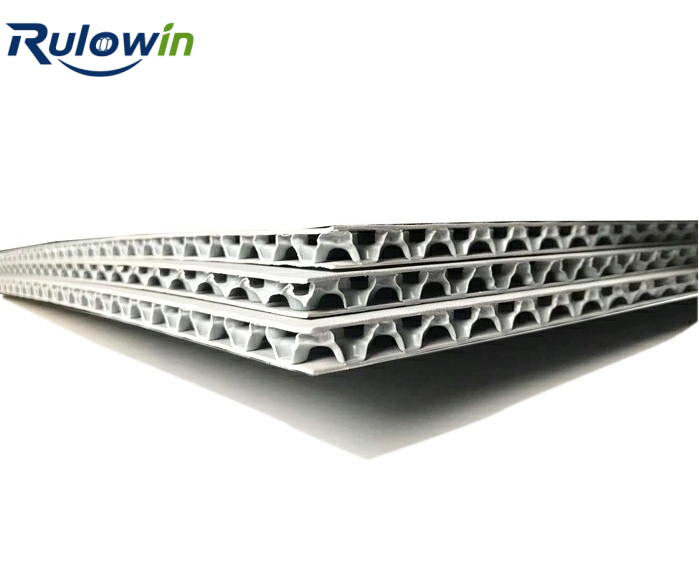
A machined casting puts its weight through a small contact area. A honeycomb board box can carry that, but not through the base panel alone. The load needs to arrive on a pad, a rail or a shaped cradle that spreads it across at least a few cells, and the pad needs to be part of the box rather than something the operator is trusted to place. Operators forget; fixtures do not.
Designing for an uneven floor
Concrete is never as flat as the drawing. A box that is designed to sit perfectly flat on all its runners will rock in one bay and be fine in the next, and rocking is what starts corner failures. Three-point support is impractical for a square box, so the practical answer is a base that tolerates a small unsupported span without deflecting into the part. That usually means a thicker deck or a small increase in runner depth, not a heavier wall.
How to check a base before buying a fleet
Load one box to its rated weight, put it on a pallet with one runner deliberately overhanging, and leave it for a week. Then lift it, set it down hard twice, and load another box on top. If the deck has not taken a set and the tunnels are intact, the base is honest. This test costs a week and one box, and it catches most of the designs that would have failed in service.
Matching the base to the part rather than the catalogue
The base is where the part and the container meet, and it is the reason a box bought to a size list is usually heavier and more awkward than it needs to be. Designing the base around the part lets the walls get thinner, which is where the weight saving comes from. The same principle runs through wall construction in a honeycomb turnover box.
What we can do
We build PP honeycomb board boxes with the base sized to the load rather than to a standard figure, including steel or timber bases where the deck load justifies it. Send us the part weight, the footprint and how it is lifted, and we will tell you what the base has to do.