
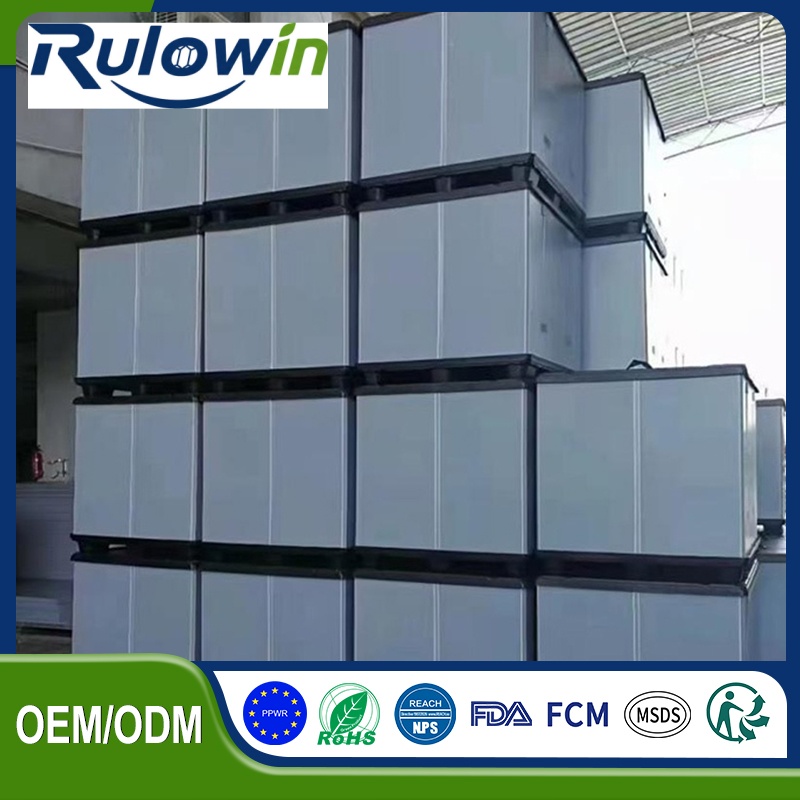
Trim panels, ducting, hose coils, mouldings, textiles – large parts that weigh very little. These break the usual packaging logic, because they fill a vehicle on volume while carrying almost no weight, and a box sized for them is large, floppy and expensive per unit. The design problem is stiffness at low weight, and the commercial problem is cost per cubic metre carried.
Stiffness at large size is the design problem
A 900 mm box with a thin wall and a light load will not hold its shape when lifted. It bows, the contents shift, and it stops locating in a stack. The answers are a rim that stiffens the top edge, a slight taper that lets empties nest, and – where the size really is large – a heavier wall on the base and rim only rather than across the whole box. Stiffening the perimeter rather than the panel is the cheapest way to get a large box to behave.
Nesting matters more here than anywhere
Large boxes take a large volume of empties, so a large box that does not nest or collapse imposes a serious return cost. Tapered walls cost a little usable volume and buy a three-to-one or better return ratio, which on a large box is worth far more than the volume lost. For anything above about 600 mm in its largest dimension, nesting is not optional.
Handling a big empty box
A large empty box is awkward: it is light, it has a lot of surface area, and it catches the wind in a yard. Two details help. Hand holes positioned so two people can carry it without it flexing, and a low stack height for empties so a stack of large empties does not become a sail. Where empties are stored outdoors, a lid or an inverted stack keeps them from filling with rain.
Cost per cubic metre, not per box
Large boxes look expensive on unit price and are often the cheapest option per unit of product carried. Compare on cost per cubic metre of usable volume, or better, on cost per part carried per trip. A large box carrying twenty parts in one movement beats five small boxes carrying four each, on handling as well as on price, and the comparison should be made on that basis rather than on the invoice line.
Storing large empties is its own problem
A large box is easy to use and awkward to store empty. A stack of large empties occupies a great deal of floor area for very little contained value, catches air in a yard, and fills with rain if it is stored outside. Plants routinely underestimate the space a large-box fleet needs for empties, and the result is empties stored somewhere inconvenient, which slows the loop.
Nesting helps and collapsing helps more. Where boxes cannot collapse, store empties nested and inverted so they cannot collect water, and store them at the point of use rather than in a central store – a large empty box takes more space than it is worth transporting to a store and back. Where empties have to be outdoors, a simple cover over the stack costs very little and prevents the rain collection that otherwise turns a stack of empties into a stack that has to be dried before use.
When the right answer is a sleeve or a stillage
Above a certain size a box stops being the right container. Where the part is large, light and stackable – panels, sheet, trim – a pallet sleeve system usually beats a big box, because the sleeve size can follow the load height rather than being fixed, and the collapsed return ratio is far better than any large box achieves. Where the part is large and heavy, a steel stillage is the right answer and a large plastic box is the wrong one.
The crossover is roughly where the largest dimension exceeds about a metre and the load is low density: at that point the sleeve wins on return volume and on flexibility. Below it, a large box is simpler and cheaper to manage. Where a plant has both categories, the fleet should include both types rather than forcing one – the operational cost of using the wrong container at that scale is larger than the cost of carrying two types.
What we can do
We build PP corrugated boxes at large sizes with stiffened rims and tapered walls for nesting, and we will quote cost per part carried rather than cost per box. Send us the part envelope and the parts per trip and we will tell you what the volume actually costs – including where a bespoke size beats a standard one, which is covered in sizing a box to the part rather than the pallet.