
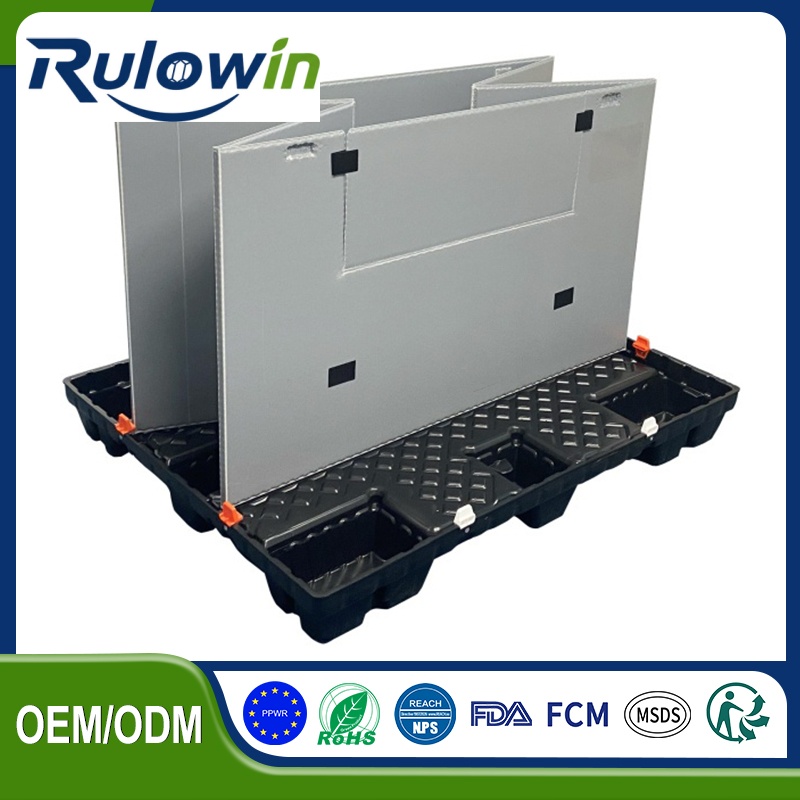
The roughest duty a box sees is rarely the truck. It is a loaded trolley being pushed over a threshold, up a ramp and across a mezzanine deck, because that combines vibration, tilt, point impact and a stack that is not restrained. Boxes specified for palletised transport routinely fail on that route, and the failure is a stack that walks apart.
Restraint beats stacking strength
On a moving trolley, nothing holds the stack together except the boxes locating on each other. Two things help: a rim that positively locates the box above rather than a flat top that lets it slide, and a lid on the top box to stop the contents bouncing out. If the trolley has sides, use them – a stack against a solid side survives a threshold crossing that an unrestrained one does not.
Ramps and thresholds are the impact events
A trolley crossing a threshold puts a vertical impulse through the whole stack, and the bottom box takes all of it. Slow down, or fit larger wheels, or move the threshold – the box cannot be specified for an impact that large at any reasonable cost. On a ramp, tilt the load back rather than forward, because a stack leaning into the direction of travel will stay together and a stack leaning away will separate at the top.
Height versus the route
Set the stack height by the route, not by the box rating. If the route includes a ramp, a lift, a door threshold and a mezzanine deck joint, cap the stack at three high and take more trolley runs. A four-high stack that arrives intact nine times out of ten is worse than a three-high stack that always arrives, because the tenth time costs more than the extra runs.
Grip when hands are full
On a mezzanine the operator is often carrying the box rather than pushing a trolley, which is where handle construction earns its cost: a reinforced opening that tolerates one-handed lifting, on the short end, with enough clearance for a gloved hand. Where boxes are moved up a mezzanine stair by hand, reconsider – it is a manual handling issue before it is a packaging one. Automated handling has its own requirements, covered in what a box has to do for robots and AGVs.
Trolley specification is part of the answer
A box stack on a trolley is only as stable as the trolley. Three features matter more than anything on the box: wheel diameter, deck condition, and whether there is any lateral restraint. Small hard wheels turn every floor joint into an impact event; larger, slightly softer wheels remove most of it. A deck with a lip or a low side contains the bottom box. And a trolley with no restraint at all asks the stack to hold itself together through a corner, which rigid boxes will do for a while and then will not.
All three are cheap at the point of purchase and effectively impossible to retrofit later. If boxes are going to travel on trolleys as a matter of routine, specify the trolley with the box: wheel size above about 150 millimetres for a plant floor with joints, a lipped or sided deck, and a strap or a bar across the top of the load. It costs less than the boxes it protects.
Lifts, and the pause that causes the damage
Where a trolley route includes a goods lift, the damage happens in the pause rather than in the movement: a loaded trolley standing in a lift while somebody finds a key, or a stack waiting at a lift door on a mezzanine with nothing restraining it. Most stack collapses on these routes happen to a stationary load, not a moving one.
The mitigations are mundane and effective. Do not leave a loaded trolley unattended in a lift lobby. Keep the stack low enough that a nudge does not topple it – three high on a trolley is the practical cap even where the box rating allows more. And if the route has a wait, build the wait in: a marked holding position with a barrier, rather than a trolley parked wherever the lift was slow.
What we can do
We build PP corrugated turnover boxes with locating rims and reinforced handles for trolley and mezzanine routes, and we will ask what the route looks like before quoting a stack height. Tell us about the thresholds and the ramp and we will cap the height for your route rather than for a test bench.