
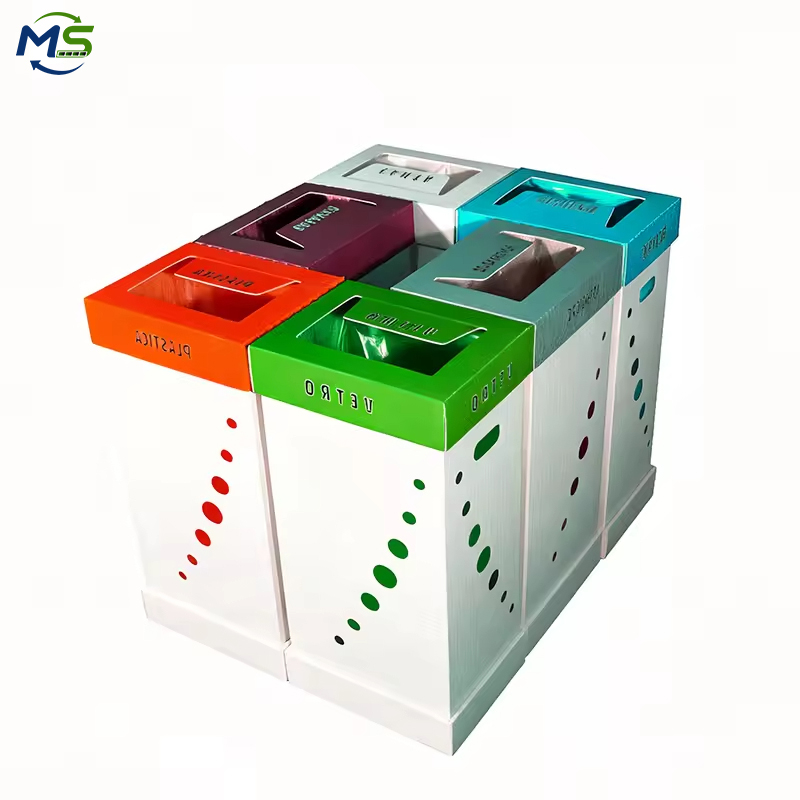
A box in a machining environment gets the worst combination a container can face: liquid contamination, sharp solid contamination, and parts heavy enough to punch. Polypropylene handles the chemistry comfortably. What needs designing for is the swarf, because sharp metal in a box does more damage than any chemical in it.
Chemistry: PP is largely indifferent
PP corrugated board is unaffected by water-based coolants, by mineral oils and by most greases at ambient temperature. It is attacked by some solvents and by strong oxidising acids, so if the process uses anything beyond coolant and oil, check the specific chemical. For the overwhelming majority of machining applications the chemical question has a boring answer and the mechanical one does not.
Swarf is a puncture and an abrasion problem
Sharp chips punch into a wall under load and abrade the base every time the box is slid. Two mitigations: a base pad – a loose corrugated PP sheet that takes the abrasion and is replaced for pennies – and a wall thickness set by the sharpest part rather than the heaviest. If swarf is heavy and persistent, separate it from the box entirely with a swarf tray below the parts rather than trying to make the box survive it.
Containment versus drainage
There is a genuine conflict here. Draining coolant out of a box is good. Draining coolant, oil and swarf out onto a bench, a trolley and a floor is not. If the contaminant is oil rather than coolant, do not drain – contain. Specify a solid base with no drainage and a sump that can be emptied at a wash station, and accept the extra wash step. Draining water is right; draining oil is a housekeeping problem.
Cleanability is a design feature
Square internal corners hold swarf; radiused corners do not. A smooth interior base with no ribs or fixings washes clean; a ribbed base with rivets does not. If the box will be washed, specify the interior for cleaning – rounded internal corners, no internal fixings, and a surface finish that releases rather than holds. The same cleanability logic applies for washing returnable produce boxes.
Specifying for a mixed fleet is a mistake
Most plants have one box fleet and several contamination regimes: dry assembly parts, oiled machined parts, washed parts, and occasionally something chemically aggressive. Specifying one box for all of them means specifying for the worst case, and paying for it across the whole fleet. Specifying several boxes means managing several fleets, which is worse.
The workable answer is one box and a range of consumables: a base pad for abrasion, a tray for oil containment, a liner for the aggressive process. The box stays standard and the consumable absorbs the difference, which keeps the fleet interchangeable while letting each regime get what it needs. Consumables are cheap, replaceable and can be changed when a process changes without touching the boxes. It is the same logic as standardising the box and varying the insert, and it is the single most useful structural decision in a mixed plant.
Where a metal box is the right answer
There is a point at which plastic stops being the right material. Heavy sharp scrap, red-hot parts, parts coming straight out of a heat treatment or a welding cell, and anything above about a hundred degrees will destroy a polypropylene box quickly. At that point the answer is a steel box or a stillage, and it is worth saying so rather than selling a plastic box into an application that will consume it.
The judgement is about temperature and edge sharpness rather than about weight. Plastic carries heavy loads perfectly well. What it does not carry is heat, and what it does not survive is a continuous abrasive stream of sharp metal at temperature. Where a plant has a small number of such applications, the right structure is a plastic fleet for the bulk of the work and a small number of steel containers for the hot and sharp exceptions, rather than one material across everything.
What we can do
We build PP corrugated boxes for machining service, with base pads, radiused interiors and either drainage or containment depending on what the contaminant is. Tell us what is in the box at the end of a shift and we will specify for that, not for a generic duty rating.