
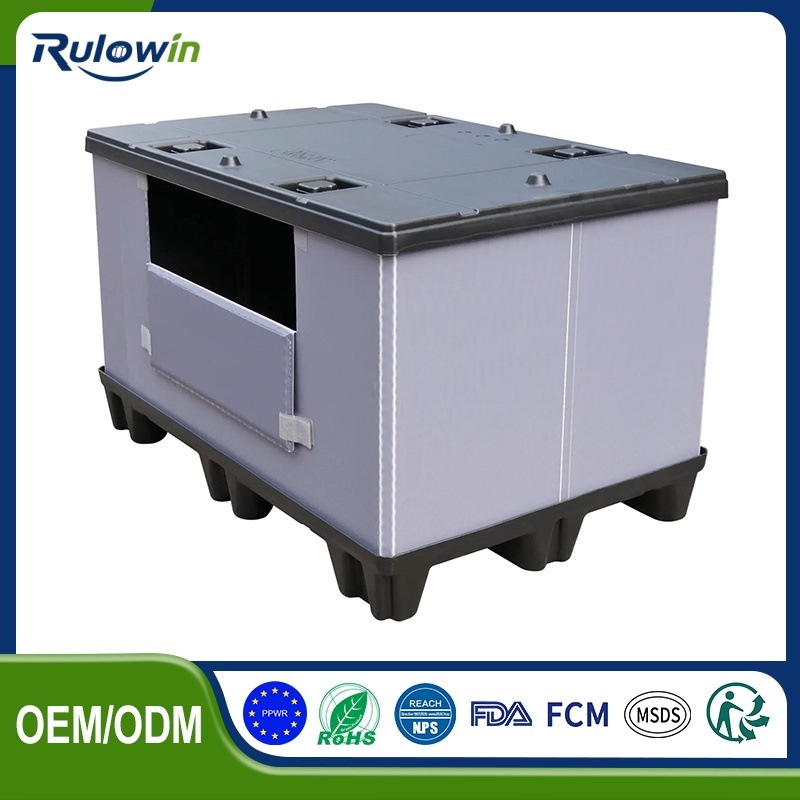
Boxes do not announce their own retirement. They keep being used, slightly deformed, stacking slightly worse, until one leans and a stack comes down. Written retirement criteria, checked at one point in the loop, are the cheapest safety and quality measure in a returnable scheme, and almost nobody has them.
Four criteria, all visible
Base corner cracked or split at any length. Hand hole torn through to the wall. Rim deformed enough that the box above does not locate – test by stacking it and looking for a gap. And any wall perforation large enough to pass the smallest part the box carries. Four checks, each a yes/no, each visible without tools. If any is true, the box leaves the fleet.
The deformation check is the one people skip
Cracks get noticed; deformation does not. A box whose rim has spread by five millimetres looks fine on a shelf and will not locate properly in a stack, so the stack above it sits on one edge rather than the rim. Test it the cheap way: stack three and look at the gaps from the end. Anything you can see a gap in has had its structural life.
Where to check
One point in the loop, at a moment when the box is already being handled: the wash station, the returns staging point, or the store when empties are put away. Checking at the point of use does not happen, because the person at the point of use is trying to build something. Checking at a choke point happens because it can be built into an existing step.
What to do with the retired box
Retired boxes are a plastic stream, not a fibre stream, and they are bulky. Two things make this manageable: granulate on site if the volume justifies a granulator, or bale and send to a PP recycler – a clean, single-polymer, labelled stream has real value and some recyclers will collect. Do not put retired boxes into general waste, because that is the point at which the environmental case for the whole scheme collapses.
Why retirement criteria have to be someone’s job
Written criteria are the easy half. The hard half is that somebody has to apply them, and that somebody needs a place, a time and a bin. Criteria posted on a wall with no named person and no disposal route get ignored within a fortnight, because pulling a box out of service is an interruption and nobody is rewarded for interruptions.
The workable version ties retirement to an existing step rather than adding one: the person who puts empties away checks them, the rejected box goes into a marked cage behind them, and the cage is emptied weekly. Three things, none of them a new role. It also helps to make the cage visible – a cage of retired boxes in a prominent place is the most effective communication there is about how the fleet is actually doing, and it tends to generate the conversation that leads to a specification change.
Why retirement criteria should be written at purchase, not later
Criteria written after the fleet is in service get negotiated. Somebody will argue that a particular box is still fine, and they will often be right, and the exception becomes the rule within a month. Criteria agreed before the first delivery are part of the specification rather than a later restriction, and they can be written into the delivery documentation so that they arrive with the boxes rather than after a disagreement.
They also need to match the failure modes the specification was built around. A box bought for puncture resistance will fail by puncture, and the retirement criterion should reflect that rather than a generic damage threshold. Ask the supplier which of the four criteria is likely to trigger first for your duty – corners, handles, rim deformation, or wall perforation – and make that one the primary check, because it is the one that will actually be used.
What we can do
We build PP corrugated turnover boxes in a single polymer with no mixed-material laminates, which is what makes them recyclable at end of life, and we will write the retirement criteria into the delivery documentation so they end up on the wall rather than in a drawer. The end-of-life route is the same question covered in recycling at end of service.