
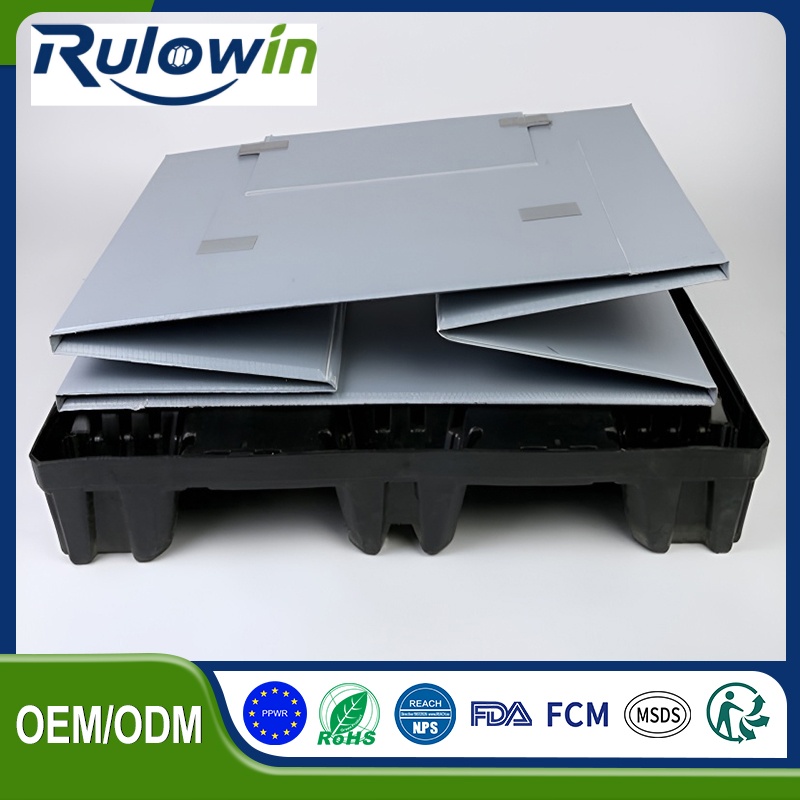
A box carrying machined parts will carry coolant, oil and swarf, and it will carry them into the next station, onto the next bench and into the next process unless it is washed. Washing a returnable box fleet is unglamorous and it is where fleets actually get lost – not through damage in service, but through a wash process that was never designed for the box.
What has to come off, and what the wash has to be
Three contaminants, three difficulties. Coolant is water-based and comes off with a cold or warm rinse. Oil needs a detergent and some temperature. Swarf is a solids problem rather than a chemistry one and needs separation from the wash water, or it recirculates and scores the boxes. Decide which of the three you actually have before specifying a wash, because a caustic hot wash bought to remove oil is expensive overkill for coolant.
Temperature is the constraint that matters
PP corrugated board is fine in a warm wash and loses stiffness as the temperature climbs. As a working ceiling, keep wash temperature below about sixty degrees unless the box is supported through the wash, and check with your supplier for the specific grade. Above that, a loaded or stacked box can deform, and boxes that come out deformed stay deformed – which then stops them stacking and the whole fleet starts failing at the stack.
Support the box through the cycle
Boxes should travel through a wash supported on their base and restrained at the sides, not tumbled. A tunnel washer with a conveyor is the clean answer; a dip tank with a rack is the cheap one. What does not work is a stack of boxes washed in place, because the wash does not reach the interior faces and the boxes come out clean on the outside and dirty where it matters.
Drying is half the process
A box that goes back into stock wet carries water into the next process, and in a machining environment that means rust on parts that were clean when they went in. Drainage slots at the base corners, boxes washed and stored open-side-down or on their end, and a forced-air or drip-dry period before they rejoin the fleet. Budget as much time for drying as for washing; the wash is the easy half. The produce-side version of the same cycle is in washing returnable produce boxes. The produce-side version of the same cycle is in washing returnable produce boxes.
Where the wash water goes
A wash station generates contaminated water, and in most jurisdictions that water cannot go down a general drain if it carries oil or metal fines. The wash specification therefore includes a treatment step: a settlement tank or a separator for swarf, an oil separator for the oil fraction, and a discharge or a licensed collection for the rest. This is not the packaging supplier’s problem and it is not optional.
What it does change is the packaging choice, because a wash with an oil separator is a slower, more expensive process and a box that does not need it is worth having. Two design decisions reduce the load. Drain or contain at the point of use so the box arrives at the wash with less contamination on it, and use a base pad or a tray so the oil sits on a replaceable surface rather than on the box itself. Both reduce what the wash has to remove, and both are cheaper than treating more water.
How often is often enough
Washing frequency should be set by what the next process can tolerate rather than by a schedule. A box feeding a paint line needs to be clean every cycle. A box carrying oiled parts between machining operations may not need washing at all, because the oil is expected. Over-washing costs money, water and box life, and it is as common a mistake as under-washing.
The useful question is what the box contaminates next. If the answer is a finished surface, a clean assembly step or a customer, wash every cycle. If the answer is another machining operation on the same part, washing may be unnecessary and a drip tray may be enough. Where the answer is unclear, wash on a condition rather than a schedule – when the base is visibly contaminated – and put the criterion on the wall next to the wash station so it is applied consistently.
What we can do
We build PP corrugated boxes with drainage and with geometry that survives a wash cycle, and we will ask about wash temperature and chemistry before specifying a grade. Tell us what the contaminant is and we will tell you the temperature ceiling for the box – and whether you need a heavier grade or just a better drying step.