
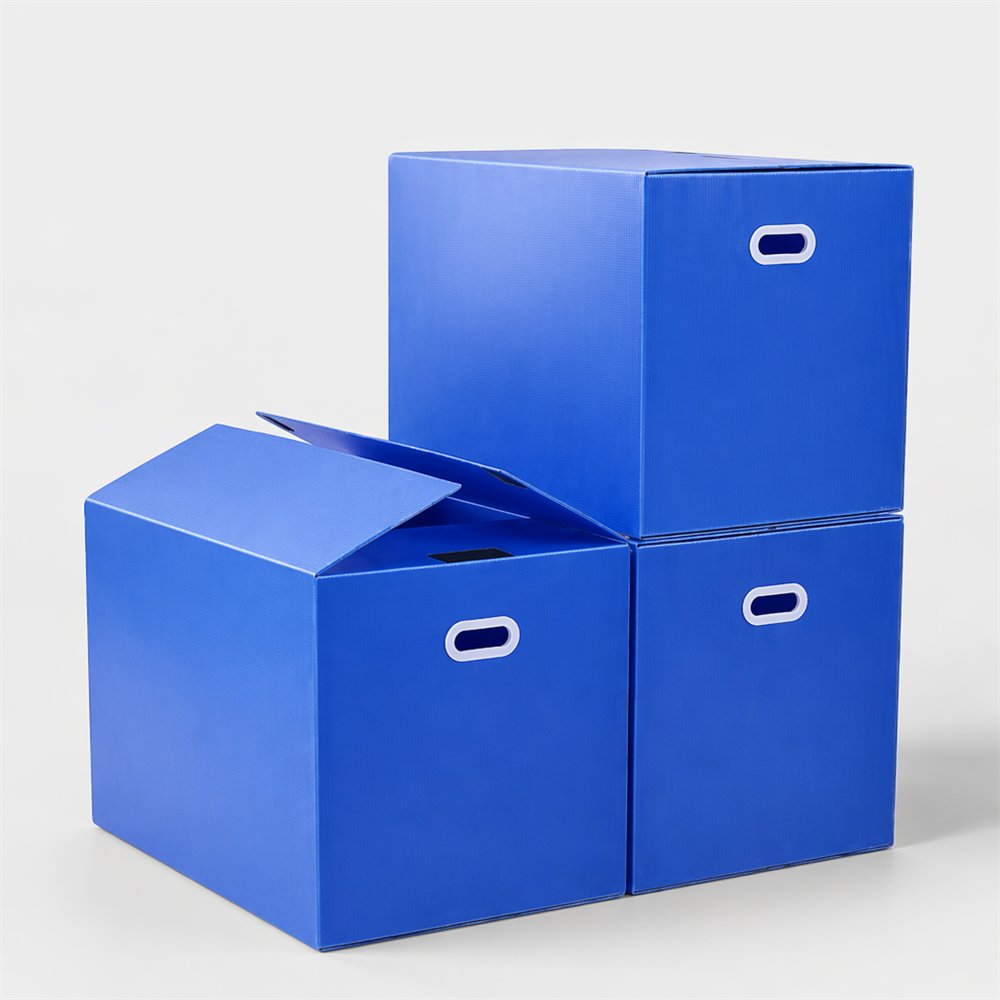
A box that goes through a wash every week will lose every paper label on it inside a month, and most so-called permanent adhesives inside three. If the operation washes boxes – and any box carrying coolant, oil or swarf should be washed – the labelling approach has to be designed for it rather than applied to it.
Split permanent from variable
The permanent data – box serial, owner, date of manufacture – should not be on a label at all. Print or emboss it into the sheet, or fit a welded plate. The variable data – destination, job number, contents – has to be replaceable by definition, so design for a label that is expected to be destroyed: a cheap one, on a recessed panel, applied to a surface that is cleaned before each application.
What survives a wash
In rough order of durability: embossed or moulded marking, welded-on plates, screen printing with a suitable ink, then labels. Of the labels, a polyester face stock with an aggressive acrylic adhesive applied to a clean, dry, warm panel is the standard answer, and it typically survives twenty to fifty wash cycles depending on wash temperature and chemistry. Above about sixty degrees or with a caustic detergent, no label survives indefinitely. The wash-cycle testing behind that figure is set out in getting barcodes to survive fifty washes. The wash-cycle testing behind that figure is set out in getting barcodes to survive fifty washes.
Design the wash around the label, or the label around the wash
If the wash is hot and caustic, accept that labels are consumable and make replacing them easy – a recessed panel, a standard label size, a cleaning wipe kept at the labelling station. Trying to find an adhesive that survives a caustic wash at seventy degrees is a longer project than building a fifteen-second relabelling step into the process, and the relabelling step also fixes the labels that were damaged in handling rather than in the wash.
Put the panel where the washer can reach
A recessed panel on the end of the box, above the base, away from handles. If the box is washed stacked or nested, the panel has to be visible and reachable in that state, or it will not get cleaned and the next label will not stick. This is a genuine design constraint and it is routinely missed – a label panel hidden inside a nested stack is a label panel that never gets relabelled.
Where to put the variable-data panel
Variable data has to be applied at some point in the loop and it is usually applied wherever is convenient rather than wherever works. Convenient is next to the packing bench; works is after the wash, because a label applied before a wash does not survive it and a label applied after is on a clean, dry surface that will take an adhesive properly. Moving the labelling step downstream of the wash costs a few seconds and typically doubles or triples label life.
It also means the label is applied to a box whose contents are known, which removes the other common failure mode: boxes labelled for a destination at the start of a loop and then redirected mid-loop, with the label still on them. Where the destination genuinely is not known until late, use a write-on wipe-off panel for the coarse sort and a barcode for the final one, and accept that the coarse marker gets rewritten. Trying to make one label serve both jobs is what produces unreadable boxes.
When to print instead of label
Where the same variable data is applied to the same box repeatedly – a fixed destination, a fixed line, a fixed customer – printing it onto the box during manufacture is cheaper than labelling it every cycle. The print is permanent, it survives the wash, and it removes a step from every loop. It is only appropriate where the data genuinely does not change.
The caution is that printed destinations become wrong when the loop changes, and a box printed for a destination that no longer exists is either relabelled – defeating the purpose – or retired early. Print the coarse, stable data – owner, site, box class – and label the fine, changeable data. Where a box’s destination is stable for the life of the box, print it. Where it is stable for a year, label it, because the box will outlive the arrangement.
What we can do
We build PP corrugated turnover boxes with permanent printed identification and a recessed, reachable label panel, and we will ask about wash temperature and detergent before specifying either. Tell us the wash and we will tell you honestly whether any label will survive it, or whether you should plan to relabel.