
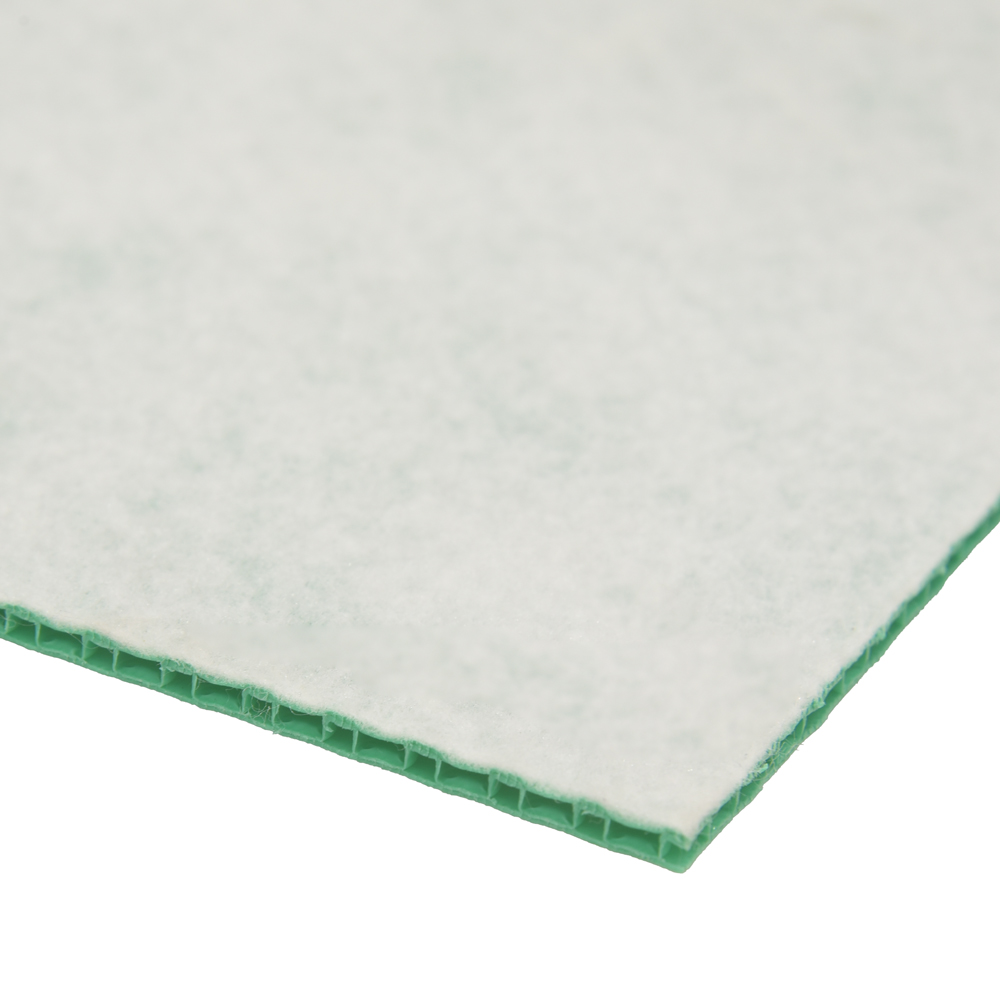
Protection board is bought on price more often than it should be, because it looks like a commodity and it is bought late. The useful question is not what the cheapest quote is but what comes with it – and the answer is usually where the real cost sits.
The four things
A price with a stated validity. A lead time that is a commitment rather than an estimate. A grade recommendation in writing against your floor and your risk. And the documentation the project needs, supplied with the quote rather than after the order. A supplier who provides all four is worth more than one who is five per cent cheaper and provides two.
What the documentation should be
Fire test report for the construction supplied, slip test data where the board is a walking surface, anti-static value where that applies, compliance statements, and recycled content declaration. Not every project needs all of them, and a good supplier will ask which rather than sending everything or nothing.
Consistency between batches
Worth asking about explicitly. Board that varies in thickness, colour or stiffness between deliveries causes problems on site that no document solves. Where the programme runs across multiple call-offs, ask whether the supplier holds to one production batch per period.
What a supplier cannot tell you
Whether the floor will tolerate the board, and whether an operator will approve it. Those are answers from the flooring contractor and the responsible person. A supplier who pretends otherwise is overstepping, and a good one will say whose answer it is.
The test worth applying
Ask them to recommend a cheaper product if one would do. A supplier who can do that is a supplier worth using; one who cannot is selling rather than advising. It is a small question and a reliable one.
The question worth asking first
“What do you need to know to recommend a grade?” A supplier who asks about the floor, the traffic and the programme before quoting is doing the job; one who asks only for the area is taking an order. It is a one-question test and it predicts almost everything else about how the order will go.
The four documents worth asking for upfront
Ask for a technical data sheet with panel weight per square metre, a fire test report that names the standard, a statement on recycled content, and cutting tolerances. If a supplier cannot produce all four quickly, that tells you how the rest of the order will go.
Weight per square metre matters more than thickness, because two panels of the same thickness can differ by a third in weight and the lighter one dents under point loads. A fire report that names the standard matters because “fire retardant” on its own means nothing to a building control officer. Cutting tolerances matter because panels cut 5 mm oversize will not sit flat against a skirting, and you will be trimming every one on site with a knife. We supply all four on request, and the commercial side of the same conversation is covered in vetting a supplier for site protection panels.
What we can do
We supply PP honeycomb protection board with price, committed lead time, written grade recommendation and documentation included. Tell us the floor, the risk and the programme, and we will come back with all four – including telling you when a cheaper board is the right answer.