
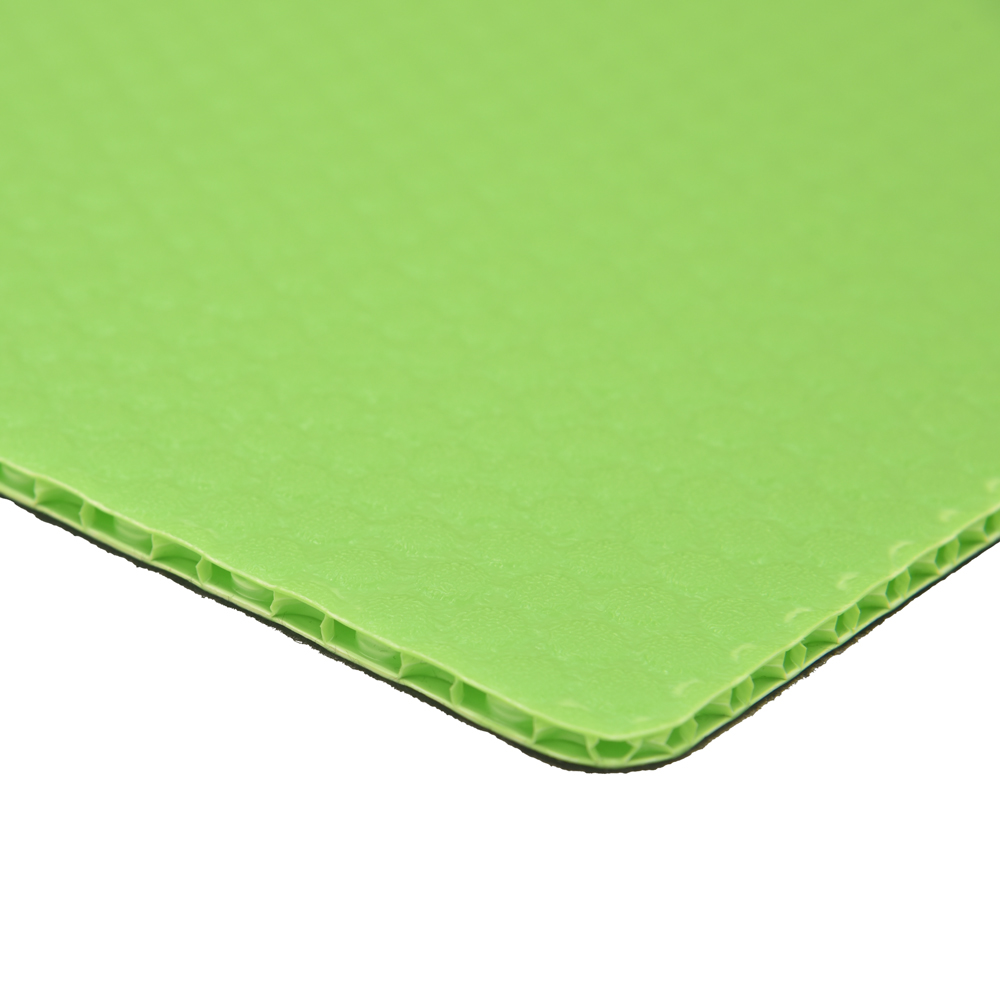
A mezzanine edge, a void, an open floor penetration – these are the places where protection has to do something different. The edge is where the floor is most fragile and it is also the part where a badly fixed cover becomes a drop hazard rather than a safeguard.
Two jobs at once
An open edge needs a cover that protects the edge from chipping and stops anyone putting a foot or a wheel into the void. Those are different requirements and a flat panel over the floor does neither: it stops short of the edge or it overhangs and becomes a trap. A purpose-made edge profile does both.
Overhangs are the danger
A panel that overhangs an open edge looks supported and is not. Someone steps on the overhang, it tips, and there is a fall – from a mezzanine that is a serious incident. Any cover near an open edge has to bear on solid floor, and the overhang question has to be answered explicitly rather than by whoever lays it that morning.
Fixing near an edge
An edge cover has to be fixed, because an unfixed cover at an edge is the one that gets kicked into the void. Fixing into the floor near the edge is often not allowed – it may be structurally thin or the finish may not take it – so the fix usually has to bear on the structure beside or below. That is a design question worth raising before the cover is made.
Who is responsible for the edge
Mezzanine edges usually have a handrail requirement and the edge protection interacts with it. Covering an edge in a way that compromises the handrail, or leaving a gap where the rail used to be, creates a bigger problem than the chipped edge it was meant to prevent. Check the two together.
Where the void should just be closed
If an opening is temporary – a void left for equipment, a penetration for services – boarding it over properly is usually better and safer than protecting around it. A properly fixed board with a kick rail is a standard detail; an edge cover is a compromise used when closing is not possible.
Kick boards at the open edge
An edge cover alone does not stop a tool, a fixing or a wheel going over. A kick board – an upstand at the edge – does, and it is a standard requirement on any open edge regardless of whether protection is involved. Where an edge is open during works, the kick board matters more than the cover and should not be left off because a cover is present.
Loading the edge
An open edge is often where materials get set down, because it is convenient and because there is nothing in the way. That is the worst possible loading position: the edge is structurally the weakest part of the floor and the cover is the least supported there. Keep a clear zone back from the edge and set materials down inboard of it.
Checking the fix
An edge cover that has come loose is more dangerous than none, because it looks like a safe surface and is not. On any open edge the fix gets checked at the start of each day, in writing. It is a two-minute check on the highest-consequence item on the floor.
The termination detail for the rest of the floor, and why edges are where the failures are, is in finishing the edge where floor protection stops.
What we can do
We make edge profiles and void covers cut to size, with a fixing detail that does not rely on the floor near the edge. Tell us the edge condition, what the floor is and whether there is a handrail, and we will say whether a cover or a closure is the right answer.