
A spiral or helical stair defeats standard protection for a simple geometric reason: the treads are wedges, not rectangles, and no two are the same. Cutting protection for one is a template job, and the going changes across the width of the walking line, which makes consistency – the thing that matters most on any stair – hard to achieve.
Why rectangles do not work
Lay a rectangular cover on a wedge-shaped tread and either the inner edge overhangs the void or the outer edge does not reach the nosing. Both are bad: an overhang into the open centre of a spiral is a trip and a drop hazard, and a cover short of the nosing leaves the part that gets hit unprotected. The cover has to be cut to each tread, which means templating each one.
The going varies across the width
On a spiral, the going is shortest at the inner radius and longest at the outer. People walk a line, usually somewhere near the outside, and the effective going they experience depends on where they walk. That means the tolerance for inconsistent cover thickness is smaller than on a straight flight: the same person can meet different effective depths depending on which line they happen to take that day.
What to do instead of a full cover
Two options that usually beat trying to cover the whole tread. Cover the walking line only – a strip along the outer two thirds, where people actually step – templated and fixed. Or cover the nosing and the riser and leave the middle of the tread, which is rarely the part that gets damaged on a spiral. Both are cheaper and both are safer than a badly fitting full cover.
The central column and the handrail
A spiral has a central column and usually a continuous handrail, and both are in the way. Fixing has to work around them, which in practice means fixing to the tread itself with a mechanical fix into the structure rather than relying on friction. That needs agreeing with whoever owns the stair, because it means fixing into a finished surface.
When to leave it alone
A spiral in a domestic property during a short job is often better handled by keeping boots clean and carrying nothing up it. A spiral that is a secondary route can simply be closed. Covering a spiral properly is more expensive than covering a straight flight of the same area and it is worth asking whether the flight needs to be in use at all.
Handrails and what people hold
On a spiral, people hold the rail almost every time, which means any cover has to leave the rail clear and grippable. A cover that wraps the tread right to the rail makes people let go, and on a spiral that is a real fall risk. Keep the inner third of the tread and the rail completely clear, and put the effort into the outer walking line instead.
What to do with the open centre
The open centre of a spiral is a drop, and anything dropped through it lands on the floor below. Where a spiral is in use during works, the centre needs a net or a temporary infill – not for the stair’s protection but for whatever is underneath it. It is the detail most often missed because everyone is looking at the treads.
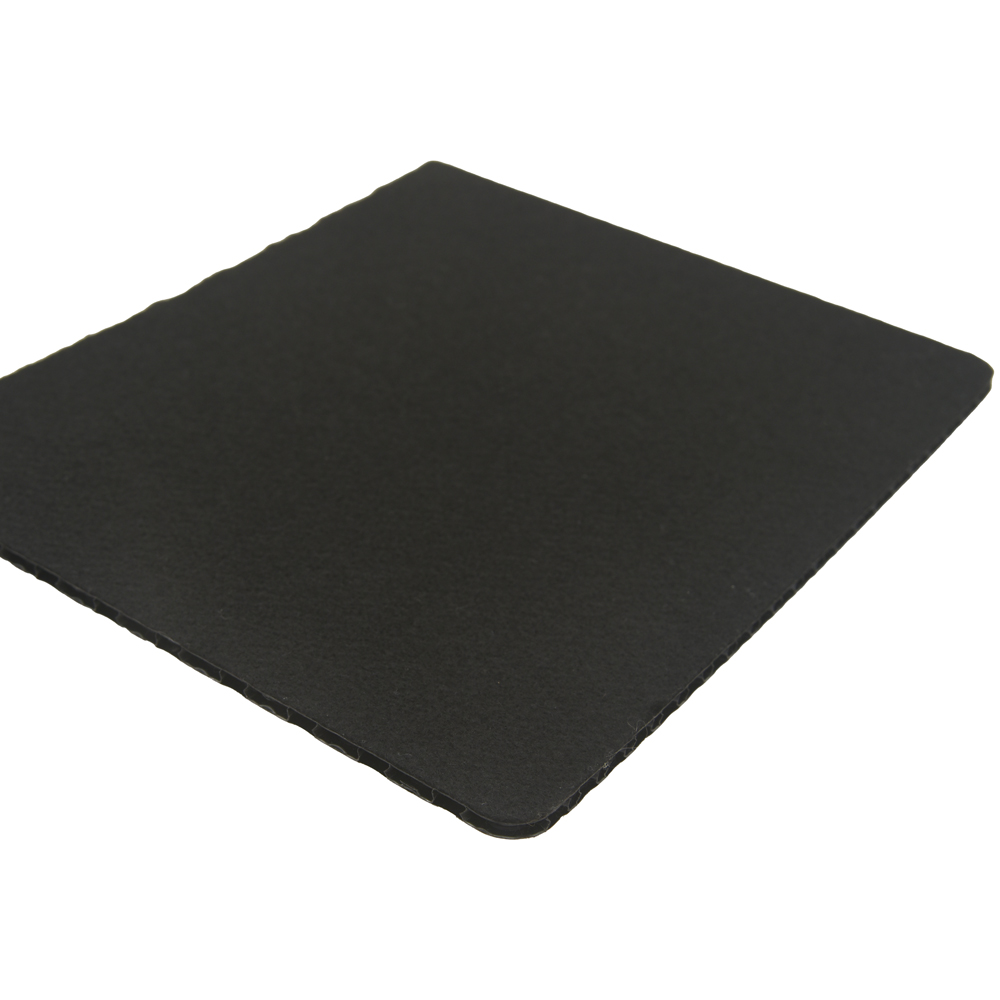
A PP honeycomb panel cut to a template for each tread is the only thing that fits a wedge properly; corrugated PP sheet cannot be made to follow one. The general stair argument is in why stairs need different protection from flat floors.
What we can do
We cut honeycomb tread covers to template for spiral and helical stairs, and will supply a walking-line strip or a nosing-only detail instead of a full cover where that is the better answer. Send us a tread template or the inner and outer dimensions and the riser count, and we will quote from that.