
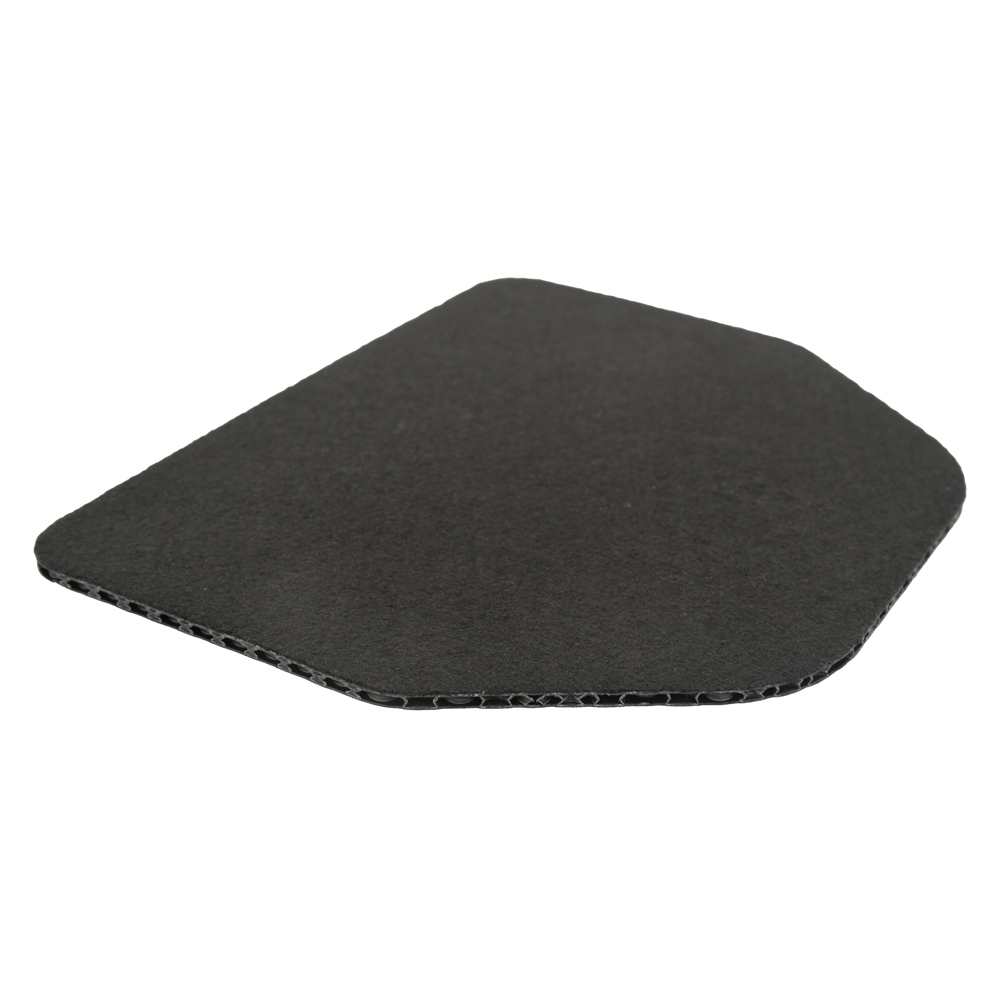
Second-fix decorating is the phase that does the most stair damage, and plastering is the reason. Paint spills, cleans up and is mostly harmless. Plaster is heavier, alkaline, full of fine aggregate, and on a stair it goes downhill – which means it ends up on the treads and the risers whether or not anyone spilled it there.
Why plaster is worse than paint on a flight
Plaster droppings set hard. On a flat floor that is a scraping job; on a stair it is a scraping job on a nosing, which is the part least able to take it. Set plaster also bonds to whatever it lands on, so a cover with plaster on it effectively sticks to the tread and has to be pulled – and pulling is how nosings get chipped. Paint, by contrast, sits on the surface and a cover with paint specks on it is cosmetically poor and functionally fine.
Slurry runs downhill
Wet plaster and grout slurry move, and on a flight they move to the front of each tread and then down to the next one. That means the nosing line – the most fragile part – collects the most material. Covering the tread is not enough: the nosing profile has to wrap the front edge, and ideally the riser below it, or the slurry simply goes around the cover.
Painting the stringer and the wall alongside
Decorating the stair wall means the stringer and the tread ends are in the splash zone. A cover that stops at the tread surface leaves the ends exposed, and paint on the end grain of a timber tread or on a stone tread return is very hard to remove. Extend the cover up the stringer face by 100 mm or so, or mask it, and the problem goes away.
Clean before it sets
Wet plaster comes off a polypropylene cover with water and a brush; set plaster does not. On a stair that is in use throughout the decorating phase, the covers in the traffic line want washing at the end of each day rather than at the end of the week. It is a five-minute job while the material is soft and a half-hour job once it is not.
Where the stair does not need covering at all
If the flight is being decorated before the floor finish goes down, there is nothing to protect yet – cover the treads against impact only, or not at all. And on a stair that is being stripped and rebuilt, the money is better spent on a temporary flight or on keeping the trade traffic to one route. We would rather say that than sell covers for a stair that is coming out.
Protecting the flight while the walls are being painted
Decorating a stairwell means ladders and planks on the flight, and a plank foot on a tread is a point load on the most fragile part of the stair. Either the flight is decorated from a tower at the bottom, or the plank feet get load-spreading pads, or the treads get covered and the plank goes on the cover. The third is the usual answer and it needs a cover stiff enough to take it.
The cover that works is a PP honeycomb panel with a wrapped nosing and a stringer upstand, because it washes clean the same day. Corrugated PP sheet will not survive set plaster and should not be used on a working flight.
What we can do
We supply honeycomb tread covers with a wrapped nosing and stringer upstand, and they wash off cleanly if they are cleaned the same day. Tell us what trades are working on the flight and for how long, and we will say what is worth covering. The sequencing question is covered in keeping wet trades off finished floors.