
Every site entrance is the same problem: people come in from outside with wet boots, the floor inside is usually finished or about to be, and the first two metres are where water, grit and sometimes a slight fall all come together. It is also the area most often protected with offcuts because it is nobody’s main concern.
What arrives on boots
Water, grit and clay. The water makes a smooth panel slippery, the grit abrades whatever is underneath, and clay fills any surface pattern within an hour. All three arrive continuously rather than once, so the protection has to deal with throughput rather than a single event.
Matting first, panel second
The most effective measure is outside the protected area: effective entrance matting that actually scrapes and absorbs, long enough that several steps land on it. One mat is rarely enough; three to four metres is a reasonable target on a busy entrance. Matting removes most of what would otherwise end up on the panel, and it is cheaper per square metre than protection board.
Studded face, coarse pattern
Where a panel is used at an entrance, use the coarsest stud pattern available and treat it as sacrificial. A coarse pattern displaces more water and holds mud in its channels rather than on the walking surface. Accept that it will need brushing daily – a fine pattern that clogs in an hour is worse than a coarse one that gets cleaned.
Deal with the water that collects
Entrance protection with a sealed perimeter becomes a paddling pool. Leave deliberate drainage at the threshold, or lift and squeegee daily. Water held on protection eventually finds the joints, and then it is under the panel against the finish – the problem described in moisture trapping under floor protection.
Replace rather than clean in bad weather
Through a wet spell, swapping the entrance panels for clean dry ones from a store is often faster than cleaning them in place. Keep a small stock of entrance-sized panels for exactly this, and treat them as consumable for the duration of the bad weather.
Where the entrance zone actually starts
The wet zone is not the doorway, it is the six to ten metres beyond it, because that is how far water and grit travel on soles before they come off. Protection laid only across the threshold leaves the area that gets the most water unprotected. Laying embossed panel ten metres in rather than one metre in costs a little more material and removes most of the slip exposure.
What to do when it is genuinely filthy
In sustained bad weather there comes a point where cleaning is a losing game and replacement is cheaper than labour. Keeping a second set of panels to swap in, and cleaning the first set under cover when there is a dry day, is the pattern that works on winter jobs. It also keeps a cleaning operation off a muddy site, which is where most of the time goes.
Lighting and the visibility of wet patches
A wet panel in a poorly lit entrance looks the same as a dry one, and a shiny film on a smooth face is very hard to see under temporary lighting. A textured face breaks up the reflection, which is a real safety benefit that has nothing to do with measured grip. Where temporary lighting is poor, a matte textured surface is worth specifying for that reason alone.
What we can do
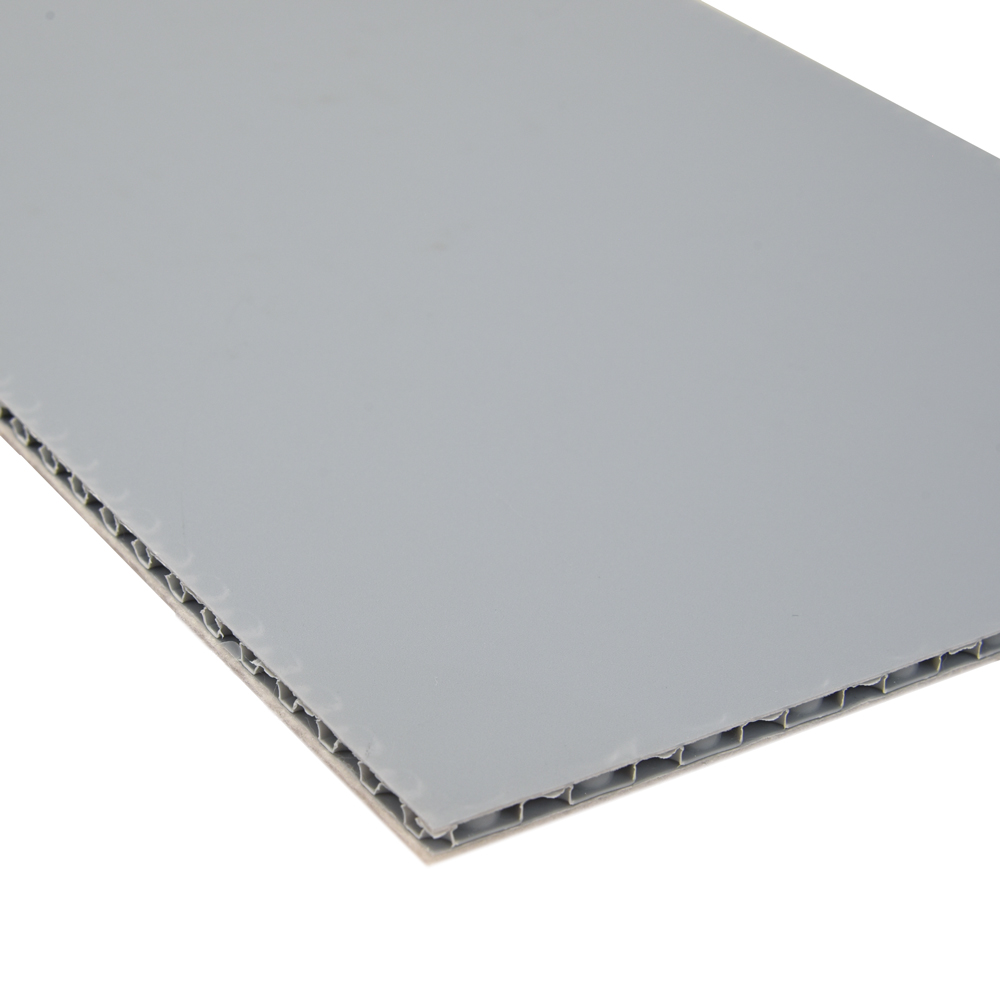
We cut honeycomb panels in entrance sizes with a coarse studded face and sealed edges, and can supply them as a sacrificial pack. Tell us the entrance width and expected footfall and we will size it – including telling you that matting matters more than the panel here.