
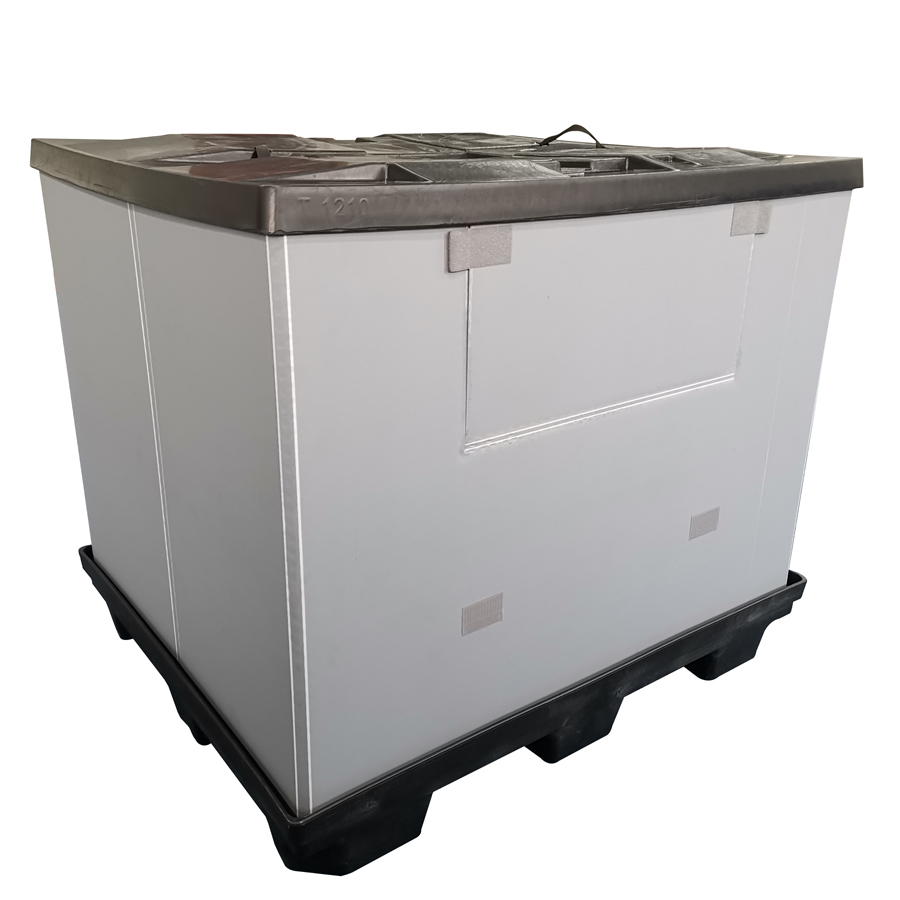
A cross-dock has no storage. Goods arrive on one door and leave on another within hours, and anything that slows either transfer costs money directly. Packaging choice here is decided by handling speed and stack predictability rather than by containment strength.
Speed of assembly and breakdown
Sleeve boxes assemble and collapse quickly with no tools, tape or fasteners, which suits a flow where somebody may be building and breaking down hundreds of units per shift. Anything that needs cutting, strapping or taping adds seconds per unit, and those seconds are the entire cost model of a cross-dock.
The honest comparison here is with nothing at all: if goods can move as a palletised unit without a box, they should. That remains the fastest option.
Predictable footprints
Cross-dock space is allocated by trailer and door slot, and unknowns cost space. A footprint that collapses to a flat, consistent height, and that sits the same way every time, is worth more than one that is marginally stronger. Consistency of the collapsed height is what makes planning possible.
Mixed loads going into one trailer
Sleeve boxes tolerate being double-stacked with different contents better than open crates, since they distribute load through walls rather than through contents. This makes them a reasonable choice for mixed consolidation. They do not solve the problem of heavy-over-light loading, and no box does.
Identification is easier than usual
A flat panel gives a large, readable surface, and one that survives hand contact reasonably well. Where cross-docks handle goods without scanning, the ability to write large readable marks directly on the pack – or apply a placard – matters more than durable print. Ownership writing on the panel usually works better with reusable markers than permanent ones, since the panel cycles.
Where the return Gets missed
Cross-dock operations move so fast that empties routinely get left behind, because nothing in the process owns them. Sleeves get set aside on the inbound side, and the outbound driver has no instruction to load them. This is the single most common reason sleeve box programmes stall, and it is a process gap rather than a packaging one – the same one we described when tracking where sleeve boxes disappear.
Reinforcement at contact points
Cross-dock handling is rough by necessity, so expect abrasion at corners and strap contact. Reinforced strap wear areas – welded strips or radiused profiles – extend life noticeably. Specify reinforcement at strap contact points as standard; it costs very little and it is where these packs fail first.
What to measure on the floor
Two numbers tell you whether sleeves earn their place in a cross-dock: build-and-break seconds per unit, and the share of empties that actually leave on the day they are emptied. The first is the labour cost, the second is whether the return works at all.
If the second number is poor, no packaging change will help – the empties are being left behind for procedural reasons, and the fix is an instruction to the outbound driver rather than a different box. This is the same conclusion we reached when tracking where sleeve boxes disappear.
What we can do
We supply returnable sleeve boxes for Cross-docks and distribution flows and can add reinforced strap wear areas. Tell us your collapse-and-build cycle time target and the dwell empties get, and we will advise honestly whether this construction fits or whether a simple palletised stretch-wrapped load is faster.